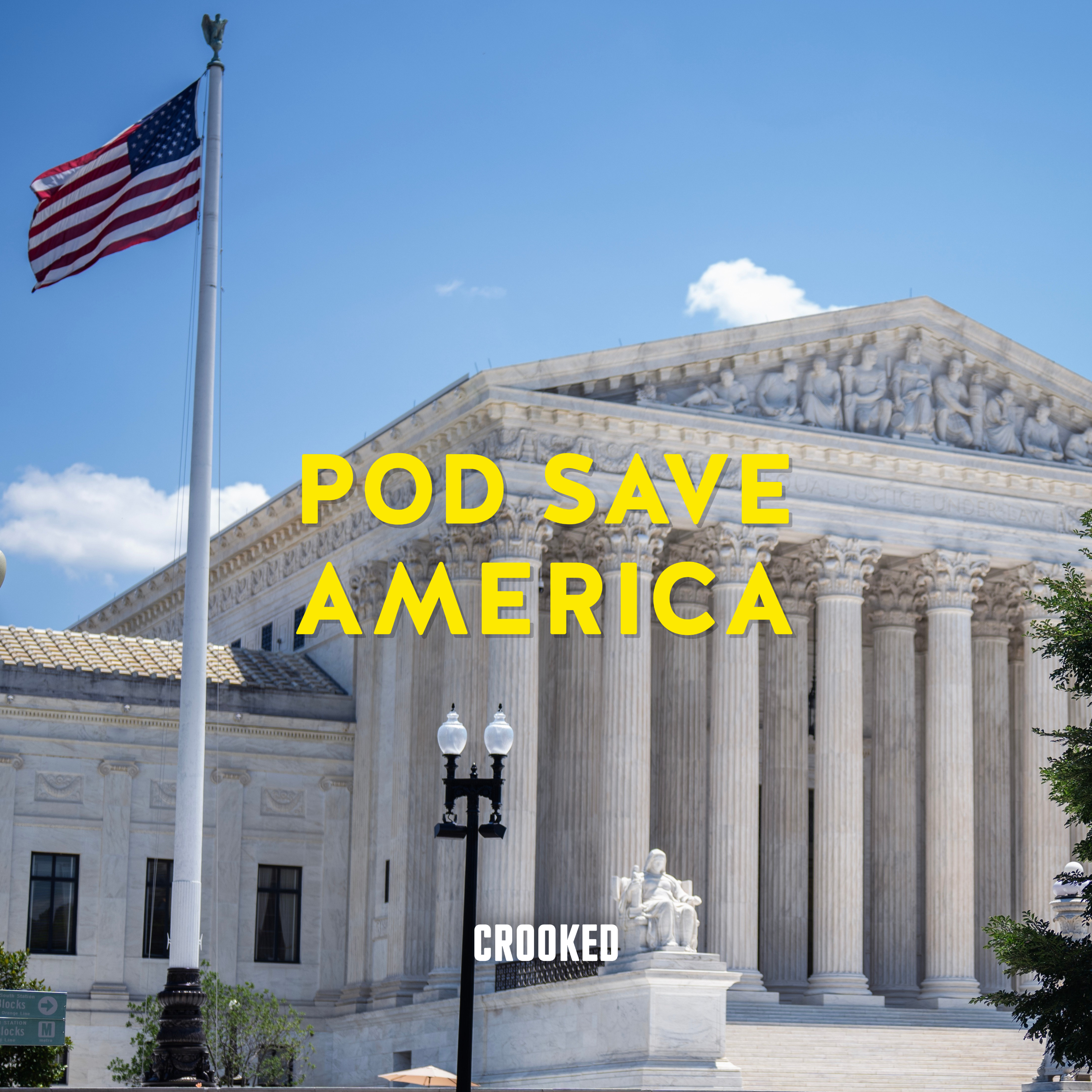
Leah Litman argues the Supreme Court engineered the birthright citizenship case to give itself a PR win — striking down the order to look independent while all the other harmful rulings fade from memory. The Court is building its own cover story.
Where this was said
At 34:50 · chapter starts 31:10
The birthright citizenship case should, in theory, be simple: the 14th Amendment's first sentence grants citizenship to all persons born in the United States and subject to its jurisdiction. The executive order purporting to deny it is, Leah says, 'wildly illegal.' And yet the Court has held the case for months, which likely signals a non-unanimous decision [1] — Leah Litman "The 14th Amendment plainly says all persons born in the US are citizens, yet the Court has sat on this case for months. Leah Litman warns t…" 32:25 . Even if the Court rules against Trump, dissenting opinions from Thomas and Alito could normalize the idea that birthright citizenship is constitutionally contestable — making it the next Republican judicial litmus test, just as opposing Roe became a litmus test. And Leah argues the Court itself manufactured this situation: last year it refused to simply say the order was unconstitutional, instead demanding the Solicitor General bring the case back to give the Court a chance to play hero — creating its own PR opportunity while having already greenlighted far more harmful immigration rulings [1] — Leah Litman "The 14th Amendment plainly says all persons born in the US are citizens, yet the Court has sat on this case for months. Leah Litman warns t…" 32:25 .
The 14th Amendment plainly says all persons born in the US are citizens, yet the Court has sat on this case for months. Leah Litman warns the delay likely signals a non-unanimous ruling — and even dissents from Thomas and Alito could make rejecting birthright citizenship the next Republican judicial litmus test.
Leah Litman warned that the Supreme Court's delay in releasing the birthright citizenship decision may signal it will not be unanimous, which would dramatically shift the Overton window on constitutional citizenship.
Right-wing legal circles have two theories: equate unauthorized immigration with a military invasion so children of undocumented parents aren't citizens, or generalize the diplomats' children exception into a broad 'allegiance' test. Both echo the logic of Dred Scott v. Sanford.
Fei-Fei Li went back to Stanford from Google in 2018 specifically to build a multi-stakeholder governance framework for AI. Her argument: market forces are not societal norms. Just as biology uses IRBs and cars have safety laws, AI needs layered oversight from educators, governments, and the public — not just a few industry titans.
Andrew Santino's personal MCU of political villains is collapsing. He and Bobby speculated that a circulating photo of Mitch McConnell with a Chinese official was AI-generated compositing two separate images.
Mass surveillance is here to stay. The real battle isn't stopping cameras — it's ensuring judges and laws keep that data out of family court and civil disputes, admitting it only for violent crimes and national security. The surveillance economy currently yields more upside than downside, but only if we build the legal guardrails now.
When people cite Scandinavia as proof socialism works, Galloway says they've got it backwards. Northern Europe runs highly competitive free-market economies with more competition in many sectors than the US — they just make sure taxes are actually paid and redistributed. Billionaires and universal healthcare can coexist.
Two percent adjustments to income tax and stamp duty tweaks are deck-chair rearrangements. The UK's competitiveness hinges on four structural levers: currency valuation, energy costs, regulatory burden, and tax rates. Devalue the pound, build 56 nuclear plants, slash red tape, introduce a flat tax — and the country transforms.
Lisbon had one of Europe's worst heroin crises. Then Portugal legalised drugs and redirected all enforcement money into rehabilitation and housing. Crime collapsed. Addiction fell. Then politics moved the money elsewhere, and the problem started creeping back. Chesterton's Fence: you forget why you were spending that money.
Congress passed the Boland Amendment 411 to 0, explicitly banning CIA and Defense Department funds for the Contras. Reagan signed it — then immediately moved the operation deeper underground, essentially responding to a bipartisan prohibition by going more illegal.
The CIA planted mines in Nicaraguan commercial harbors, wrote the Contras' press releases taking credit, and promptly blew up ships from four allied nations. The Wall Street Journal broke the story, Congress erupted, and the Boland Amendments multiplied.
Oliver North was a decorated Marine and devout Catholic with zero covert operations experience. He ran the entire shadow war against Congress — planes, airstrips, arms shipments, shell companies — learning on the job. And by every operational measure, he crushed it.
We use essential and analytics cookies to run Vuci. To understand how the site is used: Privacy Policy.
Install Vuci on your phone
Add it to your home screen for a faster, app-like experience.
Install Vuci on your phone
Tap the Share button, then “Add to Home Screen”.
A new version is available
Reload to get the latest Vuci.
