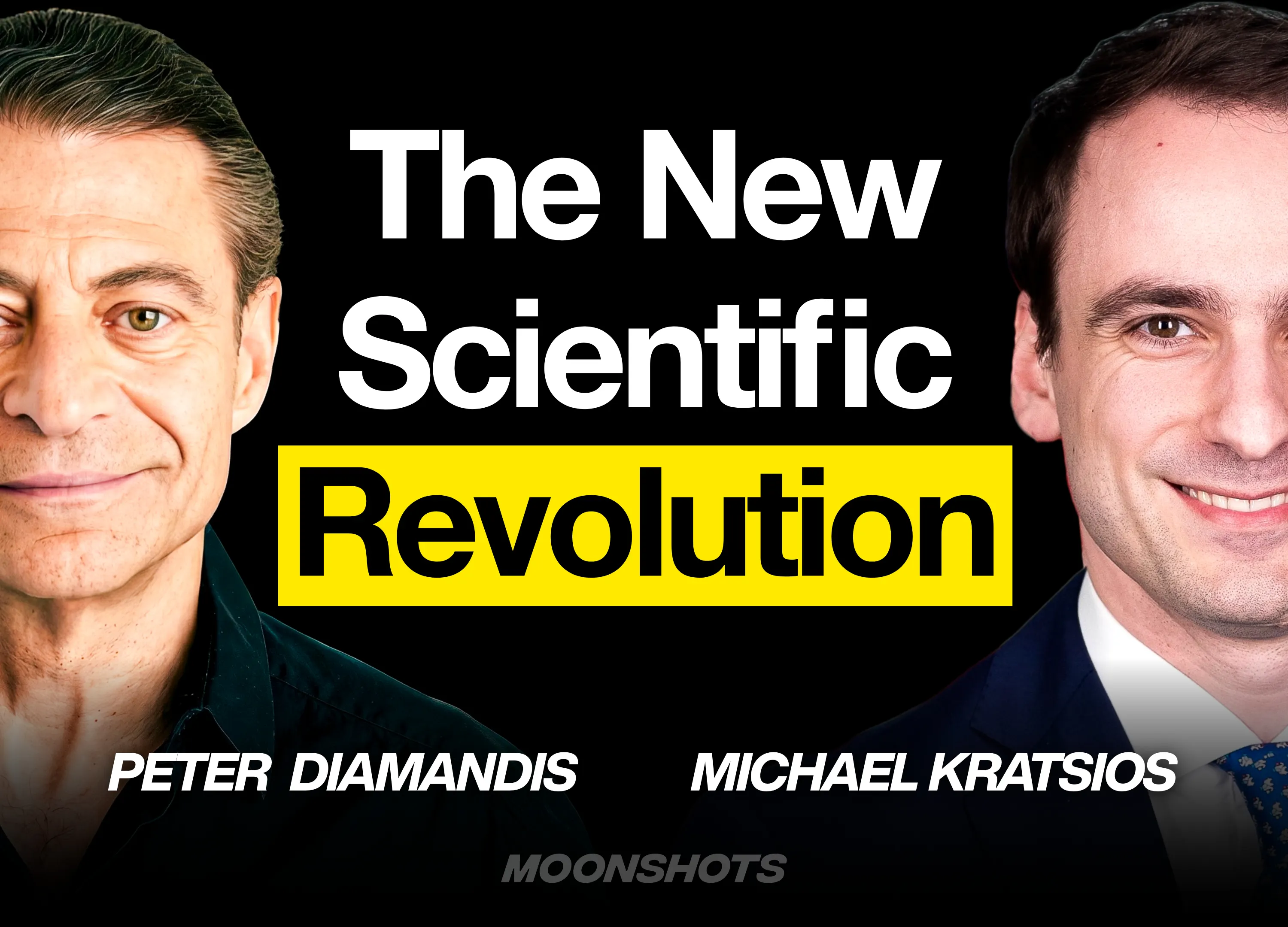
The median age of an intramural NIH scientist — those conducting research inside NIH itself — is 71, despite Nobel Prize-winning work typically being done in one's 20s.
Snapshot · Moonshots with Peter Diamandis
The median age of an intramural NIH scientist — those conducting research inside NIH itself — is 71, despite Nobel Prize-winning work typically being done in one's 20s.
Where this was said
At 36:36 · chapter starts 35:05
Beyond the data on administrative burden, Kratsios draws a concrete regulatory example that illuminates the broader problem: the US has had a blanket ban on supersonic flight over land since the 1970s, framed as a noise concern. But research and Boom Supersonic's own demonstrations showed that modern aircraft can exceed Mach 1 without creating a sonic boom — yet the law prevented any testing because flying over Mach 1 was illegal regardless of actual noise produced. The administration fixed it with an executive order replacing the speed limit with a noise limit: if you can keep it quiet, fly. Kratsios frames this as a template — the regulatory system is full of rules written for a world that no longer exists, and the act of replacing the rule's intent (noise reduction) rather than its blunt mechanism (speed cap) unlocks decades of stalled innovation. The same logic, he implies, applies throughout the science funding system.
Animals first sensed light 540 million years ago, triggering an evolutionary acceleration known as the Cambrian explosion within 10 million years.
It is estimated that half of all cortical activity in the human brain is involved in visual function, underscoring vision's central role in intelligence.
Cognitive neuroscience literature shows that by age 6, humans can recognize tens of thousands of different object categories — far more data than early AI systems were trained on.
Only about 3% of FDA-approved drugs have genuinely unclear mechanisms of action, making an unknown mechanism a meaningful early red flag for any compound.
Even compounds that clear preclinical testing often fail in humans: 30 to 50% of drugs entering phase 1 trials do not advance to phase 2, frequently because human behavior differs from animal models.
More than 80% of published BPC-157 research comes from a single academic group whose researchers have IP and commercial interests connected to the molecule, limiting independent replication.
Roughly 100 peptide drugs are already FDA-approved, about 150 more are in clinical trials, and 600–700 are in preclinical development, underscoring the legitimacy of peptide science broadly.
The scientist who discovered BPC-157 refused to disclose the screening method used to identify the compound and has never fully published the parent protein sequence — what Peter Attia calls 'scientific trust me, bro.'
The brain's visual, auditory, and motor cortices light up nearly identically whether an experience is real or imagined, making visualization a form of actual neural training.
We use essential and analytics cookies to run Vuci. To understand how the site is used: Privacy Policy.
Install Vuci on your phone
Add it to your home screen for a faster, app-like experience.
Install Vuci on your phone
Tap the Share button, then “Add to Home Screen”.
A new version is available
Reload to get the latest Vuci.
