
R&D: 70% federal in 1951, now ~30%
In 1951, 70% of US R&D was government-funded and 30% private. Today those figures are almost entirely reversed, with the private sector now dominant.
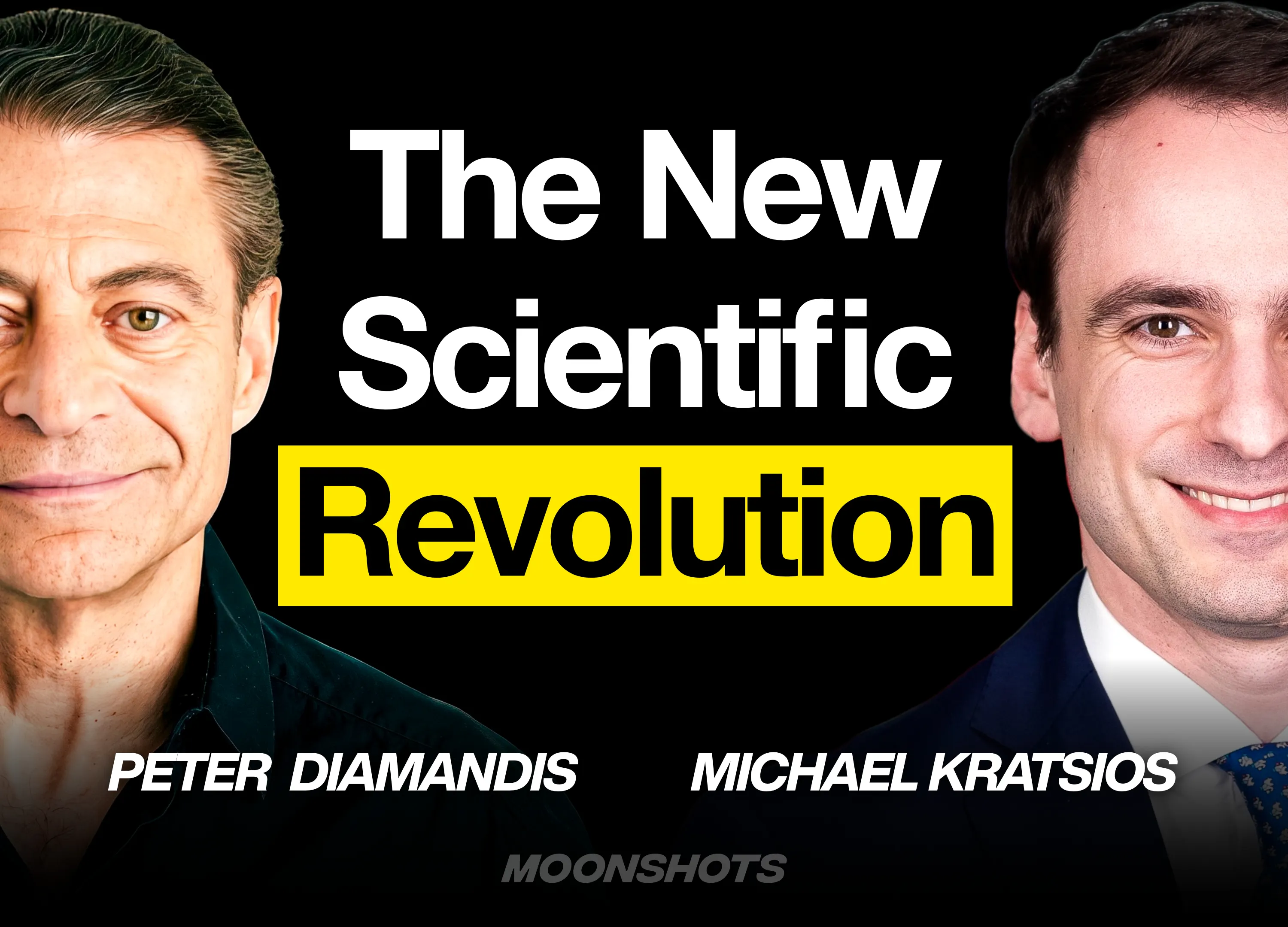
Snapshot · Moonshots with Peter Diamandis
In 1951, 70% of US R&D was government-funded and 30% private. Today those figures are almost entirely reversed, with the private sector now dominant.
Where this was said
At 45:19 · chapter starts 43:20
Peter saves what he calls his favorite idea for last — the section of the Golden Age Report that imagines a fully AI-native scientific marketplace. The vision: funders post bounties for breakthroughs, AI agents identify promising leads and 'hire' autonomous labs to run experiments, results are cryptographically signed and verified, and smart contracts automatically release payment as milestones are met. [1] — Peter Diamandis "The most radical proposal in the Golden Age report: a decentralized scientific marketplace where AI agents post bounties, run autonomous la…" 43:20 Prediction markets guide grantmakers toward the highest-value problems; reputation systems identify reliable agents; human experts remain essential only for judgment calls about which questions matter. The entire system operates at machine speed — continuously, 24/7 — replacing the institutional coordination overhead of committees, journals, and grant cycles with market incentives. Kratsios acknowledges this is blue-sky thinking but insists the technical building blocks now exist and that he genuinely believes it's achievable. Peter frames it as the mechanism that could make Elon Musk's 2036 post-capitalist prediction come true.
The most radical proposal in the Golden Age report: a decentralized scientific marketplace where AI agents post bounties, run autonomous lab experiments, verify results cryptographically, and release payments via smart contracts — operating at machine speed, 24/7, with human experts reserved only for judgment calls on which questions matter.

The widely cited ego-depletion model — the idea that willpower is a finite resource that gets depleted — failed to replicate in follow-up studies.
Humans are estimated to have 5,000–7,000 thoughts per day, yet can recall essentially none of them afterward, highlighting why in-the-moment emotional tracking matters.
A large Harvard study found that a wandering mind is an unhappy mind — people report greater happiness when their attention is tethered to the present, even if the task is unpleasant.
A key study finding that we have a 'credit card's worth of plastic' in our bodies was likely skewed because researchers used nitrile gloves that shed plastic particles onto the microplastic detector.
Emotionally sensitive people have a hyperactive amygdala, an underactive prefrontal cortex, and a frayed connection between the two — making emotional regulation structurally harder.
Rejection sensitivity can be observed as early as age 2 or 3, suggesting it has strong developmental and likely genetic roots.
A Yale study found that non-judgmental observation of emotions — without rushing to resolve them — reduces activation in the brain, making it a powerful regulation tool.

Dan Gilbert's research found that the psychological immune system — the brain's ability to justify and find satisfaction in choices — activates most powerfully when a decision is perceived as irreversible.
Barry Schwartz's research found that maximizers — people who try to optimize every decision — tend to achieve objectively better outcomes but report lower happiness than satisficers who choose 'good enough.'
We use essential and analytics cookies to run Vuci. To understand how the site is used: Privacy Policy.

Install Vuci on your phone
Add it to your home screen for a faster, app-like experience.
Install Vuci on your phone
Tap the Share button, then “Add to Home Screen”.
A new version is available
Reload to get the latest Vuci.