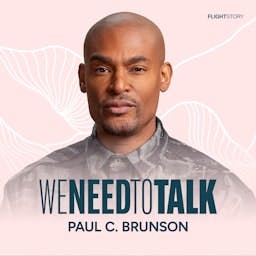
The host Paul C. Brunson reveals that a producer told him people now pay coaches specifically to teach them how to play the villain on reality TV shows.
Snapshot · We Need To Talk with Paul C. Brunson
The host Paul C. Brunson reveals that a producer told him people now pay coaches specifically to teach them how to play the villain on reality TV shows.
Where this was said
At 15:00 · chapter starts 12:43
This chapter is the episode's strategic centrepiece. Spencer starts by engaging with the host's concept of 'meta-villainy' — being not just a villain within the show, but manipulating the external media ecosystem simultaneously. He then delivers the most useful insight of the episode: the villain play works inside a franchise because you build over time, but on a one-off show it's a trap. Views come, followers don't — because no one genuinely wants to be connected to someone they dislike. [1] — Spencer Pratt "A villain edit gets you views, not followers. People don't genuinely connect with people they dislike, so a one-off villain turn gets you a…" 12:43 He cites Scott Disick as the model for doing it right: villainous honesty with heart behind it, and without a producer agenda working against you. Spencer alleges that in his case there was an explicit deal with Lauren Conrad to keep Heidi and Spencer as the show's villains in order to protect LC's protagonist arc. [2] — Spencer Pratt "Spencer alleges a deal existed between producers and Lauren Conrad to ensure Heidi and Spencer were portrayed as the worst human beings pos…" 13:56 The host caps the chapter by revealing that producers now tell him people hire coaches specifically to train reality TV contestants in villain strategy — a practice Spencer regards with cautious ambivalence.
A villain edit gets you views, not followers. People don't genuinely connect with people they dislike, so a one-off villain turn gets you a moment of attention and nothing more. Spencer learned this the hard way.
Spencer warns aspiring reality TV villains that villain edits drive views but not followers, because people fundamentally don't follow or stay connected to people they genuinely dislike.
Spencer alleges there was a deal in place with Lauren Conrad (LC) to portray Heidi and Spencer as the show's worst human beings in order to sustain LC's positive storyline.
Spencer alleges a deal existed between producers and Lauren Conrad to ensure Heidi and Spencer were portrayed as the worst human beings possible, in order to protect LC's heroine arc. That's a level of structural manipulation contestants can't fight.
Robby's wife Gabby Windey was the Bachelorette on the TV show, meaning she had 25 male contestants, before eventually coming out and marrying Robby.
Jimmy Tatro noted that The Hawk on Netflix is Will Ferrell's first TV series where he is the lead, despite Ferrell's long movie career.
Jimmy Tatro revealed The Hawk is his fifth time working with Will Ferrell, having gone straight from a movie with Ferrell's team into the series.
Reacher Season 2 attracted 56 million global viewers in a single week, making it one of the most-watched streaming shows in Amazon Prime Video history.
Motor City is a film with zero spoken dialogue, originally conceived by then-Warner Bros. president Greg Silverman so that global audiences could share the same experience without language barriers.
The Motor City script appeared on Hollywood's prestigious Blacklist of best unproduced screenplays as early as 2009 and was greenlit nine times with different directors before finally being made.
Alan Ritchson turned down the role of Hawk on Titans five times before finally accepting, having convinced himself he was destined for Shazam — which he ultimately did not get.
Alan Ritchson's failed Thor audition was so poor the casting director broke protocol to call his team and say he didn't have the craft — a moment Ritchson describes as the career-defining crossroads that sent him to acting school.
Camila Mendes shot Riverdale for 7 consecutive years, 10 months per year, with only 2-month gaps between seasons, leaving no time to stop or rest.
We use essential and analytics cookies to run Vuci. To understand how the site is used: Privacy Policy.
Install Vuci on your phone
Add it to your home screen for a faster, app-like experience.
Install Vuci on your phone
Tap the Share button, then “Add to Home Screen”.
A new version is available
Reload to get the latest Vuci.
