
SimpliSafe: 50% off + free first month
SimpliSafe is offering Pod Save America listeners 50% off a new system when signing up for professional monitoring, with the first month free.
Trump's Iran MOU gave away $300 billion and lifted sanctions before negotiations even started — the JCPOA Obama was pilloried for was strictly better on every metric.
Pod Save America
Trump's Iran MOU gave away $300 billion and lifted sanctions before negotiations even started — the JCPOA Obama was pilloried for was strictly better on every metric.
TL;DR
Recorded live from the Obama Presidential Center on its opening day in Chicago, Jon Favreau, Dan Pfeiffer, Jon Lovett, and Tommy Vietor react to Barack and Michelle Obama's dedication speeches, tour the new museum, and draw lessons for Democrats in the Trump era [1] "The Obama Presidential Center opened its doors today in Chicago, and the PSA hosts were among the first inside. The museum is less a monume…" 01:24 . They then dissect Trump's Iran MOU — signed theatrically at Versailles — arguing Democrats gave up far more in the JCPOA than Trump secured here [2] — Tommy Vietor "Under the JCPOA, Iran shipped 97% of its nuclear stockpile out of the country to Russia, the deal went through the UN Security Council with…" 50:48 , mock JD Vance's awkward View appearance [3] "Trump had the National Mall reflecting pool drained and painted American-flag blue — and it immediately turned green with algae again. The …" 59:40 , and end with the reflecting pool algae as the perfect metaphor for Trump's presidency: a cheap cosmetic fix that solved nothing [4] — Tommy Vietor "While JD Vance was doing a book tour, Marco Rubio — the national security adviser and secretary of state — went completely dark during the …" 58:10 .
Recorded live from the Obama Presidential Center in Chicago on its opening day, Jon Favreau, Dan Pfeiffer, Jon Lovett, and Tommy Vietor react to Barack and Michelle Obama's dedication speeches, tour the museum, discuss lessons Democrats can take from Obama, and then analyze Trump's Iran MOU, JD Vance's View appearance, and the reflecting pool algae debacle.
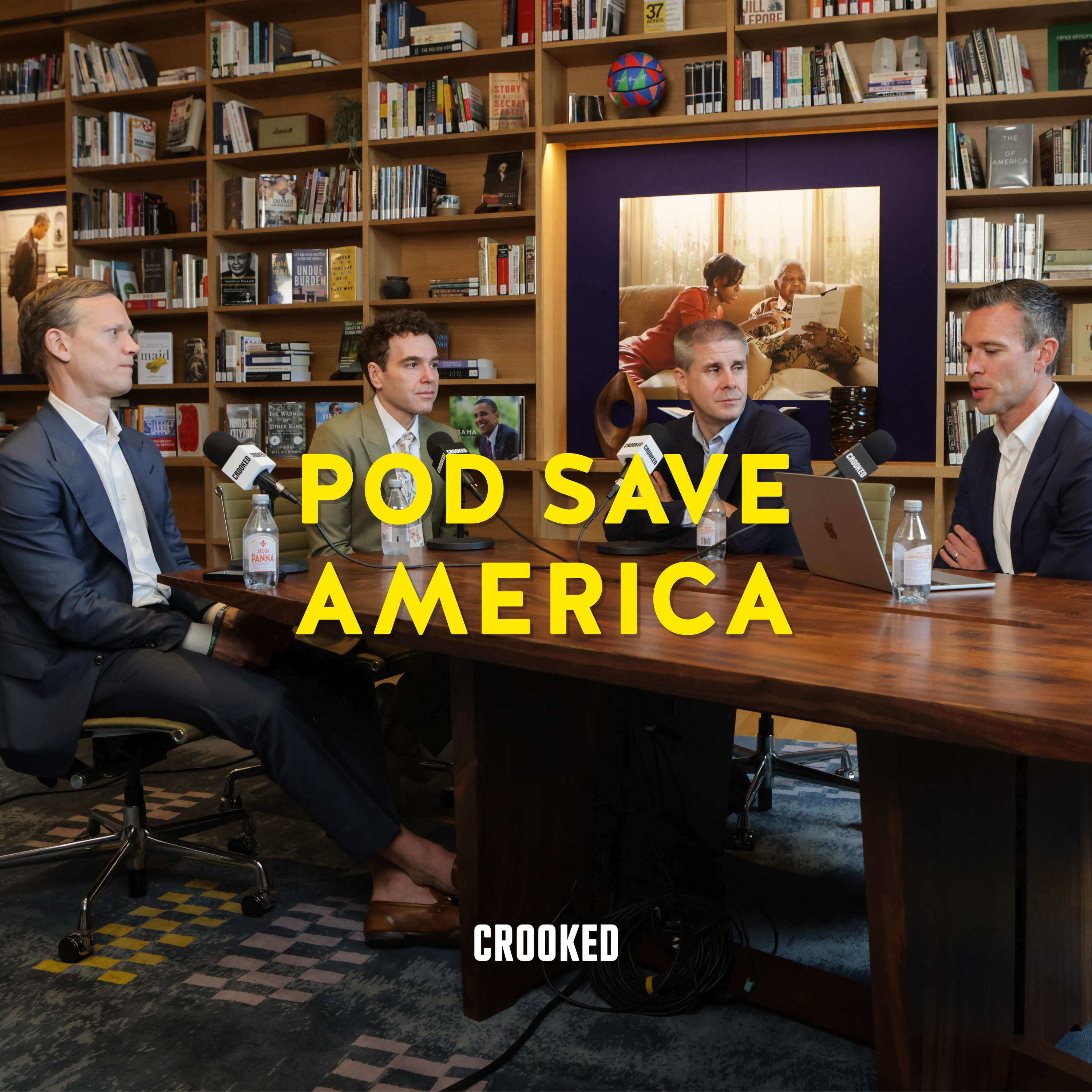
The episode kicks off with a SimpliSafe sponsorship read offering Pod Save America listeners 50% off a new system with professional monitoring. Jon Favreau then introduces the four hosts — himself, Dan Pfeiffer, Jon Lovett, and Tommy Vietor — recording from inside the Obama Presidential Center's reading library branch of the Chicago Public Library on the very day the center opened to the public. The hosts spot Dan Pfeiffer's book on the shelf and immediately begin joking about their own irrelevance versus the historic weight of the room they're sitting in.
Fresh from a tour of the newly opened Obama Presidential Center, the four hosts unpack what they saw and felt. Tommy Vietor describes the museum as interactive and inspiring — visitors can shoot hoops, check out books, and encounter exhibits featuring individual stories — while Jon Favreau recounts bringing his kids earlier in the week, only for his son Teddy to have a meltdown trying to eat the fake apple on the coffee table in the replica Oval Office. Tommy mentions an almost serendipitous brush with history: standing in a 10-minute line behind Admiral William McRaven (whose bracelet was also rejected) and reconnecting with Joshua Dubois, the old White House colleague who once pranked Tommy by autocorrecting 'the' to 'bag of assholes' in Outlook — and who gave the invocation at the ceremony. Eddie Vedder performed a musical number with teenagers who had composed a piece to play in front of four US presidents. Dan Pfeiffer notes the museum's core mission isn't retrospective celebration but a living framework to inspire future organizers, candidates, and community leaders — a point Jon Favreau says crystalized for him watching the Grant Park panel, which told the story of election night through newscasts from around the world.
A recent poll finding Obama the most positively viewed former president prompts Jon Lovett to interrogate his own warm feelings at the museum. The center presents an optimistic, civic-minded vision of America — one built on organizing, community, empathy, and democratic responsibility — but Lovett challenges himself to ask the harder question: if this was persuasive enough to elect Obama twice, what went wrong? Why didn't it stick? Jon Favreau offers what he thinks Obama and Michelle's answer is: progress is never linear, and the work of democracy requires constant renewal by every generation. Dan Pfeiffer notes that the museum's opening floors don't begin with Obama — they begin with historical moments of crisis, the civil rights movement, the labor movement, the suffrage movement, each resolved by ordinary people coming together. The implication: we are in one of those moments again, and the answer is the same. Lovett pushes back slightly, arguing it isn't enough to say 'we'll come together' without honestly asking what made Obama's vision seem hollow or unreplicable to the candidates who followed.
Tommy Vietor delivers the Bombas sponsorship read, extolling the brand's cushioned, sweat-wicking socks and Friday Slides sandals. He specifically highlights the anti-slip rings on the no-show socks — a practical improvement on socks that always fall down — and notes Bombas' social mission: for every item purchased, one is donated to someone facing housing insecurity, with over 150 million donations to date. Jon Favreau endorses them as his go-to after throwing out all his old worn-out socks. Offer: 20% off at bombas.com/crooked with code CROOKED.
Michelle Obama's dedication speech emerges as the emotional centerpiece of the day. Jon Favreau says it was the first time all week he actually cried — he describes her riff on hope as a choice (you can decide to stop complaining and put your shoulder to the wheel) as what did it for him. Dan Pfeiffer says he lost it when Michelle talked about how she just wants to brag about Barack and described how he would gather himself no matter how terrible the day was to make every new person who walked into the Oval feel that this interaction with the president was the most important moment of their life. Tommy Vietor adds that Obama's unabashed patriotism is what Democrats most often fail to replicate — he recounts attending a USA-Paraguay World Cup game, chanting USA with thousands of fans including immigrants, and feeling that this brand of politics is what's missing from the current Democratic Party. Jon Favreau extends the point: World Cup visitors from abroad who expected a dark dystopian America have been posting on social media that the country is warm and wonderful, a reminder not to let Trump define the country to its own citizens. Jon Lovett's counter: there's also an 'ICE agent in every heart' — Trump's genius is activating people's worst impulses — and Michelle's speech was powerful precisely because it acknowledged people's agency and culpability in that choice.
Jon Favreau delivers the Acorns sponsorship segment, pitching the app as the antidote to the paralysis of not knowing where to put your money. Tommy Vietor underlines the point: stop trying to find the market bottom, just start investing and keep going. The ad notes Acorns has over 14 million all-time customers who have saved and invested over $27 billion collectively. Sign up at acorns.com/crooked for a $5 bonus investment. An SEC investment advisor disclosure follows.
A clip from Obama's dedication address is played: 'The exhibits in the center are not meant to evoke nostalgia for some gauzy bygone era... they're meant to remind us of who we can be.' Jon Favreau explains that Obama had been peppered with questions — including from the New York Times's Peter Baker — framing the center as a nostalgic relic, and that this passage was a deliberate rebuttal. The hosts agree that the nostalgia critique is 'idiotic' (Dan Pfeiffer) since all museums look at the past, but also acknowledge they understand why reporters raised it in the current political climate. Jon Lovett adds that nostalgia is actually fine — it's what you do with it that matters. Tommy Vietor reports that his conversation with Governor Josh Shapiro at the event was about exactly this: whether the brand of politics Obama represented still resonates, and whether the next generation can carry it. Dan Pfeiffer is confident the winning 2028 candidate will offer something in Obama's spirit — not a carbon copy but a version that turns the page on this era of division.
Jon Lovett delivers a sharp observation: the 2008 Obama campaign ran on 'change,' but what actually closed the deal against John McCain during the financial crisis was something quieter — a preternatural evenness, reliability, and trustworthiness that gave voters permission to take a chance on him when McCain appeared erratic. That quality now stands in stark contrast to Trump. Dan Pfeiffer adds that working for Obama meant knowing he had a core belief about literally anything you brought him, and it always came from a good place — a contrast to walking into today's Oval Office where staffers are day-trading on the Iran war. Jon Favreau invokes Ta-Nehisi Coates's famous line from his long profile of Obama: 'For 8 years he walked on ice and never fell.' The hosts then turn to Michelle's speech directly, noting that she made text what was always subtext — that Obama for 8 years could not make a single mistake, could not lash out, could not send an angry tweet, because how he performed as the first Black president would determine whether and when there would be a second. Tommy Vietor notes one concrete example she cited: Obama pointing out that Trayvon Martin looked like what his son would look like.
Tommy Vietor delivers the Stamps.com ad, noting the platform lets businesses and individuals print postage 24/7, access UPS, USPS, and FedEx rates at up to 90% off, and schedule free carrier pickups without leaving their desk. He notes Crooked Media has used Stamps.com since the company's founding for shipping merch and business documents. The offer: a free 4-week trial plus a welcome kit at stamps.com/PSA.
A short ad for ThirdLove bras emphasizes their comfort-first design philosophy — soft fabrics, non-digging support — and their extensive range of over 60 sizes including rare half-cup sizes. The offer is $15 off a first purchase at thirdlove.com with code PODCAST15.
Dan Pfeiffer opens by noting that telling Democrats to be more like Obama is unhelpful advice — like telling someone to dunk like Michael Jordan — but argues three principles are extractable by any communicator. First: own patriotism. Obama will not let Republicans take the flag; he talks about the country's flaws while making clear it is a special place. Second: address the elephant in the room. He cites an early White House YouTube town hall where the number one question was marijuana legalization; Obama's instinct was 'if it's the number one question, we're talking about it.' Third: politics is a storytelling exercise, not a slogan game. It is a narrative about who you are fighting for and against, about values, about what you have to say about this specific moment in history. Jon Favreau agrees: everything — messaging, policy, positioning — flows from having something to say about the moment.
Jon Favreau introduces the Iran MOU, which Trump signed not in Washington but at the actual Palace of Versailles during a state dinner extension — a theatrical choice the hosts find almost too on-the-nose. The terms they run through: suspension of the naval blockade, Iran's 'best efforts' to allow Strait of Hormuz passage for 60 days, a permanent Lebanon ceasefire, permission to resume oil exports, a $300 billion reconstruction fund, a 60-day nuclear negotiation window, and a reaffirmation of Iran's existing non-proliferation commitment. Jon Favreau concludes the US got essentially nothing new. Tommy Vietor notes the strategic absurdity: the US gave up both its military and sanctions leverage before nuclear talks even began, ensuring Iran has no reason to make concessions. A Trump clip is played in which he dismisses the ballistic missile concern ('missiles hurt a little location but don't blow up the planet') and advises Netanyahu to use a 'softer touch' in Lebanon. Jon Lovett points out this is precisely the argument the anti-JCPOA camp used — that ballistic missiles were the core threat — but those same hawks are now silent. Tommy Vietor notes the best possible outcome is that the neocon hawk worldview gets 'smothered to death,' but even so, Iran 'cleaned his clock' in the deal.
Tommy Vietor makes a direct case: Democrats have spent years throat-clearing about the JCPOA's imperfections, and they should stop. The Obama-era deal shipped 97% of Iran's nuclear stockpile out of the country to Russia. It went through the UN Security Council with P5+1 backing. It had multilateral enforcement mechanisms. Trump's MOU does none of that — it downblends material in-country, has no multilateral framework, and comes attached to a $300 billion Gulf-funded reconstruction slush fund that Gulf states were just told to finance despite Iran having fired ballistic missiles at them. Jon Lovett adds a separate point prompted by JD Vance's pushback on pro-Israel Iran hawks: he argues those who weaponized AIPAC, alienated Democrats, and turned Israel into a partisan issue now have to reckon with where Israel actually stands — more isolated and beholden to Trump than at any point in its history. The people who called critics 'self-hating Jews,' he argues, might owe some apologies.
JD Vance's appearance on The View during his Catholic conversion book tour becomes the episode's comic centerpiece. A clip is played showing Vance gaslighting the hosts about what Trump said on inflation, only to be called out directly: 'That wasn't a direct quote. Are you his interpreter or his vice president?' The View hosts, the Pod Save America crew note, asked genuinely substantive questions — not partisan gotchas but Christian and parental challenges about the humanity of immigration enforcement. Tommy Vietor credits Vance for showing up, noting it signals he wants to be seen as a coalition-builder, but argues he failed the assignment. Dan Pfeiffer diagnoses the core problem: defending Trump is inherently dignity-destroying, but there are people who could do it with more charm than Vance. Vance, meanwhile, went to Gutfeld that night and called Democrats 'terrible people' — not even 'some of them,' just flatly 'terrible people' — undermining his entire softening effort. Jon Favreau adds that Marco Rubio, who was photographed standing over Trump at the Versailles signing, has meanwhile gone into complete media silence despite being both Secretary of State and National Security Adviser.
Jon Lovett delivers the BetterHelp sponsorship read, noting that summer's arrival doesn't automatically lift everyone's mood and that BetterHelp offers access to over 30,000 fully licensed US therapists. The platform has served over 6 million people globally, holds a 4.9/5 average rating for live sessions from 1.7 million client reviews, and uses a short questionnaire to match users with a therapist — with easy switching if the first match isn't right. Offer: 10% off the first month at betterhelp.com/PSA.
The episode closes with what the hosts call the perfect metaphor for Trump's presidency: the National Mall reflecting pool. Trump had it drained and painted a patriotic blue, only for algae to return almost immediately because — Jon Lovett explains, citing a Washington Post deep-dive — the underlying drainage and filtration infrastructure was never fixed. The Interior Department responded by deploying consumer-grade hydrogen peroxide into a 7-million-gallon body of water (you'd need 5,000 to 7,000 gallons of the stuff just to keep it clean for a week), posting triumphant tweets declaring the algae gone, and then blaming Democrats for sabotage. Newsmax sent a reporter down to allege deliberate Democratic interference. Jesse Watters sent his crew to defend Trump's good intentions. Dan Pfeiffer quips that Donald Trump Jr. now owns a hydrogen peroxide company. Jon Favreau lands the takeaway: Trump did something cheap and cosmetic that he convinced himself was a magic solution, it failed, and he pretended it worked anyway. The reflect pool, he concludes, is the whole presidency. A Washington Post report also revealed a contractor invoice of roughly $600 million for the White House ballroom, with about half in taxpayer funds — and Noted reported that OMB moved money from the Secret Service budget to pay for it after the appropriation failed in Congress.
Jon Favreau closes the episode by noting that starting inspirationally and ending with algae is 'a tale for our times.' He teases the upcoming Sunday episode featuring Alex Wagner's conversation with historian and Substack writer Heather Cox Richardson. Tommy Vietor thanks the Obama Library for letting them record inside the center. A full production credits roll acknowledges the Crooked Media team, including the show's Writers Guild of America East–unionized staff.
Chapter 1 · 00:00
The episode kicks off with a SimpliSafe sponsorship read offering Pod Save America listeners 50% off a new system with professional monitoring. Jon Favreau then introduces the four hosts — himself, Dan Pfeiffer, Jon Lovett, and Tommy Vietor — recording from inside the Obama Presidential Center's reading library branch of the Chicago Public Library on the very day the center opened to the public. The hosts spot Dan Pfeiffer's book on the shelf and immediately begin joking about their own irrelevance versus the historic weight of the room they're sitting in.
SimpliSafe is offering Pod Save America listeners 50% off a new system when signing up for professional monitoring, with the first month free.
Chapter 2 · 01:24
Fresh from a tour of the newly opened Obama Presidential Center, the four hosts unpack what they saw and felt. Tommy Vietor describes the museum as interactive and inspiring — visitors can shoot hoops, check out books, and encounter exhibits featuring individual stories — while Jon Favreau recounts bringing his kids earlier in the week, only for his son Teddy to have a meltdown trying to eat the fake apple on the coffee table in the replica Oval Office. Tommy mentions an almost serendipitous brush with history: standing in a 10-minute line behind Admiral William McRaven (whose bracelet was also rejected) and reconnecting with Joshua Dubois, the old White House colleague who once pranked Tommy by autocorrecting 'the' to 'bag of assholes' in Outlook — and who gave the invocation at the ceremony. Eddie Vedder performed a musical number with teenagers who had composed a piece to play in front of four US presidents. Dan Pfeiffer notes the museum's core mission isn't retrospective celebration but a living framework to inspire future organizers, candidates, and community leaders — a point Jon Favreau says crystalized for him watching the Grant Park panel, which told the story of election night through newscasts from around the world.
The Obama Presidential Center opened its doors today in Chicago, and the PSA hosts were among the first inside. The museum is less a monument to the past and more a deliberate call to action, built around the idea that community organizing, not nostalgia, is what actually changes America.
A recent poll found Obama leads all former presidents in positive retrospective approval, highlighted as the hosts tour the new Presidential Center.
Chapter 3 · 08:10
A recent poll finding Obama the most positively viewed former president prompts Jon Lovett to interrogate his own warm feelings at the museum. The center presents an optimistic, civic-minded vision of America — one built on organizing, community, empathy, and democratic responsibility — but Lovett challenges himself to ask the harder question: if this was persuasive enough to elect Obama twice, what went wrong? Why didn't it stick? Jon Favreau offers what he thinks Obama and Michelle's answer is: progress is never linear, and the work of democracy requires constant renewal by every generation. Dan Pfeiffer notes that the museum's opening floors don't begin with Obama — they begin with historical moments of crisis, the civil rights movement, the labor movement, the suffrage movement, each resolved by ordinary people coming together. The implication: we are in one of those moments again, and the answer is the same. Lovett pushes back slightly, arguing it isn't enough to say 'we'll come together' without honestly asking what made Obama's vision seem hollow or unreplicable to the candidates who followed.
Walking through the center, Jon Lovett felt the pull of optimism — then immediately challenged himself to ask why it hadn't proven durable enough to stop Trump from winning twice. The honest reckoning: a hopeful vision of America isn't self-sustaining if the candidates who follow can't replicate it.
Chapter 4 · 12:40
Tommy Vietor delivers the Bombas sponsorship read, extolling the brand's cushioned, sweat-wicking socks and Friday Slides sandals. He specifically highlights the anti-slip rings on the no-show socks — a practical improvement on socks that always fall down — and notes Bombas' social mission: for every item purchased, one is donated to someone facing housing insecurity, with over 150 million donations to date. Jon Favreau endorses them as his go-to after throwing out all his old worn-out socks. Offer: 20% off at bombas.com/crooked with code CROOKED.
Michelle Obama argued in her dedication speech that hope is an active choice, not passive optimism — you decide to stop complaining and put your shoulder to the wheel.
Chapter 5 · 14:06
Michelle Obama's dedication speech emerges as the emotional centerpiece of the day. Jon Favreau says it was the first time all week he actually cried — he describes her riff on hope as a choice (you can decide to stop complaining and put your shoulder to the wheel) as what did it for him. Dan Pfeiffer says he lost it when Michelle talked about how she just wants to brag about Barack and described how he would gather himself no matter how terrible the day was to make every new person who walked into the Oval feel that this interaction with the president was the most important moment of their life. Tommy Vietor adds that Obama's unabashed patriotism is what Democrats most often fail to replicate — he recounts attending a USA-Paraguay World Cup game, chanting USA with thousands of fans including immigrants, and feeling that this brand of politics is what's missing from the current Democratic Party. Jon Favreau extends the point: World Cup visitors from abroad who expected a dark dystopian America have been posting on social media that the country is warm and wonderful, a reminder not to let Trump define the country to its own citizens. Jon Lovett's counter: there's also an 'ICE agent in every heart' — Trump's genius is activating people's worst impulses — and Michelle's speech was powerful precisely because it acknowledged people's agency and culpability in that choice.
Tommy Vietor went to a USA-Paraguay World Cup qualifier and felt something that's been missing from Democratic politics: unabashed love of country. Jon Favreau cited World Cup visitors from abroad who expected a dystopia and found a great nation. The message: just because Trump is president doesn't mean the country is bad — and Democrats need to stop ceding that terrain.
The Acorns investing app has served over 14 million all-time customers who have collectively saved and invested more than $27 billion.
Chapter 8 · 26:30
Jon Lovett delivers a sharp observation: the 2008 Obama campaign ran on 'change,' but what actually closed the deal against John McCain during the financial crisis was something quieter — a preternatural evenness, reliability, and trustworthiness that gave voters permission to take a chance on him when McCain appeared erratic. That quality now stands in stark contrast to Trump. Dan Pfeiffer adds that working for Obama meant knowing he had a core belief about literally anything you brought him, and it always came from a good place — a contrast to walking into today's Oval Office where staffers are day-trading on the Iran war. Jon Favreau invokes Ta-Nehisi Coates's famous line from his long profile of Obama: 'For 8 years he walked on ice and never fell.' The hosts then turn to Michelle's speech directly, noting that she made text what was always subtext — that Obama for 8 years could not make a single mistake, could not lash out, could not send an angry tweet, because how he performed as the first Black president would determine whether and when there would be a second. Tommy Vietor notes one concrete example she cited: Obama pointing out that Trayvon Martin looked like what his son would look like.
Michelle Obama's dedication speech at the Obama Presidential Center moved the audience to tears — including the sign language interpreter. Her remarks on the impossible standard applied to the first Black president, her barely-veiled indictment of the current administration, and her rallying cry that people of all backgrounds are America made it arguably the most powerful political speech of the year.
The 2008 Obama campaign ran on 'change,' but what actually carried him to the White House in the final weeks was something quieter: a preternatural evenness and reliability that made voters comfortable taking a chance on him when the financial crisis hit and John McCain seemed erratic. That calm has only grown more striking in contrast to what Trump is.
Jon Favreau cited Ta-Nehisi Coates's famous line that for eight years Obama walked on ice and never fell, capturing the impossible standard applied to the first Black president.
Chapter 10 · 39:10
A short ad for ThirdLove bras emphasizes their comfort-first design philosophy — soft fabrics, non-digging support — and their extensive range of over 60 sizes including rare half-cup sizes. The offer is $15 off a first purchase at thirdlove.com with code PODCAST15.
You can't just tell Democrats to be more like Obama — that's like telling someone to dunk more like Michael Jordan. But there are three things any communicator can steal: own patriotism unapologetically, always take the hardest question head-on, and frame everything as a values story rather than a policy list.
Chapter 11 · 39:38
Dan Pfeiffer opens by noting that telling Democrats to be more like Obama is unhelpful advice — like telling someone to dunk like Michael Jordan — but argues three principles are extractable by any communicator. First: own patriotism. Obama will not let Republicans take the flag; he talks about the country's flaws while making clear it is a special place. Second: address the elephant in the room. He cites an early White House YouTube town hall where the number one question was marijuana legalization; Obama's instinct was 'if it's the number one question, we're talking about it.' Third: politics is a storytelling exercise, not a slogan game. It is a narrative about who you are fighting for and against, about values, about what you have to say about this specific moment in history. Jon Favreau agrees: everything — messaging, policy, positioning — flows from having something to say about the moment.
Chapter 12 · 43:00
Jon Favreau introduces the Iran MOU, which Trump signed not in Washington but at the actual Palace of Versailles during a state dinner extension — a theatrical choice the hosts find almost too on-the-nose. The terms they run through: suspension of the naval blockade, Iran's 'best efforts' to allow Strait of Hormuz passage for 60 days, a permanent Lebanon ceasefire, permission to resume oil exports, a $300 billion reconstruction fund, a 60-day nuclear negotiation window, and a reaffirmation of Iran's existing non-proliferation commitment. Jon Favreau concludes the US got essentially nothing new. Tommy Vietor notes the strategic absurdity: the US gave up both its military and sanctions leverage before nuclear talks even began, ensuring Iran has no reason to make concessions. A Trump clip is played in which he dismisses the ballistic missile concern ('missiles hurt a little location but don't blow up the planet') and advises Netanyahu to use a 'softer touch' in Lebanon. Jon Lovett points out this is precisely the argument the anti-JCPOA camp used — that ballistic missiles were the core threat — but those same hawks are now silent. Tommy Vietor notes the best possible outcome is that the neocon hawk worldview gets 'smothered to death,' but even so, Iran 'cleaned his clock' in the deal.
Trump signed his Iran MOU at the actual Palace of Versailles. The deal gives Iran a 60-day window, a $300 billion reconstruction fund, an immediate oil export license, and joint control over the Strait of Hormuz — while getting only a theoretical opening of the Strait and a reaffirmation of Iran's existing non-proliferation commitment in return. The hosts can't find a single concrete US gain.
Trump's Iran MOU grants Iran access to a $300 billion redevelopment and reconstruction fund — dwarfing anything ever contemplated under the JCPOA.
Trump's MOU creates only a 60-day window to negotiate Iran's nuclear program, with Iran merely reaffirming its existing commitment not to develop nukes.
Under Trump's MOU, Iran immediately received a license to sell oil and gas on international markets, giving up significant leverage before nuclear talks begin.
Chapter 13 · 50:48
Tommy Vietor makes a direct case: Democrats have spent years throat-clearing about the JCPOA's imperfections, and they should stop. The Obama-era deal shipped 97% of Iran's nuclear stockpile out of the country to Russia. It went through the UN Security Council with P5+1 backing. It had multilateral enforcement mechanisms. Trump's MOU does none of that — it downblends material in-country, has no multilateral framework, and comes attached to a $300 billion Gulf-funded reconstruction slush fund that Gulf states were just told to finance despite Iran having fired ballistic missiles at them. Jon Lovett adds a separate point prompted by JD Vance's pushback on pro-Israel Iran hawks: he argues those who weaponized AIPAC, alienated Democrats, and turned Israel into a partisan issue now have to reckon with where Israel actually stands — more isolated and beholden to Trump than at any point in its history. The people who called critics 'self-hating Jews,' he argues, might owe some apologies.
Under the JCPOA, Iran shipped 97% of its nuclear stockpile out of the country to Russia, the deal went through the UN Security Council with full P5+1 backing, and it had robust sanctions enforcement. Trump's MOU downblends material in-country, has no multilateral framework, and comes with a $300 billion slush fund. Democrats should stop throat-clearing about JCPOA's flaws and just say it was better.
Under the JCPOA, Iran shipped out 97% of its nuclear stockpile — sent out of the country to Russia — while Trump's deal only contemplates downblending.
Chapter 14 · 53:35
JD Vance's appearance on The View during his Catholic conversion book tour becomes the episode's comic centerpiece. A clip is played showing Vance gaslighting the hosts about what Trump said on inflation, only to be called out directly: 'That wasn't a direct quote. Are you his interpreter or his vice president?' The View hosts, the Pod Save America crew note, asked genuinely substantive questions — not partisan gotchas but Christian and parental challenges about the humanity of immigration enforcement. Tommy Vietor credits Vance for showing up, noting it signals he wants to be seen as a coalition-builder, but argues he failed the assignment. Dan Pfeiffer diagnoses the core problem: defending Trump is inherently dignity-destroying, but there are people who could do it with more charm than Vance. Vance, meanwhile, went to Gutfeld that night and called Democrats 'terrible people' — not even 'some of them,' just flatly 'terrible people' — undermining his entire softening effort. Jon Favreau adds that Marco Rubio, who was photographed standing over Trump at the Versailles signing, has meanwhile gone into complete media silence despite being both Secretary of State and National Security Adviser.
JD Vance went on The View as part of his Catholic conversion book tour, trying to project bridge-building moderation. The result: gaslit the hosts about Trump's inflation comments, then called Democrats 'terrible people' on Fox that same night. Defending Trump is an impossible task, but Vance made it worse by having absolutely no charm.
While JD Vance was doing a book tour, Marco Rubio — the national security adviser and secretary of state — went completely dark during the Iran MOU saga. Tommy Vietor pointed out that Rubio, who once ran press conferences about Iran's ballistic missile threat, hadn't done a single interview about the deal he was photographed standing next to Trump to sign.
Chapter 15 · 59:40
Jon Lovett delivers the BetterHelp sponsorship read, noting that summer's arrival doesn't automatically lift everyone's mood and that BetterHelp offers access to over 30,000 fully licensed US therapists. The platform has served over 6 million people globally, holds a 4.9/5 average rating for live sessions from 1.7 million client reviews, and uses a short questionnaire to match users with a therapist — with easy switching if the first match isn't right. Offer: 10% off the first month at betterhelp.com/PSA.
Trump had the National Mall reflecting pool drained and painted American-flag blue — and it immediately turned green with algae again. The Department of Interior deployed hydrogen peroxide buckets into a 7-million-gallon tank (you'd need 5,000–7,000 gallons for even a week of cleanliness), declared victory anyway, and then blamed Democrats for sabotage. It's Trump's entire presidency in one petri dish.
Chapter 16 · 1:00:30
The episode closes with what the hosts call the perfect metaphor for Trump's presidency: the National Mall reflecting pool. Trump had it drained and painted a patriotic blue, only for algae to return almost immediately because — Jon Lovett explains, citing a Washington Post deep-dive — the underlying drainage and filtration infrastructure was never fixed. The Interior Department responded by deploying consumer-grade hydrogen peroxide into a 7-million-gallon body of water (you'd need 5,000 to 7,000 gallons of the stuff just to keep it clean for a week), posting triumphant tweets declaring the algae gone, and then blaming Democrats for sabotage. Newsmax sent a reporter down to allege deliberate Democratic interference. Jesse Watters sent his crew to defend Trump's good intentions. Dan Pfeiffer quips that Donald Trump Jr. now owns a hydrogen peroxide company. Jon Favreau lands the takeaway: Trump did something cheap and cosmetic that he convinced himself was a magic solution, it failed, and he pretended it worked anyway. The reflect pool, he concludes, is the whole presidency. A Washington Post report also revealed a contractor invoice of roughly $600 million for the White House ballroom, with about half in taxpayer funds — and Noted reported that OMB moved money from the Secret Service budget to pay for it after the appropriation failed in Congress.
The National Mall reflecting pool holds about 7 million gallons, making the handful of hydrogen peroxide buckets dumped in to fight algae comically inadequate.
To properly shock the 7-million-gallon reflecting pool with hydrogen peroxide you'd need 5,000 to 7,000 gallons — for only one week of cleanliness.
The Washington Post found an invoice showing a White House ballroom contractor was paid roughly $600 million, with half reportedly coming from taxpayers.
Noted reported that OMB moved money out of the Secret Service budget to fund White House ballroom construction because the appropriation couldn't pass Congress.
No indexed bits in this chapter.
Michelle Obama's dedication speech at the Obama Presidential Center moved the audience to tears — including the sign language interpreter. Her remarks on the impossible standard applied to the first Black president, her barely-veiled indictment of the current administration, and her rallying cry that people of all backgrounds are America made it arguably the most powerful political speech of the year.
Trump signed his Iran MOU at the actual Palace of Versailles. The deal gives Iran a 60-day window, a $300 billion reconstruction fund, an immediate oil export license, and joint control over the Strait of Hormuz — while getting only a theoretical opening of the Strait and a reaffirmation of Iran's existing non-proliferation commitment in return. The hosts can't find a single concrete US gain.
Trump had the National Mall reflecting pool drained and painted American-flag blue — and it immediately turned green with algae again. The Department of Interior deployed hydrogen peroxide buckets into a 7-million-gallon tank (you'd need 5,000–7,000 gallons for even a week of cleanliness), declared victory anyway, and then blamed Democrats for sabotage. It's Trump's entire presidency in one petri dish.
This episode
Factual claims made this episode, and whether a source was named.
Obama leads all former presidents in positive retrospective approval in a recent poll.
Under the JCPOA, Iran shipped out 97% of its nuclear stockpile, sending it to Russia.
Trump's Iran MOU includes a $300 billion redevelopment and reconstruction fund for Iran.
Trump's Iran MOU creates a 60-day window to negotiate Iran's nuclear program, during which Iran only reaffirms its existing non-proliferation commitment.
Trump's Iran MOU requires Iran to use its 'best efforts' to allow traffic through the Strait of Hormuz without tolls for 60 days.
Iran received an immediate license to sell oil and gas under the terms of the MOU.
The National Mall reflecting pool holds approximately 7 million gallons.
Properly treating the reflecting pool's algae with hydrogen peroxide would require 5,000 to 7,000 gallons and would only keep it clean for one week.
A Washington Post report found a White House ballroom contractor invoice of approximately $600 million, with roughly half coming from taxpayer funds.
OMB moved money from the Secret Service budget to fund the White House ballroom construction because the appropriation couldn't pass Congress.
The JCPOA was endorsed by the UN Security Council and had the backing of the P5+1 nations, giving it multilateral legitimacy Trump's MOU lacks.
Acorns has served over 14 million all-time customers who have saved and invested over $27 billion.
This episode
44th US President; the Obama Presidential Center opened in Chicago on this episode's recording date.
45th and 47th US President; his Iran MOU, reflecting pool makeover, and political style are central topics.
Former First Lady whose dedication speech at the Obama Presidential Center moved listeners to tears.
US Vice President discussed for his book tour on Catholic conversion and his awkward appearance on The View.
US Secretary of State who previously made Iran's ballistic missiles a central concern but went silent after the MOU was signed.
Israeli Prime Minister; referenced in context of Trump's advice to him to use a 'softer touch' and the MOU's ceasefire terms.
Governor of Pennsylvania; briefly spoken with at the Obama Center event, seen as a model of decent politics.
Author whose line 'for 8 years he walked on ice and never fell' was cited as the best description of Obama's presidency.
Historian and Substack writer scheduled for an upcoming Alex Wagner interview in the Pod Save America feed.
The 2015 Obama-era Iran nuclear deal; compared favorably to Trump's MOU by the hosts.
ABC daytime talk show where JD Vance appeared during his book tour; hosts praised the substantive questions asked.
Subject of Trump's MOU signed at Versailles, granting Iran oil export rights and access to a $300B reconstruction fund.
Presidential library and community center in Chicago that opened on June 19, 2026; hosts recorded there.
Washington DC landmark painted blue under Trump, which quickly turned green with algae — a metaphor for the administration.
Historic French palace where Trump chose to sign his Iran MOU, which the hosts found theatrically absurd.
Critical global oil shipping lane; the MOU calls for Iran and Oman to jointly control it, potentially enabling toll collection.
Stats
We use essential and analytics cookies to run Vuci. To understand how the site is used: Privacy Policy.

Install Vuci on your phone
Add it to your home screen for a faster, app-like experience.
Install Vuci on your phone
Tap the Share button, then “Add to Home Screen”.
A new version is available
Reload to get the latest Vuci.