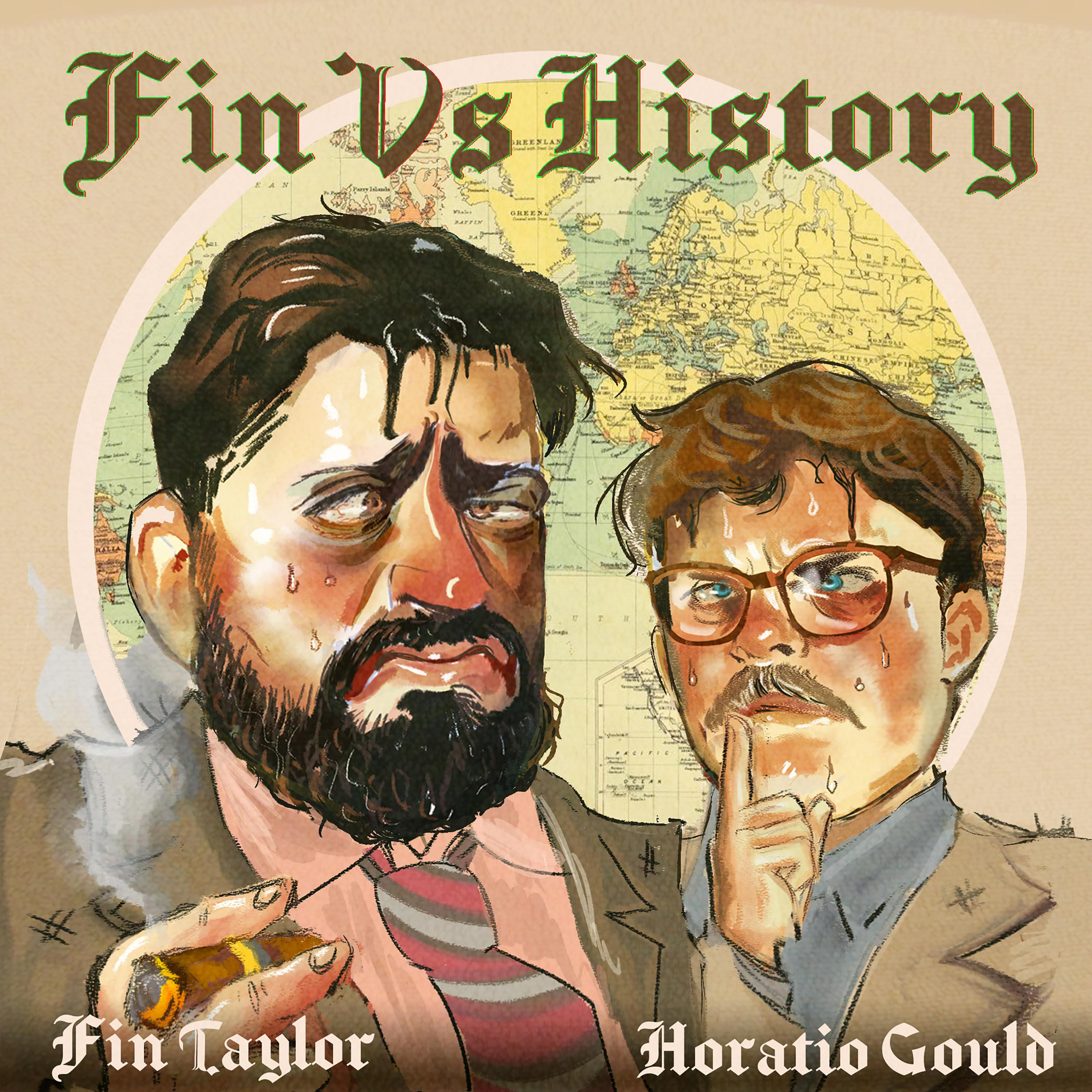
First Port Stanley, Now This?? (with The Upshot!) | The History of The World Cup (Part 3/4)
Argentina allegedly traded 35,000 tons of grain and promised to torture 13 Peruvian political prisoners in exchange for a 6-0 scoreline that put them into the 1978 World Cup final.
Jun 15, 20261:01:53
Difficulty: Intermediate
Played
Fin vs History
First Port Stanley, Now This?? (with The Upshot!) | The History of The World Cup (Part 3/4)
Argentina allegedly traded 35,000 tons of grain and promised to torture 13 Peruvian political prisoners in exchange for a 6-0 scoreline that put them into the 1978 World Cup final.
Jun 15, 20261:01:53
Difficulty: Intermediate
Played
TL;DR
Part 3 of Fin vs History's World Cup series covers the 1978 Argentina tournament — a junta-hosted sportswashing spectacular with allegations of match-fixing[1]— Fin Taylor"Henry Kissinger and Argentine dictator Videla walked into the Peruvian dressing room before their 1978 World Cup match. The Peruvian captai…"11:47, Josef Mengele as a rumoured guest of honour, and torture happening 700 metres from the stadium[2]— Fin Taylor"While Argentina played the 1978 World Cup final, prisoners were being tortured in the Navy School of Mechanics just 700 metres away. Guards…"20:40. The episode then charts Diego Maradona's rise: falling into a cesspit as a child, doing cocaine in the Pope's bathroom[3]— Horatio Gould"In 1985, Pope John Paul II invited Diego Maradona to the Vatican specifically to promote an anti-drug campaign. Maradona went on an all-nig…"26:24, faking drug tests with a prosthetic penis, and scoring both the Hand of God and Goal of the Century against England in 1986[4]— Fin Taylor"In the same quarterfinal, Diego Maradona punched the ball into the net past 6-foot goalkeeper Peter Shilton — and then ran 60 yards from hi…"44:50. The single most useful takeaway: corruption at the 1978 World Cup ran so deep it allegedly included a grain-and-torture deal to fix the Argentina vs Peru scoreline.
#World Cup history#Argentine military junta#Maradona cocaine#1978 World Cup corruption#1986 Hand of God#sportswashing#Falklands War#drug testing in football#Napoli Maradona era#Zaire 1974#Kissinger foreign policy#Josef Mengele Argentina#Italia 90#football and politics#football match-fixing#World Cup#Maradona#Argentina#1978 World Cup#1986 World Cup#cocaine#corruption#Mobutu#Zaire#Kissinger#Josef Mengele#Napoli#Hand of God#drug testing#Whizzinator#junta#football history
Part 3 of Fin vs History's World Cup series, covering the 1978 Argentina tournament and the rise of Diego Maradona through 1982, the Napoli years, and 1986.
Chapter list
The episode opens with Fin Taylor setting the scene for a journey into South American football's darkest chapter, joined by the Upshot Boys. Before diving into 1978, the hosts address a moment from the 1974 West German World Cup that Fin only recently re-understood. Zaire — qualifying under the shadow of dictator Mobutu Sese Seko — lost 9-0 to Yugoslavia before facing Brazil. With Mobutu threatening the squad they would not be allowed to return to Zaire if they lost to Brazil by more than 3 goals, defender Mwepu Ilunga sprinted out and booted a free kick before the whistle had been blown[1]— Fin Taylor"The BBC presented Zaire defender Mwepu Ilunga booting a free kick before the whistle as 'native confusion — he doesn't know the rules.' He …"03:15. The BBC framed this as charming ignorance — 'he doesn't even know the rules' — but the reality was a desperate act of time-wasting by a man fearing for his life. The hosts delight in this reframe, with Fin noting the FIFA-sanctioned History of the World Cup box set he watched as a child had sold him this colonial narrative wholesale.
Switching to Argentina in 1978, the picture the hosts paint is one of almost incomprehensible chaos and violence. Inflation had exceeded 560% in 1976, a bomb was detonating somewhere in Buenos Aires every three hours, and political assassinations were occurring every five hours[1]— Horatio Gould"560% inflation in Argentina 1976: Argentine inflation exceeded 560% in 1976, making the economy effectively 'psychedelic' and ungovernable."04:52. Into this cauldron steps the military junta of Jorge Videla, who inherit the hosting rights from the previous government and view the World Cup as a propaganda opportunity. The junta would go on to disappear an estimated 30,000 people. Johan Cruyff refuses to travel after a kidnapping attempt on his family. The man responsible for building the stadiums is blown up in a car bomb hours before the opening match — possibly suicide, the hosts speculate, possibly just probability at work in a country detonating round the clock. Maradona is 17 and too young to play, but the foundations of his story are already being laid in a Buenos Aires shantytown where, as a child, he fell into a cesspit and almost drowned[2]— Fin Taylor"As a child in a Buenos Aires shantytown, Diego Maradona fell into a cesspit and nearly drowned, saved only by his uncle jumping in after hi…"07:40.
The episode breaks for a Shopify advertisement, positioning the platform as the commerce solution behind 10% of all US e-commerce. The ad highlights ready-to-use templates, integrated inventory and analytics tools, and built-in email and social media marketing campaigns. Gymshark, Rare Beauty, and Heinz are cited as major clients. The offer is a $1 per month trial available at shopify.com/realm.
This is the episode's darkest factual passage. Argentina needed to beat Peru by at least four goals to reach the 1978 final. They won 6-0. The alleged deal was extraordinary: Videla promised to take and 'process' — a bureaucratic euphemism for torture and disappear — 13 Peruvian political dissidents[1]— Fin Taylor"To reach the 1978 final, Argentina needed to beat Peru by at least 4 goals. They won 6-0. The alleged price: 35,000 tons of grain, $50 mill…"08:24. In exchange, Argentina shipped 35,000 tons of grain to Peru and released $50 million in previously frozen assets after the final whistle[2]— Fin Taylor"35,000 tons of grain shipped to Peru: Argentina allegedly shipped 35,000 tons of grain to Peru and released $50 million in frozen assets af…"09:14. Hours before kick-off, Henry Kissinger — fresh from Cambodia and still post-Watergate toxic — and Videla walked into the Peruvian dressing room, smiled, shook hands, and left. The Peruvian captain later recalled it felt like a silent threat disguised as a diplomatic greeting, and the players were unsettled by the fact that no one had visited the home team[3]— Fin Taylor"Henry Kissinger and Argentine dictator Videla walked into the Peruvian dressing room before their 1978 World Cup match. The Peruvian captai…"11:47. Fin compares this to the Brittney Griner-for-Viktor-Bout prisoner swap, noting Peru got a reasonably good deal — they were never going to win the tournament anyway.
The depths of the 1978 World Cup's moral abyss continue to reveal themselves. Josef Mengele, the Nazi concentration camp doctor who conducted lethal experiments and escaped to South America, was reportedly invited to watch the final[1]— Fin Taylor"While Argentina played the 1978 World Cup final, prisoners were being tortured in the Navy School of Mechanics just 700 metres away. Guards…"20:40. An Israeli referee assigned to the final causes Argentina's players to walk off the pitch for seven minutes in protest — with the hosts noting darkly that with Mengele in the stands, an Israeli official would indeed be 'triggering' for him. FIFA replaces the Israeli ref with an Italian. Meanwhile, 700 metres from the cheering stadium, political prisoners are being held and tortured in the Navy School of Mechanics[2]— Fin Taylor"Torture centre 700m from the 1978 stadium: The Navy School of Mechanics, where people were being tortured, was just 700 metres from the 197…"20:44. Guards reportedly told captives that the crowd noise was the stadium jeering at them. The ticker-tape finale — an extraordinary avalanche of blue and white paper — becomes the visual symbol of a tournament sitting atop an atrocity. Netherlands, again without Cruyff, loses the final, their second in a row.
With Argentina crowned 1978 champions in a tournament that stinks of corruption, the focus shifts to Maradona himself — the player who wasn't there. Born in a Buenos Aires shantytown, he fell into a cesspit as a child and was saved by his uncle. He is described as probably the most naturally talented player ever to play the game. The GOAT debate with Messi is settled quickly: Maradona did it on terrible pitches while addicted to cocaine, had the build of a darts player, and scored the greatest goal of all time with an approximate BMI of 40[1]— Fin Taylor"He scores the greatest goal of all time, all time, while having a BMI of 40."25:35. By contrast, Messi's achievements, though immense, came with hormone injections rather than recreational drugs. Maradona's famous closeness to family is highlighted by a staggering detail: he spent a minimum of $15,000 a month on phone calls to his parents and siblings[2]— Horatio Gould"Maradona spent $15,000/month on phone calls: Diego Maradona spent a minimum of $15,000 a month calling his parents and siblings, demonstrat…"24:39. His cycle at Napoli is documented: three days of training, winning a game single-handedly, then a four-day cocaine-and-Mafia bender, followed by Thursday on a treadmill in an oxygen mask and cling film.
The 1982 World Cup takes place in Spain, recently emerged from Franco's dictatorship, with the shadow of the Falklands conflict hanging over every Argentina match. The Argentine junta has imposed a news blackout, so the squad genuinely believes the war is going well until they arrive in Spain and read Spanish newspapers, discovering that Port Stanley has already fallen[1]— Horatio Gould"Maradona faked drug tests with prosthetic penis: Diego Maradona used a fake penis filled with baby urine to pass drug tests during his time…"32:34. Maradona, now 21 and fully grown at 5'5", is making his first World Cup appearance, distracted and grieving from the Argentine perspective. Italian defender Claudio Gentile commits foul after foul on Maradona — 23 in one game — and when challenged on his aggression, replies with what becomes a celebrated football aphorism: 'Football is not for ballerinas'[2]— Fin Taylor"Football is not for ballerinas."31:24. Maradona is ultimately sent off for retaliation, violently kicking Brazilian midfielder Batista in the groin in Argentina's final group match against Brazil. It's a World Cup that belongs to Italy, not Argentina.
With drug testing introduced in the 1980s, Maradona faced a practical problem: he was consuming industrial quantities of cocaine. His solution was the Whizzinator — a prosthetic penis filled with the urine of his infant son, used to fool supervised drug tests[1]— Horatio Gould"Maradona's fake penis later stolen from a museum: The prosthetic penis Maradona used to fake drug tests ended up in a museum, from which it…"35:31. The hosts learn in real time that the device is a real, commercially available product — still sold today — and spend several minutes examining the product range, including its colour variants and accompanying accessories. Mike Tyson also allegedly used the same method. The original Whizzinator allegedly used by Maradona eventually made its way into a museum before being stolen in a break-in, never to be found again[2]— Horatio Gould"Maradona found with 500g of cocaine in Argentina: After fleeing Italy, Maradona was busted in Argentina with approximately 500 grams of coc…"52:35. The hosts remark that Pickles the dog, famous for finding the original World Cup trophy, is unfortunately dead.
At Napoli, Maradona achieves the most romantic player-club combination in football history, leading the city to its first ever Serie A title and a UEFA Cup — transforming a perpetually marginalised southern Italian club into champions. But the price was accelerating chaos: Mafia connections deepened, cocaine consumption escalated, and the protective infrastructure that had shielded him from authorities gradually corroded. According to one mistress, Maradona's particular intimate preference was sucking a partner's big toe — a detail the hosts file under 'wrong 'un, absolute wrong 'un.' The segment briefly detours into Brian Johnson's documented interest in measuring his girlfriend's vaginal pH, a comparison which the hosts conclude illustrates very different philosophies of self-optimisation. Gareth Southgate's legendary water-drinking interview is recalled as a counterpoint to all of the above.
The entire England-Argentina 1986 quarterfinal is saturated with the Falklands War. Maradona would later write in his autobiography that it felt like beating a country, not a football team — the Argentine boys killed in the Falklands were present in his mind, and this was revenge[1]— Fin Taylor"It was like beating a country, not a football team. Although we had said before the game football had nothing to do with the Malvinas War, …"43:31. Two moments define the game and Maradona's legend. First, with a 5'5" Maradona outjumping 6-foot goalkeeper Peter Shilton to punch the ball into the net with his left hand — clearly visible in photographs, missed by Tunisian referee Ali Ben Nasser[2]— Fin Taylor"In the same quarterfinal, Diego Maradona punched the ball into the net past 6-foot goalkeeper Peter Shilton — and then ran 60 yards from hi…"44:50. Minutes later, Maradona receives the ball in his own half and runs 60 yards, beating five English outfield players and the goalkeeper in a sequence of movement the hosts describe as the goal of the century, accompanied on screen by iconic Argentine commentary. The Upshot boys reflect on the game's unique quality — England supporters were willing to admire the goal even as they hated the cheating, a cognitive dissonance that endures to this day.
The hosts frame Italia '90 as the moment football truly became big business. England, dogged through the 1980s by hooliganism and stadium disasters, achieves a kind of national rehabilitation. Cameroon's performances mark the breakthrough of African football on the world stage, with Roger Milla's celebrations becoming iconic. The Italian Mafia absorb FIFA's stadium construction contracts — which the hosts note is somehow more romantic than modern state-sponsored corruption, in the way that The Godfather is more romantic than Gianni Infantino. Maradona, his protection from Italian authorities eroded by his divisive Italia '90 stunts, is eventually exposed. Before a semi-final in Naples between Italy and Argentina, he publicly tells Napoli fans that the north has always despised the south — and a significant faction of Italian supporters cheer Argentina. In northern Italy, a subsequent poll names Maradona the worst villain of the 20th century, with Hitler a distant fifth[1]— Horatio Gould"They do a poll of most hated— worst villain of the 20th century in northern Italy, and he wins it by miles. Hitler's like distant fifth."53:15. Maradona's drug test failures mount; he eventually flees to Argentina, where he is found with 500 grams of cocaine but receives a minor punishment[2]— Horatio Gould"Maradona's shirt sold for ~£7–9 million: England player Steve Hodge, who swapped shirts with Maradona after the 1986 Hand of God game, late…"51:50.
The episode closes with Fin Taylor directing listeners to the Patreon for the fourth and final part of the World Cup story, already available, and an exclusive bonus episode on hooliganism recorded with the Upshot Boys. Horatio Gould and Jack recommend their standout episodes — the Lotto Lout episode, a Roman Abramovich deep-dive, and a piece on Robin Friday, the LSD-taking footballer. The Golden Age of Snooker is flagged as a future crossover episode. The Upshot Boys reveal they have cancelled their plan to attend the current World Cup in person, citing the cost and a decision to 'set fire to $150' at home instead. A forthcoming Patreon live event is announced: an alternative commentary for Switzerland versus Bosnia on June 18th, described as likely to get sectarian.
Sportswashing
The use of sport to improve a government's or regime's international image and distract from human rights abuses — used here to describe Argentina's 1978 World Cup hosting.
Junta
A military group that has taken control of a country's government by force; here refers to Jorge Videla's Argentine regime that hosted the 1978 World Cup.
Operation Condor
A CIA-backed campaign coordinating South American military dictatorships to hunt down and eliminate left-wing political opponents across borders in the 1970s.
Cesspit
A covered pit or underground tank used to collect and store sewage from a building; the hosts use it both literally (Maradona's childhood fall) and metaphorically.
Whizzinator
A brand of synthetic urine device consisting of a prosthetic penis and bladder designed to allow users to pass observed drug tests with clean urine.
Total Football
A Dutch tactical football philosophy of the 1970s, associated with Ajax and the Netherlands national team, in which outfield players are interchangeable and fluid in position.
FARC
Fuerzas Armadas Revolucionarias de Colombia — a Marxist-Leninist guerrilla organisation involved in a decades-long armed conflict in Colombia; cited here as the reason Colombia returned the 1986 World Cup hosting rights.
Whizzinator Touch
An updated commercial version of the original Whizzinator drug-evasion prosthetic device, humorously reviewed by the hosts after discussing Maradona's alleged use.
Merchant of Death
The nickname of Russian arms dealer Viktor Bout, referenced here as the figure exchanged for WNBA player Brittney Griner in a US-Russia prisoner swap.
Angel of Death
The nickname of Nazi SS physician Josef Mengele, who conducted lethal experiments on prisoners at Auschwitz and later fled to South America.
Racketeering
Engaging in a pattern of criminal activity, typically organised crime extracting money through illegal schemes; used here to describe how the Italian Mafia absorbed FIFA's Italia '90 stadium contracts.
Shithousery
British football slang for cynical, unsporting, or rule-bending tactics; the hosts use it to describe a broader pattern of Latin American tournament corruption.
Hippocratic oath
The traditional ethical code taken by medical doctors pledging to do no harm; invoked satirically here in reference to Nazi doctor Josef Mengele.
Navy School of Mechanics (ESMA)
A clandestine detention and torture centre operated by the Argentine navy under the Videla regime, located approximately 700 metres from the 1978 World Cup stadium.
Cesspit
A covered underground pit for collecting sewage; used here literally (Maradona fell into one as a child) and metaphorically to describe the 1978 World Cup's moral atmosphere.
Iniquity
Gross injustice or wickedness; the host uses 'den of iniquity' to describe South America in the 1970s as a place of moral corruption and political violence.
Sportswashing
Using high-profile sporting events to launder a regime's international reputation and divert attention from domestic repression.
Ticker tape
Thin strips of paper, traditionally from telegraph machines, thrown from buildings as a festive celebration; the 1978 World Cup final in Buenos Aires was famous for an extraordinary ticker-tape display.
Prosthetic
An artificial replacement for a body part; used here in the context of Maradona's fake penis used to cheat drug tests.
Eichmann
Adolf Eichmann, a senior Nazi official responsible for organising the Holocaust's logistics, who fled to Argentina after WWII and was covertly captured by Israeli Mossad agents in 1960 and tried in Jerusalem.
Chapter 1 · 00:00
Time Wasting
The episode opens with Fin Taylor setting the scene for a journey into South American football's darkest chapter, joined by the Upshot Boys. Before diving into 1978, the hosts address a moment from the 1974 West German World Cup that Fin only recently re-understood. Zaire — qualifying under the shadow of dictator Mobutu Sese Seko — lost 9-0 to Yugoslavia before facing Brazil. With Mobutu threatening the squad they would not be allowed to return to Zaire if they lost to Brazil by more than 3 goals, defender Mwepu Ilunga sprinted out and booted a free kick before the whistle had been blown[1]— Fin Taylor"The BBC presented Zaire defender Mwepu Ilunga booting a free kick before the whistle as 'native confusion — he doesn't know the rules.' He …"03:15. The BBC framed this as charming ignorance — 'he doesn't even know the rules' — but the reality was a desperate act of time-wasting by a man fearing for his life. The hosts delight in this reframe, with Fin noting the FIFA-sanctioned History of the World Cup box set he watched as a child had sold him this colonial narrative wholesale.
Zaire, playing under threats from dictator Mobutu not to lose by more than 3 goals to Brazil, had previously lost 9-0 to Yugoslavia in the same group stage.
The BBC presented Zaire defender Mwepu Ilunga booting a free kick before the whistle as 'native confusion — he doesn't know the rules.' He knew exactly what he was doing. With dictator Mobutu threatening the squad they would not be allowed back into Zaire if they lost by too many goals, the defender was time-wasting to save his own life.
The 1978 World Cup was hosted by a military junta that disappeared 30,000 people. Josef Mengele was allegedly a guest of honour. Henry Kissinger attended as a diplomatic figurehead. Johan Cruyff refused to travel after a kidnapping attempt on his family. The organisers' chief financier was blown up in a car bomb hours before the tournament began.
4:00
7:20
Chapter 2 · 04:30
Keep Your Head Above The Shit
Switching to Argentina in 1978, the picture the hosts paint is one of almost incomprehensible chaos and violence. Inflation had exceeded 560% in 1976, a bomb was detonating somewhere in Buenos Aires every three hours, and political assassinations were occurring every five hours[1]— Horatio Gould"560% inflation in Argentina 1976: Argentine inflation exceeded 560% in 1976, making the economy effectively 'psychedelic' and ungovernable."04:52. Into this cauldron steps the military junta of Jorge Videla, who inherit the hosting rights from the previous government and view the World Cup as a propaganda opportunity. The junta would go on to disappear an estimated 30,000 people. Johan Cruyff refuses to travel after a kidnapping attempt on his family. The man responsible for building the stadiums is blown up in a car bomb hours before the opening match — possibly suicide, the hosts speculate, possibly just probability at work in a country detonating round the clock. Maradona is 17 and too young to play, but the foundations of his story are already being laid in a Buenos Aires shantytown where, as a child, he fell into a cesspit and almost drowned[2]— Fin Taylor"As a child in a Buenos Aires shantytown, Diego Maradona fell into a cesspit and nearly drowned, saved only by his uncle jumping in after hi…"07:40.
As a child in a Buenos Aires shantytown, Diego Maradona fell into a cesspit and nearly drowned, saved only by his uncle jumping in after him. Fin Taylor suggests this may be Maradona's Spider-Man villain origin story — and there was probably a lot of cocaine in the shit.
To reach the 1978 final, Argentina needed to beat Peru by at least 4 goals. They won 6-0. The alleged price: 35,000 tons of grain, $50 million in frozen assets released after the game, and a promise from the Videla regime to 'process' 13 Peruvian political dissidents — a euphemism for torture and execution.
8:24
9:38
Chapter 3 · 08:33
The Merchant Of Death
The episode breaks for a Shopify advertisement, positioning the platform as the commerce solution behind 10% of all US e-commerce. The ad highlights ready-to-use templates, integrated inventory and analytics tools, and built-in email and social media marketing campaigns. Gymshark, Rare Beauty, and Heinz are cited as major clients. The offer is a $1 per month trial available at shopify.com/realm.
Henry Kissinger and Argentine dictator Videla walked into the Peruvian dressing room before their 1978 World Cup match. The Peruvian captain later recalled it felt like a silent threat disguised as a diplomatic greeting — and the players couldn't help noticing that no one had visited the home team.
This is the episode's darkest factual passage. Argentina needed to beat Peru by at least four goals to reach the 1978 final. They won 6-0. The alleged deal was extraordinary: Videla promised to take and 'process' — a bureaucratic euphemism for torture and disappear — 13 Peruvian political dissidents[1]— Fin Taylor"To reach the 1978 final, Argentina needed to beat Peru by at least 4 goals. They won 6-0. The alleged price: 35,000 tons of grain, $50 mill…"08:24. In exchange, Argentina shipped 35,000 tons of grain to Peru and released $50 million in previously frozen assets after the final whistle[2]— Fin Taylor"35,000 tons of grain shipped to Peru: Argentina allegedly shipped 35,000 tons of grain to Peru and released $50 million in frozen assets af…"09:14. Hours before kick-off, Henry Kissinger — fresh from Cambodia and still post-Watergate toxic — and Videla walked into the Peruvian dressing room, smiled, shook hands, and left. The Peruvian captain later recalled it felt like a silent threat disguised as a diplomatic greeting, and the players were unsettled by the fact that no one had visited the home team[3]— Fin Taylor"Henry Kissinger and Argentine dictator Videla walked into the Peruvian dressing room before their 1978 World Cup match. The Peruvian captai…"11:47. Fin compares this to the Brittney Griner-for-Viktor-Bout prisoner swap, noting Peru got a reasonably good deal — they were never going to win the tournament anyway.
The depths of the 1978 World Cup's moral abyss continue to reveal themselves. Josef Mengele, the Nazi concentration camp doctor who conducted lethal experiments and escaped to South America, was reportedly invited to watch the final[1]— Fin Taylor"While Argentina played the 1978 World Cup final, prisoners were being tortured in the Navy School of Mechanics just 700 metres away. Guards…"20:40. An Israeli referee assigned to the final causes Argentina's players to walk off the pitch for seven minutes in protest — with the hosts noting darkly that with Mengele in the stands, an Israeli official would indeed be 'triggering' for him. FIFA replaces the Israeli ref with an Italian. Meanwhile, 700 metres from the cheering stadium, political prisoners are being held and tortured in the Navy School of Mechanics[2]— Fin Taylor"Torture centre 700m from the 1978 stadium: The Navy School of Mechanics, where people were being tortured, was just 700 metres from the 197…"20:44. Guards reportedly told captives that the crowd noise was the stadium jeering at them. The ticker-tape finale — an extraordinary avalanche of blue and white paper — becomes the visual symbol of a tournament sitting atop an atrocity. Netherlands, again without Cruyff, loses the final, their second in a row.
While Argentina played the 1978 World Cup final, prisoners were being tortured in the Navy School of Mechanics just 700 metres away. Guards reportedly told captives the crowd noise was the stadium mocking them. Josef Mengele was rumoured to be a guest of honour in the stands.
The Navy School of Mechanics, where people were being tortured, was just 700 metres from the 1978 World Cup stadium in Buenos Aires.
Chapter 6 · 21:21
Pope's Bathroom
With Argentina crowned 1978 champions in a tournament that stinks of corruption, the focus shifts to Maradona himself — the player who wasn't there. Born in a Buenos Aires shantytown, he fell into a cesspit as a child and was saved by his uncle. He is described as probably the most naturally talented player ever to play the game. The GOAT debate with Messi is settled quickly: Maradona did it on terrible pitches while addicted to cocaine, had the build of a darts player, and scored the greatest goal of all time with an approximate BMI of 40[1]— Fin Taylor"He scores the greatest goal of all time, all time, while having a BMI of 40."25:35. By contrast, Messi's achievements, though immense, came with hormone injections rather than recreational drugs. Maradona's famous closeness to family is highlighted by a staggering detail: he spent a minimum of $15,000 a month on phone calls to his parents and siblings[2]— Horatio Gould"Maradona spent $15,000/month on phone calls: Diego Maradona spent a minimum of $15,000 a month calling his parents and siblings, demonstrat…"24:39. His cycle at Napoli is documented: three days of training, winning a game single-handedly, then a four-day cocaine-and-Mafia bender, followed by Thursday on a treadmill in an oxygen mask and cling film.
The 1982 World Cup takes place in Spain, recently emerged from Franco's dictatorship, with the shadow of the Falklands conflict hanging over every Argentina match. The Argentine junta has imposed a news blackout, so the squad genuinely believes the war is going well until they arrive in Spain and read Spanish newspapers, discovering that Port Stanley has already fallen[1]— Horatio Gould"Maradona faked drug tests with prosthetic penis: Diego Maradona used a fake penis filled with baby urine to pass drug tests during his time…"32:34. Maradona, now 21 and fully grown at 5'5", is making his first World Cup appearance, distracted and grieving from the Argentine perspective. Italian defender Claudio Gentile commits foul after foul on Maradona — 23 in one game — and when challenged on his aggression, replies with what becomes a celebrated football aphorism: 'Football is not for ballerinas'[2]— Fin Taylor"Football is not for ballerinas."31:24. Maradona is ultimately sent off for retaliation, violently kicking Brazilian midfielder Batista in the groin in Argentina's final group match against Brazil. It's a World Cup that belongs to Italy, not Argentina.
In 1985, Pope John Paul II invited Diego Maradona to the Vatican specifically to promote an anti-drug campaign. Maradona went on an all-night bender the night before, ignored his agent's pleas, and — according to the agent — demanded to use the papal bathroom to do a line of cocaine. The irony was total.
Before meeting the Pope at the Vatican in 1985, Maradona went on an all-night bender and then demanded to use the Pope's bathroom to do a line of cocaine.
Diego Maradona used a fake penis filled with baby urine to pass drug tests during his time at Napoli in the 1980s.
Chapter 8 · 32:36
Wind It Down
With drug testing introduced in the 1980s, Maradona faced a practical problem: he was consuming industrial quantities of cocaine. His solution was the Whizzinator — a prosthetic penis filled with the urine of his infant son, used to fool supervised drug tests[1]— Horatio Gould"Maradona's fake penis later stolen from a museum: The prosthetic penis Maradona used to fake drug tests ended up in a museum, from which it…"35:31. The hosts learn in real time that the device is a real, commercially available product — still sold today — and spend several minutes examining the product range, including its colour variants and accompanying accessories. Mike Tyson also allegedly used the same method. The original Whizzinator allegedly used by Maradona eventually made its way into a museum before being stolen in a break-in, never to be found again[2]— Horatio Gould"Maradona found with 500g of cocaine in Argentina: After fleeing Italy, Maradona was busted in Argentina with approximately 500 grams of coc…"52:35. The hosts remark that Pickles the dog, famous for finding the original World Cup trophy, is unfortunately dead.
Maradona used a prosthetic penis — a device later marketed as the Whizzinator — filled with baby urine to pass drug tests throughout his Napoli years. The original fake penis eventually ended up in a museum, from which it was stolen and never recovered.
The prosthetic penis Maradona used to fake drug tests ended up in a museum, from which it was later stolen and never recovered.
Chapter 9 · 37:18
Farcing Hell Mate
At Napoli, Maradona achieves the most romantic player-club combination in football history, leading the city to its first ever Serie A title and a UEFA Cup — transforming a perpetually marginalised southern Italian club into champions. But the price was accelerating chaos: Mafia connections deepened, cocaine consumption escalated, and the protective infrastructure that had shielded him from authorities gradually corroded. According to one mistress, Maradona's particular intimate preference was sucking a partner's big toe — a detail the hosts file under 'wrong 'un, absolute wrong 'un.' The segment briefly detours into Brian Johnson's documented interest in measuring his girlfriend's vaginal pH, a comparison which the hosts conclude illustrates very different philosophies of self-optimisation. Gareth Southgate's legendary water-drinking interview is recalled as a counterpoint to all of the above.
Colombia were awarded the 1986 World Cup but, with their economy collapsed under FARC drug war violence, gave it back — the first country ever to win hosting rights and then resign from them. Mexico stepped in again. Fin Taylor calls it 'one of the great iconic not todays in history.'
41:15
42:18
Chapter 10 · 42:19
Bad Egg
The entire England-Argentina 1986 quarterfinal is saturated with the Falklands War. Maradona would later write in his autobiography that it felt like beating a country, not a football team — the Argentine boys killed in the Falklands were present in his mind, and this was revenge[1]— Fin Taylor"It was like beating a country, not a football team. Although we had said before the game football had nothing to do with the Malvinas War, …"43:31. Two moments define the game and Maradona's legend. First, with a 5'5" Maradona outjumping 6-foot goalkeeper Peter Shilton to punch the ball into the net with his left hand — clearly visible in photographs, missed by Tunisian referee Ali Ben Nasser[2]— Fin Taylor"In the same quarterfinal, Diego Maradona punched the ball into the net past 6-foot goalkeeper Peter Shilton — and then ran 60 yards from hi…"44:50. Minutes later, Maradona receives the ball in his own half and runs 60 yards, beating five English outfield players and the goalkeeper in a sequence of movement the hosts describe as the goal of the century, accompanied on screen by iconic Argentine commentary. The Upshot boys reflect on the game's unique quality — England supporters were willing to admire the goal even as they hated the cheating, a cognitive dissonance that endures to this day.
In the same quarterfinal, Diego Maradona punched the ball into the net past 6-foot goalkeeper Peter Shilton — and then ran 60 yards from his own half past the entire English defence to score what is universally considered the greatest goal ever scored. Two moments, one game, one man — and the Falklands War as backdrop.
44:50
47:20
Chapter 11 · 46:17
Red Rag To A Bull
The hosts frame Italia '90 as the moment football truly became big business. England, dogged through the 1980s by hooliganism and stadium disasters, achieves a kind of national rehabilitation. Cameroon's performances mark the breakthrough of African football on the world stage, with Roger Milla's celebrations becoming iconic. The Italian Mafia absorb FIFA's stadium construction contracts — which the hosts note is somehow more romantic than modern state-sponsored corruption, in the way that The Godfather is more romantic than Gianni Infantino. Maradona, his protection from Italian authorities eroded by his divisive Italia '90 stunts, is eventually exposed. Before a semi-final in Naples between Italy and Argentina, he publicly tells Napoli fans that the north has always despised the south — and a significant faction of Italian supporters cheer Argentina. In northern Italy, a subsequent poll names Maradona the worst villain of the 20th century, with Hitler a distant fifth[1]— Horatio Gould"They do a poll of most hated— worst villain of the 20th century in northern Italy, and he wins it by miles. Hitler's like distant fifth."53:15. Maradona's drug test failures mount; he eventually flees to Argentina, where he is found with 500 grams of cocaine but receives a minor punishment[2]— Horatio Gould"Maradona's shirt sold for ~£7–9 million: England player Steve Hodge, who swapped shirts with Maradona after the 1986 Hand of God game, late…"51:50.
Before Italy's 1990 World Cup semi-final in Naples against Argentina, Maradona publicly told Napoli fans that the Italian north had always hated and marginalised the south. A significant chunk of Italian fans cheered for Argentina. In northern Italy, Maradona would later win a poll for worst villain of the 20th century — with Hitler a distant fifth.
52:55
53:50
Chapter 12 · 53:02
And It's Live
The episode closes with Fin Taylor directing listeners to the Patreon for the fourth and final part of the World Cup story, already available, and an exclusive bonus episode on hooliganism recorded with the Upshot Boys. Horatio Gould and Jack recommend their standout episodes — the Lotto Lout episode, a Roman Abramovich deep-dive, and a piece on Robin Friday, the LSD-taking footballer. The Golden Age of Snooker is flagged as a future crossover episode. The Upshot Boys reveal they have cancelled their plan to attend the current World Cup in person, citing the cost and a decision to 'set fire to $150' at home instead. A forthcoming Patreon live event is announced: an alternative commentary for Switzerland versus Bosnia on June 18th, described as likely to get sectarian.
By Italia '90, the World Cup had transformed from a prestige tournament into a global television product. England's rehabilitation from the hooligan era, Cameroon's breakthrough, Maradona's implosion — and the Mafia quietly pocketing FIFA's stadium contracts. The tournament's value now lay in commercial and geopolitical power, and the truly corrupt era was only just beginning.
In 1985, Pope John Paul II invited Diego Maradona to the Vatican specifically to promote an anti-drug campaign. Maradona went on an all-night bender the night before, ignored his agent's pleas, and — according to the agent — demanded to use the papal bathroom to do a line of cocaine. The irony was total.
To reach the 1978 final, Argentina needed to beat Peru by at least 4 goals. They won 6-0. The alleged price: 35,000 tons of grain, $50 million in frozen assets released after the game, and a promise from the Videla regime to 'process' 13 Peruvian political dissidents — a euphemism for torture and execution.
Factual claims made this episode, and whether a source was named.
⚠
Zaire defender Mwepu Ilunga deliberately ran out and kicked the ball during a Brazilian free kick at the 1974 World Cup as a time-wasting tactic to avoid losing by enough goals to trigger Mobutu's threat of not allowing the squad to return home.
Fin Taylorno source cited
⚠
Argentine inflation exceeded 560% in 1976.
Horatio Gouldno source cited
⚠
In 1976 Buenos Aires, a bomb exploded on average every 3 hours and there was a political assassination every 5 hours.
Fin Taylorno source cited
⚠
The Videla military junta disappeared an estimated 30,000 people in Argentina.
Fin Taylorno source cited
⚠
Argentina needed to beat Peru by at least 4 goals to reach the 1978 World Cup final, and won 6-0, with the result allegedly fixed through a deal involving grain, money, and political prisoners.
Fin Taylorno source cited
⚠
Argentina allegedly shipped 35,000 tons of grain to Peru and released $50 million of frozen assets after Peru lost 6-0 to Argentina at the 1978 World Cup.
Fin Taylorno source cited
⚠
The Peruvian captain recalled that Kissinger and Videla's visit to the dressing room felt like a silent threat disguised as a diplomatic greeting, and the players wondered why the home team was not being visited.
Fin Taylorno source cited
⚠
Josef Mengele was rumoured to have been a guest of honour at the 1978 World Cup final in Argentina.
Fin Taylorno source cited
⚠
Johan Cruyff did not travel to the 1978 World Cup due to a kidnapping attempt on his family.
Fin Taylorno source cited
⚠
The Navy School of Mechanics, a clandestine torture centre operated by Argentina's military regime, was located just 700 metres from the 1978 World Cup stadium.
Fin Taylorno source cited
⚠
Diego Maradona spent a minimum of $15,000 a month on phone calls to his parents and siblings.
Horatio Gouldno source cited
⚠
In 1985, Pope John Paul II invited Diego Maradona to the Vatican to promote an anti-drug campaign.
Horatio Gouldno source cited
✓
According to Maradona's agent, Maradona demanded to use the Pope's bathroom to do cocaine before meeting Pope John Paul II at the Vatican.
Horatio GouldMaradona's agent, as recounted in the book the Asif Kapadia documentary is base…
⚠
Diego Maradona had 23 fouls committed against him in a single game at the 1982 World Cup.
Fin Taylorno source cited
⚠
Maradona used a prosthetic penis filled with baby urine, marketed as the Whizzinator, to pass drug tests at Napoli in the 1980s.
Horatio Gouldno source cited
⚠
Maradona's prosthetic penis was stolen from a museum after being put on display there.
Horatio Gouldno source cited
⚠
Carlos Tevez refused to learn English during his time at Manchester United because his father or uncle had fought against Britain in the Falklands War.
Horatio Gouldno source cited
⚠
Maradona was found with approximately 500 grams of cocaine in Argentina after fleeing Italy, but received only a minor punishment.
Horatio Gouldno source cited
⚠
In a poll of worst villains of the 20th century conducted in northern Italy, Maradona won by a large margin, with Hitler coming in a distant fifth.
Horatio Gouldno source cited
⚠
Colombia was the first country ever to be awarded World Cup hosting rights and then relinquish them.
Fin Taylorno source cited
⚠
Steve Hodge swapped shirts with Maradona after the 1986 Hand of God game and later sold the shirt for approximately £7–9 million.
Horatio Gouldno source cited
This episode
Cast
Central figure of the episode — his childhood, cocaine use, Napoli years, and iconic 1986 World Cup performances are extensively discussed.
The World Cup hosted by Argentina's military junta, discussed as the most corrupt pre-commercial-era tournament, featuring alleged match-fixing and Mengele as a rumoured guest.
Hosted by Mexico, this tournament is defined by Maradona's iconic Hand of God and Goal of the Century against England in the quarterfinal.
Nazi war criminal and 'Angel of Death' who fled to Argentina after WWII and was rumoured to have been a guest of honour at the 1978 World Cup final.
Dictator of Zaire who threatened the 1974 World Cup squad not to return home if they lost by too many goals, providing the real context for Mwepu Ilunga's infamous free-kick sprint.
US Secretary of State who attended the 1978 World Cup as guest of honour and allegedly visited the Peruvian dressing room as an implied threat before the key match.
The 1990 World Cup in Italy, described as the moment football became fully commercialised, featuring Maradona's divisive use of Italian north-south tensions.
Argentine military dictator who headed the junta that hosted the 1978 World Cup and disappeared an estimated 30,000 people.
Dutch football legend who refused to travel to the 1978 World Cup, reportedly due to a kidnapping attempt on his family and his wife's veto.
The Italian football club where Maradona achieved legendary status, winning Serie A for the first time, while descending into heavy cocaine use and Mafia connections.
Guest podcast whose hosts Horatio Gould and Jack join Fin Taylor for this World Cup series, bringing additional research and commentary on Maradona and football history.
Hosts of the 1978 World Cup under a military junta, discussed as the epicentre of corruption, disappearances, and the Falklands War.
British territory invaded by Argentina in 1982, providing the geopolitical backdrop to the England vs Argentina 1986 World Cup quarterfinal.
Country whose national football team allegedly agreed to lose 6-0 to Argentina at the 1978 World Cup in exchange for grain, frozen assets, and political concessions.
Was awarded the 1986 World Cup but became the first country to relinquish hosting rights, due to economic collapse caused by FARC guerrilla violence.