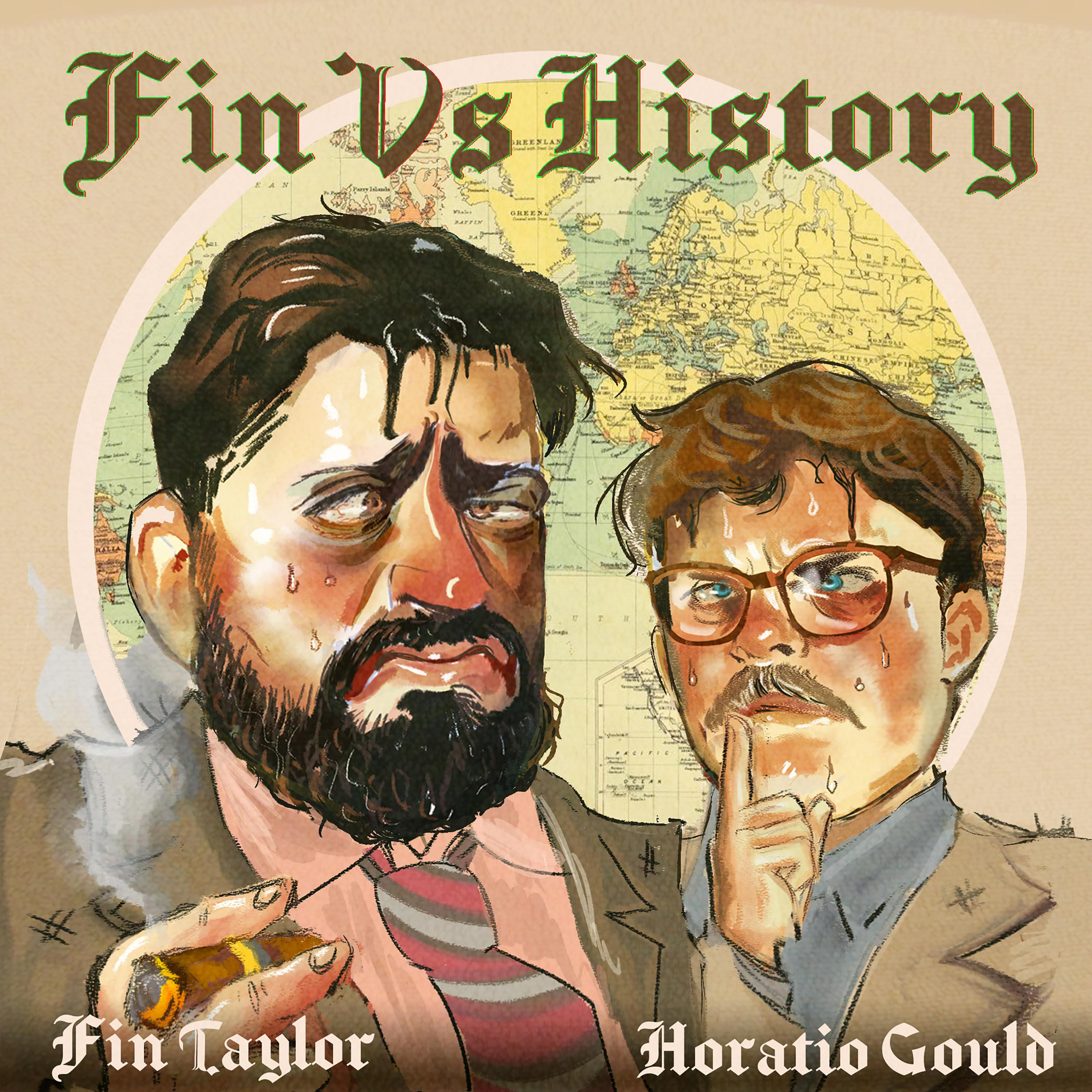
I Prefer El Alamein’s Early Stuff (with Pierre Novellie) | Monty vs Rommel (Part 3/4)
The Second Battle of El Alamein was the first defeat of German forces in all of WWII — and Britain won it without America, using autistic generals and ripped nerds who loved suffering.
Jul 6, 20261:01:39
Difficulty: Intermediate
Played
Fin vs History
I Prefer El Alamein’s Early Stuff (with Pierre Novellie) | Monty vs Rommel (Part 3/4)
The Second Battle of El Alamein was the first defeat of German forces in all of WWII — and Britain won it without America, using autistic generals and ripped nerds who loved suffering.
Jul 6, 20261:01:39
Difficulty: Intermediate
Played
TL;DR
Fin Taylor, Horatio Gould, and guest Pierre Novellie — a self-described autistic military history obsessive — power through Part 3 of their Monty vs. Rommel series, covering the Battle of Alam el-Halfa, the Second Battle of El Alamein, and Rommel's eventual retreat[1]— Pierre Novellie"Pierre Novellie, one of comedy's great military history obsessives, joins Fin and Horatio for Part 3 of Monty vs. Rommel. Within seconds he…"01:17. Pierre's encyclopaedic knowledge of North African logistics, tank names, and desert sand granularity adds gleeful depth to the comedy trio's analysis[2]— Fin Taylor"After the First Battle of El Alamein, Churchill purged North African leadership entirely. Gott's plane was shot down because the Germans th…"08:50. The key takeaway: El Alamein was the first defeat of German forces in WWII, and Churchill's line — "Before Alamein we never had a victory; after Alamein we never had a defeat" — still hits hard[3]— Fin Taylor"Before Alamein, we never had a victory. After Alamein, we never had a defeat."1:00:44.
#Second Battle of El Alamein#Desert War logistics#Operation Supercharge#Monty's leadership style#Enigma code intelligence#German military doctrine#Axis supply lines#British autism in WWII#Long Range Desert Group#Campaign for North Africa board game#El Alamein#Montgomery#Rommel#North Africa#WWII#desert warfare#Enigma#Eighth Army#autism#British Empire#logistics#Pierre Novellie#military history#comedy podcast
Part 3 of the Monty and Rommel miniseries, with guest Pierre Novellie joining Fin Taylor and Horatio Gould to cover the Battle of Alam el-Halfa, the Second Battle of El Alamein, and the first defeat of German forces in WWII.
Chapter list
After weeks of anticipation, Pierre Novellie finally joins the show. Fin introduces him as one of the greatest stand-ups of their generation and a 'card-carrying autist,' noting that when Pierre got his diagnosis, the reaction was simply 'ah, right, obvious.' Horatio reveals there used to be a game among friends of timing how long before Pierre brought up military history. Pierre immediately begins correcting everyone's board game knowledge, noting that the Campaign for North Africa board game requires sessions every two weeks — and that the Italian forces need extra water because they're constantly boiling pasta, which is technically accurate to the rules. The trio quickly fall into the comic groove that defines this episode: absurdist riffs grounded in genuine historical detail. Pierre's arrival is framed as a structural mirror of Montgomery's own arrival in North Africa — an autistic expert parachuted in to sort out the chaos.
Pierre explains that the game must be played twice a month to complete it in a manageable timeframe, and notes that the Italian forces require additional water resources because the rules account for pasta-cooking — a detail that delights the hosts. The prospect of finishing after 18 years only to see someone else complete it first is floated as a particular horror. The discussion naturally pivots to the theater's actual historical value: Pierre frames it as the war's best spin-off, a clean duel between a supervillain and a superhero, free from the overwhelming shadow of Normandy and D-Day. Fin adds that the inhabitable strip of North Africa is only a few hundred miles wide, making the entire campaign essentially a siege of logistics.[1]— Pierre Novellie"North Africa isn't D-Day — it's the spin-off where a supervillain and a superhero go head to head. Pierre argues it's the most compelling t…"07:35
On 13 August 1942, Montgomery assumed command of the Eighth Army and his first act was to order the burning of all pamphlets and instruction booklets explaining how to retreat in good order. Pierre identifies this as one of Monty's great skills — the kind of morale-boosting symbolic gesture that recalibrates an army's entire psychology. The analogy of 'getting Big Sam in to avoid relegation' is floated and approved. The hosts then play their recurring segment of placing the date relative to historical events: 13 August 1942 is confirmed to be after sliced bread (invented 1928) and before the miniskirt (1964). The group riffs that the window between those two events represents some kind of belle époque — technological progress with intact social conservatism — before the divorce laws of 1969 dissolved the family unit entirely.[1]— Pierre Novellie"On day one, Montgomery ordered every retreat pamphlet and withdrawal instruction manual burned. Pierre explains the genius of it: it's pure…"13:03
On 13 August 1942, Montgomery assumed command of the Eighth Army and his first act was to order the burning of all pamphlets and instruction booklets explaining how to retreat in good order. Pierre identifies this as one of Monty's great skills — the kind of morale-boosting symbolic gesture that recalibrates an army's entire psychology. The analogy of 'getting Big Sam in to avoid relegation' is floated and approved. The hosts then play their recurring segment of placing the date relative to historical events: 13 August 1942 is confirmed to be after sliced bread (invented 1928) and before the miniskirt (1964). The group riffs that the window between those two events represents some kind of belle époque — technological progress with intact social conservatism — before the divorce laws of 1969 dissolved the family unit entirely.[1]— Pierre Novellie"On day one, Montgomery ordered every retreat pamphlet and withdrawal instruction manual burned. Pierre explains the genius of it: it's pure…"13:03
Fin reads a vivid contemporary account of the desert conditions: fine sand infiltrating vehicles, weapons, food, and 'bodily orifices,' constant flies drawn to dead bodies and corned beef, scorpions, sandstorms that stopped fighting altogether. Horatio notes the Australians performed particularly well in this theater, probably because the conditions broadly resembled home. The discussion then turns to Monty's leadership philosophy: where Rommel was improvisational, speed-addicted, and led from the front, Monty wanted to know every variable before committing — a style compared to José Mourinho. Pierre identifies this as autistic in the most productive sense: a refusal to act under uncertainty, framed as planning every detail of a night out before agreeing to go. Fin notes that Monty also cared unusually deeply about preserving his men's lives — whether from empathy or because they were expensively trained resources is left open.[1]— Pierre Novellie"Montgomery's defining tactical principle was simple: never attack unless you are certain of victory. Pierre frames this as an autistic refu…"18:09
With his supply line stretching back to Tripoli and the SAS increasingly effective at disrupting it, Rommel attempts one final push before Allied reinforcements arrive. Pierre explains why resources were so stretched: Churchill's obsession with invading through Greece had drained Allied focus northward, while Italy's catastrophic military incompetence — culminating in 100,000 immediate POWs — meant the Germans also had to absorb the logistical burden of guarding and feeding Italian prisoners. The group examines a map of the battle and Pierre reads the military symbols: infantry squares, tank crosses, parachute icons. At Alam el-Halfa, Monty — knowing Rommel's plan via Enigma decrypts — left the southern approach empty and packed a ridge with dug-in tanks and anti-tank guns. Rommel's panzers ran out of fuel trying to force the position. It was the first time German armour hadn't simply bulldozed everything in its path.[1]— Pierre Novellie"Knowing via Enigma that Rommel would swing south, Montgomery left the open desert empty and packed the overlooking ridge with dug-in tanks …"25:35
With Alam el-Halfa secured, the group turns to the theatre of Montgomery's public image. Fin observes that WWII saw the birth of the military celebrity, and Monty was acutely brand-aware. Pierre explains that the black beret was the badge of armoured divisions — by wearing it, Monty was signalling to the tank crews 'he's one of ours,' which gave morale a significant boost. The SAS's beret history is also covered: they originally wore beige, which got them mocked as sissies when they returned to Cairo, fights broke out, so they eventually switched to the now-iconic red. The fly whisk Monty carried is distinguished from a fly swatter — it deters rather than kills. Horatio notes Patton's contrasting image management: pearl-handled revolvers and an always-on helmet that made him look, in Horatio's phrase, like 'a Deliveroo driver picking up McDonald's.'[1]— Pierre Novellie"Montgomery wore a black beret to signal solidarity with armoured divisions, carried a fly whisk for swagger, and was obsessively media-awar…"30:55
The group explores the German military's improvisation-based 'yes-and' doctrine — essentially Auftragstaktik — in contrast to Monty's methodical planning. Rommel, having operated on Pervitin (methamphetamine) for 18 months in 40-degree heat, retreats to Germany in September 1942, where Pierre imagines him doing jumping jacks in the Alps and drinking mineral water in a spa. Meanwhile, Alan Turing's cracking of the Enigma code is giving Monty total awareness — he knows when ships carrying Rommel's fuel are sailing, where each unit is positioned, even when Rommel is at a spa. Horatio frames Monty and Turing as 'Andy Cole and Dwight York,' two autistic geniuses forming an unbeatable partnership. The Second Battle of El Alamein opens on 23 October 1942 with a massive Allied bombardment. Hitler frantically summons Rommel back from his recovery.[1]— Pierre Novellie"The Germans had been reading Allied plans via the American ambassador in Cairo, whose cipher the Italians broke by rummaging through a desk…"23:35
With Monty launching Operation Lightfoot — infantry tiptoeing through minefields set to anti-tank pressure thresholds — the group tries to visualise the flat, flour-fine desert terrain and fails entertainingly. Pierre notes that what looks like a gentle slope is actually three metres higher than your position, which means you're dead. The Allied force is celebrated as genuinely multinational: Australians, Indians, Kiwis, South Africans, Greeks — all before any meaningful American involvement. Pierre praises the Long Range Desert Group as 'ripped nerds' who had pre-war master's degrees and charted the desert out of sheer enthusiasm, a quality that gave the Allies irreplaceable local knowledge. The episode's comedic highpoint arrives: Rommel's replacement, the overweight, hypertensive General Stümer, attempts to visit the front line in a Jeep, his driver's head is blown off by an anti-tank gun, Stümer falls out of the moving vehicle, and is found three days later in the desert — dead of a heart attack, no bullet wounds.[1]— Fin Taylor"Rommel's replacement, the portly, hypertensive General Stümer, tried to mimic Rommel's frontline style, drove into Allied fire, the driver'…"38:10
Rommel arrives back at the front on 25 October — having missed the opening chaos — but Stümer is already gone and the situation is critical. Fin describes the period from 26–31 October as 'barbaric': close-range artillery fire, men being squashed by tanks (evoking the famous scene from All Quiet on the Western Front), combat degenerating into fists, spades, and knives. The proximity to Cairo means Allied supplies flow freely, while Rommel's lines stretch back to Libya. Horatio drops the observation that Muammar Gaddafi was born in 1942 and is therefore approximately four months old during all of this, and the group confirms he is a Gemini ('makes sense'). Fin has been watching Tom Hanks' 20-part WWII documentary series on streaming, described as 'WWII for a more online generation,' and the group debates whether any new take on the war is possible. [1]
On 2 November 1942, Montgomery commits his reserves to Operation Supercharge, the decisive final phase of the Second Battle. A tank regiment — approximately 150 tanks — is told to punch straight through the Axis lines and to expect total casualties. They suffer 75% losses and lose 120 tanks, but the breach is made. A second armoured regiment follows through the gap. Rommel's forces begin to be encircled. The group's discussion of tank crew survival prospects ('often they just get out the back') lightens the grimness only slightly. Fin notes the broader arc: this is Mourinho's team against Pep's, but the pitch has been progressively shrunk until there is no room left to manoeuvre. The 'no chill-out room in the desert' quip becomes a summary of the entire theater of war.[1]— Fin Taylor"For Operation Supercharge, Montgomery told the tank regiment assigned to punch through the Axis line to expect 100% casualties. They suffer…"50:43
As Rommel's encirclement becomes clear, he contacts High Command for permission to withdraw. Hitler — distracted by Stalingrad and described as having 'a lot on, famously' — issues a direct order: no retreat, victory or death. The group discusses Hitler's strategic decision-making pathology: his pattern of gambling on if-then scenarios (if we win Stalingrad, the Soviet Union collapses, and the Western powers come to terms) that became increasingly detached from reality. Pierre notes the Germans were still holding out hope that Britain might negotiate, even as late as November 1942. Fin steers toward the broader claim that El Alamein is the war's true turning point — Stalingrad's a sideshow — and the Nazi pattern of doubling down on lost positions begins here. [1]
As Rommel's encirclement becomes clear, he contacts High Command for permission to withdraw. Hitler — distracted by Stalingrad and described as having 'a lot on, famously' — issues a direct order: no retreat, victory or death. The group discusses Hitler's strategic decision-making pathology: his pattern of gambling on if-then scenarios (if we win Stalingrad, the Soviet Union collapses, and the Western powers come to terms) that became increasingly detached from reality. Pierre notes the Germans were still holding out hope that Britain might negotiate, even as late as November 1942. Fin steers toward the broader claim that El Alamein is the war's true turning point — Stalingrad's a sideshow — and the Nazi pattern of doubling down on lost positions begins here. [1]
Operation Supercharge
Montgomery's final decisive offensive at the Second Battle of El Alamein in November 1942, designed to punch through the Axis lines and encircle Rommel's forces.
Operation Lightfoot
The opening phase of the Second Battle of El Alamein in which Allied infantry crossed minefields on foot, exploiting the fact that mines were set to anti-tank pressure thresholds.
Alam el-Halfa
A ridge south of El Alamein where Montgomery set a defensive trap for Rommel's last major offensive in August–September 1942; widely seen as Monty's first victory.
Enigma / Ultra
The German military cipher machine (Enigma) and the Allied intelligence operation (Ultra) that decoded its messages, giving the Allies significant foreknowledge of Axis plans.
Pervitin
A methamphetamine-based stimulant widely issued to German soldiers and officers during WWII; referenced in the episode as what Rommel was taking during the desert campaign.
Long Range Desert Group (LRDG)
A British special forces unit that operated behind Axis lines in North Africa, formed partly from pre-war desert explorers and surveyors who had charted the terrain before the war.
Qattara Depression
A vast, inhospitable salt flat in Egypt that formed the southern boundary of the El Alamein defensive line, making a full flanking manoeuvre extremely difficult.
Auftragstaktik
The German military doctrine of decentralised, initiative-based command — described in the episode as a 'yes-and' approach to battlefield decision-making.
SAS (Special Air Service)
British special forces unit formed during the North African campaign, initially renowned for raiding Rommel's supply lines and airfields behind enemy lines.
Matilda / Valentine
British infantry tanks used in the early North African campaign, considered inferior to German armour and later supplemented by American-supplied Sherman tanks.
Sherman tank
American-designed medium tank supplied to Allied forces; praised for its modular, easily repaired construction even if not individually superior to German counterparts.
attritional
Relating to a strategy of gradually wearing down an opponent through sustained pressure and resource depletion, rather than a single decisive blow.
Cairo Purge
Churchill's wholesale removal and restructuring of British desert command leadership in mid-1942, which ultimately led to Montgomery's appointment.
Storch
A small German liaison and reconnaissance aircraft (Fieseler Fi 156 Storch) used by Rommel for aerial observation of the battlefield.
Barbarossa
Germany's massive invasion of the Soviet Union launched in June 1941; its delay — partly blamed on Italian failures in Greece — is argued to have been decisive in Germany's eventual defeat in the East.
post-nut clarity
Colloquial term for the sudden shift in perspective after achieving a long-sought goal; used humorously in the episode about the feeling upon finishing the 20-year board game.
fly whisk
A long-handled switch used to deter flies; Montgomery carried one in the desert as part of his distinctive personal image, distinct from a fly swatter (which kills rather than deters).
aura farm
Internet slang meaning to deliberately cultivate an impressive or intimidating personal mystique; used in the episode to describe Montgomery's deliberate image management.
Chapter 1 · 00:00
Rude But Correct
After weeks of anticipation, Pierre Novellie finally joins the show. Fin introduces him as one of the greatest stand-ups of their generation and a 'card-carrying autist,' noting that when Pierre got his diagnosis, the reaction was simply 'ah, right, obvious.' Horatio reveals there used to be a game among friends of timing how long before Pierre brought up military history. Pierre immediately begins correcting everyone's board game knowledge, noting that the Campaign for North Africa board game requires sessions every two weeks — and that the Italian forces need extra water because they're constantly boiling pasta, which is technically accurate to the rules. The trio quickly fall into the comic groove that defines this episode: absurdist riffs grounded in genuine historical detail. Pierre's arrival is framed as a structural mirror of Montgomery's own arrival in North Africa — an autistic expert parachuted in to sort out the chaos.
Pierre Novellie, one of comedy's great military history obsessives, joins Fin and Horatio for Part 3 of Monty vs. Rommel. Within seconds he's correcting their board game logistics and establishing that he knows North African WWII better than almost anyone — except perhaps Al Murray.
The Campaign for North Africa board game takes roughly 20 years to complete at a reasonable pace, and no one has ever actually finished it. Pierre already knows the Italian forces need extra water for pasta, which is technically accurate to the rules.
The board game 'Campaign for North Africa' is so detailed it reportedly takes approximately 20 years to complete, and no one is known to have ever finished it.
Pierre explains that the game must be played twice a month to complete it in a manageable timeframe, and notes that the Italian forces require additional water resources because the rules account for pasta-cooking — a detail that delights the hosts. The prospect of finishing after 18 years only to see someone else complete it first is floated as a particular horror. The discussion naturally pivots to the theater's actual historical value: Pierre frames it as the war's best spin-off, a clean duel between a supervillain and a superhero, free from the overwhelming shadow of Normandy and D-Day. Fin adds that the inhabitable strip of North Africa is only a few hundred miles wide, making the entire campaign essentially a siege of logistics.[1]— Pierre Novellie"North Africa isn't D-Day — it's the spin-off where a supervillain and a superhero go head to head. Pierre argues it's the most compelling t…"07:35
North Africa isn't D-Day — it's the spin-off where a supervillain and a superhero go head to head. Pierre argues it's the most compelling theater precisely because it's clean: two exceptional commanders, pure logistics, almost no war crimes.
The port of Tobruk changed hands three times over the course of the North African campaign, exemplifying the grinding, back-and-forth nature of desert warfare.
After the First Battle of El Alamein, Churchill purged North African leadership entirely. Gott's plane was shot down because the Germans thought Churchill was on it — and that accident handed command to Montgomery. Sometimes history is just farce.
After the First Battle of El Alamein, Churchill ordered a complete overhaul of Allied desert leadership, leading to Montgomery's appointment.
Chapter 3 · 12:40
Sliced Bread
On 13 August 1942, Montgomery assumed command of the Eighth Army and his first act was to order the burning of all pamphlets and instruction booklets explaining how to retreat in good order. Pierre identifies this as one of Monty's great skills — the kind of morale-boosting symbolic gesture that recalibrates an army's entire psychology. The analogy of 'getting Big Sam in to avoid relegation' is floated and approved. The hosts then play their recurring segment of placing the date relative to historical events: 13 August 1942 is confirmed to be after sliced bread (invented 1928) and before the miniskirt (1964). The group riffs that the window between those two events represents some kind of belle époque — technological progress with intact social conservatism — before the divorce laws of 1969 dissolved the family unit entirely.[1]— Pierre Novellie"On day one, Montgomery ordered every retreat pamphlet and withdrawal instruction manual burned. Pierre explains the genius of it: it's pure…"13:03
On day one, Montgomery ordered every retreat pamphlet and withdrawal instruction manual burned. Pierre explains the genius of it: it's pure morale. Bringing in a ferociously rude man obsessed with fitness is exactly the reset a broken army needs.
Montgomery took command of the Eighth Army on 13 August 1942 and immediately ordered a no-withdrawal policy, burning all retreat pamphlets.
Chapter 4 · 13:30
The British Experience
On 13 August 1942, Montgomery assumed command of the Eighth Army and his first act was to order the burning of all pamphlets and instruction booklets explaining how to retreat in good order. Pierre identifies this as one of Monty's great skills — the kind of morale-boosting symbolic gesture that recalibrates an army's entire psychology. The analogy of 'getting Big Sam in to avoid relegation' is floated and approved. The hosts then play their recurring segment of placing the date relative to historical events: 13 August 1942 is confirmed to be after sliced bread (invented 1928) and before the miniskirt (1964). The group riffs that the window between those two events represents some kind of belle époque — technological progress with intact social conservatism — before the divorce laws of 1969 dissolved the family unit entirely.[1]— Pierre Novellie"On day one, Montgomery ordered every retreat pamphlet and withdrawal instruction manual burned. Pierre explains the genius of it: it's pure…"13:03
Sliced bread was invented in 1928, meaning Monty's arrival in North Africa came 14 years after what is proverbially 'the best thing since sliced bread'.
Chapter 5 · 16:51
Farting In A Lift
Fin reads a vivid contemporary account of the desert conditions: fine sand infiltrating vehicles, weapons, food, and 'bodily orifices,' constant flies drawn to dead bodies and corned beef, scorpions, sandstorms that stopped fighting altogether. Horatio notes the Australians performed particularly well in this theater, probably because the conditions broadly resembled home. The discussion then turns to Monty's leadership philosophy: where Rommel was improvisational, speed-addicted, and led from the front, Monty wanted to know every variable before committing — a style compared to José Mourinho. Pierre identifies this as autistic in the most productive sense: a refusal to act under uncertainty, framed as planning every detail of a night out before agreeing to go. Fin notes that Monty also cared unusually deeply about preserving his men's lives — whether from empathy or because they were expensively trained resources is left open.[1]— Pierre Novellie"Montgomery's defining tactical principle was simple: never attack unless you are certain of victory. Pierre frames this as an autistic refu…"18:09
Montgomery's defining tactical principle was simple: never attack unless you are certain of victory. Pierre frames this as an autistic refusal to tolerate social ambiguity — the same instinct that makes autistic people plan every detail of a night out applied to total war.
With his supply line stretching back to Tripoli and the SAS increasingly effective at disrupting it, Rommel attempts one final push before Allied reinforcements arrive. Pierre explains why resources were so stretched: Churchill's obsession with invading through Greece had drained Allied focus northward, while Italy's catastrophic military incompetence — culminating in 100,000 immediate POWs — meant the Germans also had to absorb the logistical burden of guarding and feeding Italian prisoners. The group examines a map of the battle and Pierre reads the military symbols: infantry squares, tank crosses, parachute icons. At Alam el-Halfa, Monty — knowing Rommel's plan via Enigma decrypts — left the southern approach empty and packed a ridge with dug-in tanks and anti-tank guns. Rommel's panzers ran out of fuel trying to force the position. It was the first time German armour hadn't simply bulldozed everything in its path.[1]— Pierre Novellie"Knowing via Enigma that Rommel would swing south, Montgomery left the open desert empty and packed the overlooking ridge with dug-in tanks …"25:35
Italy's military failures forced Germany to intervene in Greece, delaying Operation Barbarossa by six weeks — a delay that is argued to have been decisive in Germany's failure in the East.
The Germans had been reading Allied plans via the American ambassador in Cairo, whose cipher the Italians broke by rummaging through a desk in the Rome embassy. Once that was plugged, the Enigma decrypts gave Monty total visibility — including when Rommel was at a spa.
The Germans had been receiving Allied intelligence via the American ambassador in Cairo, whose codes the Italians had broken by finding a codebook in the Rome embassy.
Knowing via Enigma that Rommel would swing south, Montgomery left the open desert empty and packed the overlooking ridge with dug-in tanks and anti-tank guns. Rommel ran out of fuel, couldn't force the position, and had to pull back — the first time German armour hadn't steamrolled everything.
25:35
29:55
Chapter 7 · 25:54
The Gay Beret
With Alam el-Halfa secured, the group turns to the theatre of Montgomery's public image. Fin observes that WWII saw the birth of the military celebrity, and Monty was acutely brand-aware. Pierre explains that the black beret was the badge of armoured divisions — by wearing it, Monty was signalling to the tank crews 'he's one of ours,' which gave morale a significant boost. The SAS's beret history is also covered: they originally wore beige, which got them mocked as sissies when they returned to Cairo, fights broke out, so they eventually switched to the now-iconic red. The fly whisk Monty carried is distinguished from a fly swatter — it deters rather than kills. Horatio notes Patton's contrasting image management: pearl-handled revolvers and an always-on helmet that made him look, in Horatio's phrase, like 'a Deliveroo driver picking up McDonald's.'[1]— Pierre Novellie"Montgomery wore a black beret to signal solidarity with armoured divisions, carried a fly whisk for swagger, and was obsessively media-awar…"30:55
The group explores the German military's improvisation-based 'yes-and' doctrine — essentially Auftragstaktik — in contrast to Monty's methodical planning. Rommel, having operated on Pervitin (methamphetamine) for 18 months in 40-degree heat, retreats to Germany in September 1942, where Pierre imagines him doing jumping jacks in the Alps and drinking mineral water in a spa. Meanwhile, Alan Turing's cracking of the Enigma code is giving Monty total awareness — he knows when ships carrying Rommel's fuel are sailing, where each unit is positioned, even when Rommel is at a spa. Horatio frames Monty and Turing as 'Andy Cole and Dwight York,' two autistic geniuses forming an unbeatable partnership. The Second Battle of El Alamein opens on 23 October 1942 with a massive Allied bombardment. Hitler frantically summons Rommel back from his recovery.[1]— Pierre Novellie"The Germans had been reading Allied plans via the American ambassador in Cairo, whose cipher the Italians broke by rummaging through a desk…"23:35
Montgomery wore a black beret to signal solidarity with armoured divisions, carried a fly whisk for swagger, and was obsessively media-aware. Pierre calls him an influencer — someone who understood that aura is a force multiplier.
With Monty launching Operation Lightfoot — infantry tiptoeing through minefields set to anti-tank pressure thresholds — the group tries to visualise the flat, flour-fine desert terrain and fails entertainingly. Pierre notes that what looks like a gentle slope is actually three metres higher than your position, which means you're dead. The Allied force is celebrated as genuinely multinational: Australians, Indians, Kiwis, South Africans, Greeks — all before any meaningful American involvement. Pierre praises the Long Range Desert Group as 'ripped nerds' who had pre-war master's degrees and charted the desert out of sheer enthusiasm, a quality that gave the Allies irreplaceable local knowledge. The episode's comedic highpoint arrives: Rommel's replacement, the overweight, hypertensive General Stümer, attempts to visit the front line in a Jeep, his driver's head is blown off by an anti-tank gun, Stümer falls out of the moving vehicle, and is found three days later in the desert — dead of a heart attack, no bullet wounds.[1]— Fin Taylor"Rommel's replacement, the portly, hypertensive General Stümer, tried to mimic Rommel's frontline style, drove into Allied fire, the driver'…"38:10
Rommel was reportedly using Pervitin (methamphetamine) throughout the North African campaign — approximately 18 months — before returning to Germany in September 1942.
Rommel's replacement, the portly, hypertensive General Stümer, tried to mimic Rommel's frontline style, drove into Allied fire, the driver's head exploded, Stümer fell off the car, was found three days later in the desert — dead of a heart attack, no bullet wounds.
Rommel's replacement, General Georg Stümer, fell out of a Jeep under fire, was found three days later in the desert, and had died of a stress-induced heart attack with no bullet wounds.
Chapter 10 · 41:08
He's A Gemini
Rommel arrives back at the front on 25 October — having missed the opening chaos — but Stümer is already gone and the situation is critical. Fin describes the period from 26–31 October as 'barbaric': close-range artillery fire, men being squashed by tanks (evoking the famous scene from All Quiet on the Western Front), combat degenerating into fists, spades, and knives. The proximity to Cairo means Allied supplies flow freely, while Rommel's lines stretch back to Libya. Horatio drops the observation that Muammar Gaddafi was born in 1942 and is therefore approximately four months old during all of this, and the group confirms he is a Gemini ('makes sense'). Fin has been watching Tom Hanks' 20-part WWII documentary series on streaming, described as 'WWII for a more online generation,' and the group debates whether any new take on the war is possible. [1]
North Africa was won by the British Empire's genuinely multinational force — Australians, Indians, New Zealanders, South Africans, Greeks — before American forces had any meaningful involvement. Fin calls it the last great hurrah of empire.
The Long Range Desert Group were there before the war charting the desert. Pierre says they're the same personality type as today's rock climbers — people with master's degrees and a master's appetite for suffering. That scholarly obsession turned out to be a decisive Allied advantage.
On 2 November 1942, Montgomery commits his reserves to Operation Supercharge, the decisive final phase of the Second Battle. A tank regiment — approximately 150 tanks — is told to punch straight through the Axis lines and to expect total casualties. They suffer 75% losses and lose 120 tanks, but the breach is made. A second armoured regiment follows through the gap. Rommel's forces begin to be encircled. The group's discussion of tank crew survival prospects ('often they just get out the back') lightens the grimness only slightly. Fin notes the broader arc: this is Mourinho's team against Pep's, but the pitch has been progressively shrunk until there is no room left to manoeuvre. The 'no chill-out room in the desert' quip becomes a summary of the entire theater of war.[1]— Fin Taylor"For Operation Supercharge, Montgomery told the tank regiment assigned to punch through the Axis line to expect 100% casualties. They suffer…"50:43
Muammar Gaddafi was born in 1942, meaning he was approximately four months old during the Second Battle of El Alamein — and the hosts confirmed he was a Gemini.
For Operation Supercharge, Montgomery told the tank regiment assigned to punch through the Axis line to expect 100% casualties. They suffered 75% and lost 120 tanks. It worked — the breach encircled Rommel and forced his retreat.
Monty warned the tank regiment tasked with breaking the Axis line to expect 100% casualties; they ultimately suffered 75% casualties, losing 120 tanks.
Chapter 13 · 52:52
Just Ignore Him
As Rommel's encirclement becomes clear, he contacts High Command for permission to withdraw. Hitler — distracted by Stalingrad and described as having 'a lot on, famously' — issues a direct order: no retreat, victory or death. The group discusses Hitler's strategic decision-making pathology: his pattern of gambling on if-then scenarios (if we win Stalingrad, the Soviet Union collapses, and the Western powers come to terms) that became increasingly detached from reality. Pierre notes the Germans were still holding out hope that Britain might negotiate, even as late as November 1942. Fin steers toward the broader claim that El Alamein is the war's true turning point — Stalingrad's a sideshow — and the Nazi pattern of doubling down on lost positions begins here. [1]
The North African theater is considered the only major theater of WWII with essentially no war crimes committed, described by the hosts as the most gentlemanly campaign.
With his lines breached and his forces encircled, Rommel contacted Hitler who ordered no retreat. Rommel ignored the direct order, saved his mobile forces, and began withdrawing westward to Libya — handing the Allies the first defeat of German arms in WWII.
The Second Battle of El Alamein marked the first time German forces were defeated in World War II, a turning point Churchill immortalised with a famous quote.
Montgomery lived until 1976, meaning the WWII general survived into Harold Wilson's second term and the Callaghan government — far outlasting his wartime contemporaries.
Montgomery's defining tactical principle was simple: never attack unless you are certain of victory. Pierre frames this as an autistic refusal to tolerate social ambiguity — the same instinct that makes autistic people plan every detail of a night out applied to total war.
Rommel's replacement, the portly, hypertensive General Stümer, tried to mimic Rommel's frontline style, drove into Allied fire, the driver's head exploded, Stümer fell off the car, was found three days later in the desert — dead of a heart attack, no bullet wounds.
Factual claims made this episode, and whether a source was named.
⚠
The Second Battle of El Alamein was the first defeat of German forces in World War II.
Fin Taylorno source cited
⚠
The Campaign for North Africa board game takes approximately 20 years to complete and has reportedly never been finished by any group.
Fin Taylorno source cited
⚠
Italy's military failures in Greece forced Germany to intervene, delaying Operation Barbarossa by six weeks — a delay argued to have been critical to Germany's eventual defeat in the East.
Fin Taylorno source cited
⚠
Montgomery ordered all retreat pamphlets and withdrawal instruction booklets burned on assuming command of the Eighth Army.
Pierre Novellieno source cited
⚠
The Italians broke the American ambassador's cipher by finding the codebook in a desk at the Rome embassy, allowing the Germans to read Allied communications from Cairo.
Pierre Novellieno source cited
⚠
General Georg Stümer died of a heart attack in the desert during the Second Battle of El Alamein with no bullet wounds or injuries — caused by the stress of falling from a Jeep under fire.
Fin Taylorno source cited
⚠
During Operation Supercharge, the Allied tank regiment tasked with breaching the Axis line suffered 75% casualties and lost 120 tanks.
Fin Taylorno source cited
⚠
Rommel habitually rode in the front lines in an armoured car and sometimes flew aerial reconnaissance personally in a Storch aircraft.
Pierre Novellieno source cited
⚠
The North African theater of World War II is considered to have been conducted with essentially no war crimes by either side.
Fin Taylorno source cited
⚠
Montgomery lived until 1976, surviving into Harold Wilson's second government and the Callaghan era.
Horatio Gouldno source cited
⚠
Tobruk changed hands three times over the course of the North African campaign.
Fin Taylorno source cited
⚠
Sliced bread was first commercially produced in 1928.
Horatio Gouldno source cited
This episode
Cast
German field marshal commanding Axis forces in North Africa; portrayed as an improvisational genius undone by supply failures, Hitler's orders, and Monty's counter-strategy.
British general who took command of the Eighth Army in August 1942 and defeated Rommel at El Alamein; discussed throughout as an autism-coded morale genius.
Discussed as issuing a 'victory or death' order to Rommel at El Alamein and as a distracted, micromanaging leader simultaneously dealing with Stalingrad.
British Prime Minister who initiated the Cairo Purge, installed Montgomery, and immortalised El Alamein with his 'never had a victory' quote.
Overweight, hypertensive German general who replaced Rommel, fell out of a Jeep under fire, and died of a heart attack in the desert with no bullet wounds.
Credited with cracking the Enigma code, described as another 'British autism' success story analogous to Montgomery in genius.
Noted to have been four months old during the Second Battle of El Alamein; the hosts find it funny he was a Gemini.
British Commonwealth desert force commanded by Montgomery from August 1942, which defeated Rommel at El Alamein.
Discussed as a force that evolved to effectively disrupt Rommel's supply lines during the North African campaign.
British special forces unit that had charted the North African desert before the war, providing crucial intelligence and behind-lines disruption.
Legendarily complex board game that takes approximately 20 years to complete and has reportedly never been finished; a recurring comic touchstone in the episode.
Egyptian site of two pivotal WWII battles; the Second Battle in October–November 1942 is the central subject of this episode.
Island base crucial to Allied air and supply operations in the Mediterranean; discussed as a key asset Germany failed to neutralise.
Libyan port city that changed hands three times during the North African campaign, exemplifying the attritional back-and-forth of desert warfare.