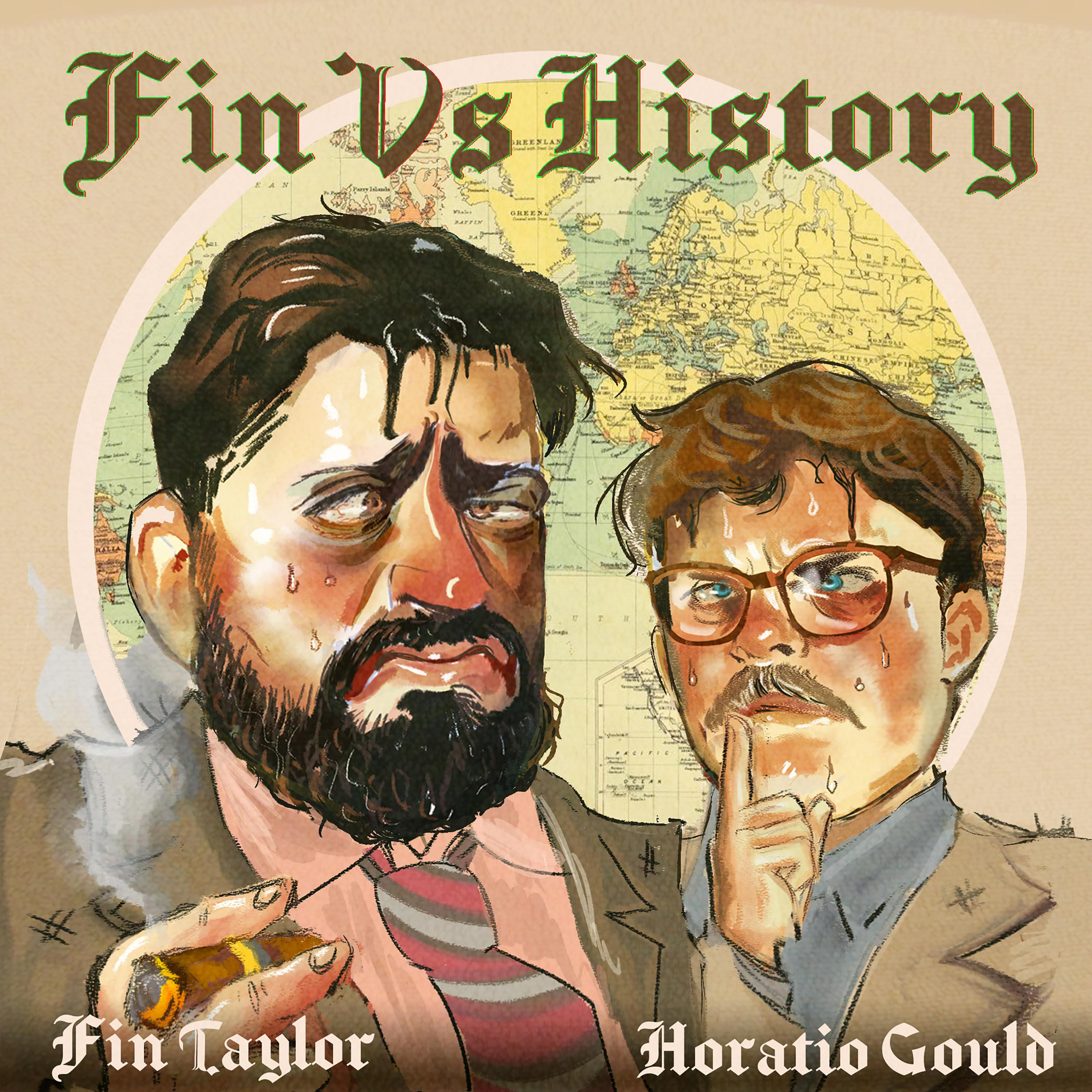
Nazis Are No Match For Knobbly Knees | Monty vs Rommel (Part 1/4)
The North African desert campaign is the only theatre of World War II where Britain beats the Nazis without American help — and it was won by a man who went to bed at 9:30pm and didn't drink.
Fin vs History
Nazis Are No Match For Knobbly Knees | Monty vs Rommel (Part 1/4)
The North African desert campaign is the only theatre of World War II where Britain beats the Nazis without American help — and it was won by a man who went to bed at 9:30pm and didn't drink.
TL;DR
Fin Taylor and Horatio Gould kick off a four-part series on Bernard Montgomery and Erwin Rommel, tracing both commanders from birth through their World War I experiences and the interwar years, up to Italy's catastrophic entry into North Africa in September 1940 [1] — Fin Taylor "The North African Desert campaign is the only part of World War II where Britain beats the enemy without American help. The Americans arriv…" 04:55 . Monty is painted as an autistic, teetotal, knees-out Presbyterian drilled to perfection; Rommel as an ADHD improviser who perfected Blitzkrieg tactics and moonlighted as Hitler's personal escort [2] — Fin Taylor "At Meteren in October 1914, Monty was shot in the right lung. British forces thought he was dead. A comrade then lay on top of him for hour…" 30:00 . The key takeaway: the North African desert campaign is the only theater where Britain wins without American help [3] — Fin Taylor "Britain's only WWII win without Americans: The North African desert campaign is the only theatre of World War II where Britain defeats the …" 05:00 .
Part 1 of a 4-part series on Bernard Montgomery and Erwin Rommel, covering their early lives, WWI experiences, and the lead-up to the North African Desert War. Comedic history in shorts.
-
Fin Taylor opens by greeting his co-host Horatio Gould, who immediately complains of being 'tan-mogged' — Fin has just returned from Tenerife and is sporting a formidable tan against Horatio's famously pallid complexion. The pair spend several minutes debating the aesthetic hierarchy of knees, the historical beauty standards that would favour Fin's muscular thighs, and whether Horatio's notably large head would survive being crushed between them. It's chaotic, puerile, and precisely calibrated to the show's audience. The Patreon and guest Pierre Novelli are teased, and the knee/shorts motif that will run through the entire series is established as both comedy and genuine historical comment on British military identity.
-
With the banter out of the way, Fin makes his first serious historiographical claim: the North African desert is the high point of 'Big Shorts' culture and the only part of WWII where Britain beats the Nazis without American assistance. Horatio notes this is probably why the rest of the world ignores it — the Americans arrive in 1943 and immediately make Monty's achievements seem irrelevant, while the Russians are busy doing the actual decisive fighting. The hosts agree the campaign is fascinating precisely because it's a gentleman's war: no Einsatzgruppen, no Holocaust, just a pure tactical ding-dong across a desert pitch. The football analogy arrives naturally — creating overloads, going in behind, beating the offside trap — and the debate settles on Cruyff versus Mourinho as the closest parallel to Monty's methodical style versus Rommel's free-wheeling genius.
-
Born in 1887 — after the first kipper was created in 1843, before Jack the Ripper — Bernard Montgomery enters the world as the fourth of nine children. Producer Charlie's research contributions become a running feature here, including a story about a 112-year-old Somali man marrying a 17-year-old, which the hosts compare approvingly to Monty's father Henry proposing to 13-year-old Maud (she was 11 when they met, 14 when he proposed). The family moves to Tasmania when Henry becomes Bishop, and Maud beats the children to prevent them acquiring Australian accents — which Fin defends as reasonable parenting. Back in London at 13 and nicknamed 'Monkey', Monty tattoos both forearms in a failed bid to fit in socially, later hiding them in shame. The picture that emerges is of a deeply unusual, intensely driven young man ill-suited to conventional Edwardian social life.
-
Surfshark's sponsorship is introduced as a running joke about the hosts not knowing what a VPN actually does. Horatio vouches for genuinely using it to tell websites he is still in Britain while on holiday. Fin's dream use case is scrambling his wife's Find My Friends to make her think he's not hiding in the shed. The hosts riff through increasingly absurd expansions of the 'VPN' acronym — 'Vagina Pussy Network', 'Very Pooey Nigel' — before directing listeners to surfshark.com/fvh for four extra months with code FVH. The segment is silly but affectionate; Surfshark is described as 'our most loyal sponsor'.
-
The key distinction Fin draws here is that both Monty and Rommel were career soldiers before either world war began — a tiny minority compared to the conscripted masses. For Monty, World War I was simply the job he'd trained for. He was already in India at Peshawar in 1908, marvelling at Peshawari naan. Historians now believe he almost certainly had Asperger's syndrome, which meant that even in the ultra-formal Edwardian Army, he stood out as socially inept: he didn't drink, didn't share banter, and kept it all to himself. In a desperate bid to fit in, he had both forearms tattooed, then spent the rest of his life hiding them. The portrait is of a man for whom the Army was not a career choice but a psychological necessity — the only structure that could contain and channel his ferocious, oddball intelligence.
-
Erwin Rommel arrives on the scene in 1891, two years after Hitler, in the newly unified German nation. Where Monty is autistic and methodical, Rommel is the avatar of ADHD: impulsive, physical, barely able to let anyone finish a sentence. At 18 he's accepted into the 124th Württemberg Infantry Regiment — the WASP equivalent of a bar mitzvah. Fin explains the German military philosophy of Auftragstaktik: where the British relied on regimented chain of command to manage a sprawling empire, the Germans (newer country, no colonial legacy) gave individual commanders freedom to exploit chaos. Rommel was its purest expression. In 1911, he falls in love with Lucy Mollin, but a digression about German women not shaving in the 1910s leads to a surprisingly coherent thesis: the 1970s was the height of the bush, the '80s were the overcorrection, and all of it is reactionary. The hosts move swiftly on.
-
While ostensibly engaged to Lucy Mollin, Rommel begins an affair with Walburga Stemmer (immediately rechristened 'Val Burger' by the hosts) and fathers a daughter named Gertrude. He then returns to Lucy, marries her, and Val Burger dies young — which the hosts attribute largely to the indignity of being called Val Burger. The researcher's script typo — 'shot in the lung' rendered as something else — triggers the episode's longest and most anarchic tangent: a detailed discussion of a personal injury case involving a ferromagnetic butt plug, an MRI machine, and injuries sustained at the speed of sound. Producer Charlie produces the receipts. The hosts conclude, reasonably, that anyone wearing a butt plug to an MRI deserves whatever happens. The actual historical fact — that Montgomery was shot in the right lung at Meteren in October 1914 — is eventually confirmed.
-
The mid-roll ad break features a clinical Botox advertisement for chronic migraine prevention (defined as 15 or more headache days per month), followed by Ryan Reynolds for Mint Mobile advertising unlimited premium wireless at $15 per month. Both are standard paid placements with no content connection to the episode.
-
Monty recovers from his lung wound only to rejoin in time for the Somme — which Fin notes is the darkest possible FOMO. Serving as a courier between front-line troops and distant generals, Monty observes firsthand that the class-bound British command structure is catastrophically inefficient: generals are nowhere near the action. This shapes his entire subsequent philosophy. The hosts reflect that WWI heroes were generally just men who got lucky — who 'slipped at the right time'. Fin's great-grandfather appears briefly, having been shell-shocked at Gallipoli, recovered, returned for the Somme, and survived to face Ypres. By 1940, Monty's organisation and preparation earn him praise when he fights a disciplined rearguard action near Dunkirk, possibly the only part of the British Expeditionary Force to acquit itself with any honour.
-
Rommel fights in the 27th Division across France, Romania, and the Italian front — a theatre the hosts note is rarely discussed. Romania's comic war strategy (join at the last minute, declare war on Austria-Hungary again the day before the armistice to claim Transylvania at Versailles) provides a memorable counterpoint to Rommel's serious tactical development. At Caporetto in October 1917, he captures 81 guns and 9,000 Italian prisoners — establishing the running joke about how easy it is to take Italians prisoner, and the logistical nightmare of feeding and processing them. In the 1930s he writes Infantry Attacks, his tactical Bible. By 1940, his closeness to Hitler — he commands the Führer's personal escort battalion — sees him leapfrog older Prussian generals to command the 7th Panzers. Fin and Horatio briefly debate whether Rommel was truly a Nazi (Fin says he was; Horatio notes the conservative anti-Hitler Prussian tradition that will ultimately contribute to Rommel's downfall in Part 4).
-
Charlie interrupts the invasion of France narrative to ask a genuinely interesting question: would the pigs in the Ardennes forest have understood that a war was happening around them? The hosts spiral into imagining a young pig who has only ever known war, and an older pig born in 1910 who has seen the Killing Fields of Flanders and the Battle of the Bulge. Producer Charlie reports that the oldest pig ever recorded was named Baby Jane, who lived to 23 and died in September 2021, meaning she was alive for 9/11. This triggers an extended imagining of Baby Jane whispering in George Bush's ear at the Florida school, and Bush wondering why his chief of staff is a pig. It is, the hosts agree, the nub of the story.
-
Fin lays out the strategic map: Britain controls Egypt and the Suez Canal, France controls Morocco, Algeria and Tunisia, and Italy — having grabbed Libya — declares war on Britain and France on June 10, 1940, convinced the conflict is nearly over. Mussolini's grand strategy, Fin reveals, essentially consists of imagining himself riding bareback on a white horse into Cairo like Napoleon, and working backwards from there. The Italian military has no motorised units worth mentioning, no plan, and — Horatio adds — no interest in digging latrines, leading to epidemic dysentery. These are not Romans. The decline from Caesar to Mussolini over 2,000 years is, the hosts agree, staggering. On September 13, 1940, at the height of the London Blitz, Italy crosses the Libyan border into Egypt. The Desert War begins. Fin teases Part 2: Rommel's arrival in theatre, the First Battle of El Alamein, Blitzkrieg in the desert, and meth. The series Patreon has just hit 40,000 subscribers — a fact the hosts find almost embarrassingly successful.
- Blitzkrieg
- German for 'lightning war'; a fast-moving military tactic combining armour, motorised infantry and air support to overwhelm enemies before they can react. Rommel was its greatest practitioner.
- Auftragstaktik
- German military doctrine giving individual commanders freedom to exploit opportunities on the ground without waiting for orders from above — the philosophical root of Rommel's improvisational style.
- Einsatzgruppen
- Nazi paramilitary death squads responsible for mass executions, primarily of Jews and other groups, on the Eastern Front. Their absence in North Africa is cited as evidence of the campaign's relative 'gentlemanliness'.
- BEF
- British Expeditionary Force — the professional British army deployed to France at the start of World War II in 1939.
- Panzer Division
- A German armoured division centred on tanks (Panzers), the main strike force behind Blitzkrieg warfare.
- Pervitin
- A methamphetamine tablet widely issued to German soldiers in WWII to allow them to fight without sleep; referenced as Rommel's troops' secret weapon during the invasion of France.
- Alpenkorps
- Elite German mountain troops; Rommel served with them in the Italian/Romanian theatre of WWI, developing his early mobile warfare tactics.
- Treaty of Versailles
- The 1919 peace settlement after WWI that stripped Germany of its colonies, imposed reparations, and is often cited as a cause of Hitler's rise.
- Gegenpress
- A high-intensity football pressing tactic popularised by Jürgen Klopp; used here as an analogy for Rommel's aggressive, chaotic, forward-moving warfare style.
- Asperger's syndrome
- A form of autism spectrum disorder characterised by difficulties with social interaction and a preference for routine; historians believe Montgomery almost certainly had it.
- rearguard action
- A military manoeuvre where troops cover the retreat of a larger force, delaying the enemy; Monty's rearguard near Dunkirk is cited as saving many British lives.
- tan-mogged
- Portmanteau of 'tan' and 'mogged' (from 'mog', internet slang for being outclassed); used here to mean being humiliated by someone with a better tan.
- Gegenpress
- Jürgen Klopp's high-energy counter-pressing football tactic; used in the episode as a metaphor for Rommel's aggressive, space-exploiting battlefield style.
- Infantry Attacks
- Rommel's tactical manual written in the 1930s, documenting his WWI experiences and laying out his signature improvisational combat methods; it became a military bestseller.
- Auftragstaktik
- German command philosophy emphasising mission-type orders and individual initiative over rigid top-down control — the ideological foundation of Rommel's battlefield improvisation.
- Prussian tradition
- The conservative, aristocratic military culture of old Prussia, associated with pompous, hierarchical generalship; contrasted in the episode with the more meritocratic Nazi military.
- VAR
- Video Assistant Referee — football's video review system; used humorously to note that WWI soldiers' heroic stories couldn't be fact-checked.
- knobbly knees
- Stereotypically British, thin, bony knees; used throughout as a comic shorthand for the quintessentially British character of the shorts-wearing desert soldier.
- big shorts
- The loose, knee-length khaki shorts worn by British troops in the desert; used as a recurring comic motif for British imperial identity and military culture.
- Ghost Division
- Nickname for Rommel's 7th Panzer Division during the invasion of France, because it moved so fast and unpredictably that neither the enemy nor German high command could track its position.
Chapter 1 · 00:00
Tan Mogging
Fin Taylor opens by greeting his co-host Horatio Gould, who immediately complains of being 'tan-mogged' — Fin has just returned from Tenerife and is sporting a formidable tan against Horatio's famously pallid complexion. The pair spend several minutes debating the aesthetic hierarchy of knees, the historical beauty standards that would favour Fin's muscular thighs, and whether Horatio's notably large head would survive being crushed between them. It's chaotic, puerile, and precisely calibrated to the show's audience. The Patreon and guest Pierre Novelli are teased, and the knee/shorts motif that will run through the entire series is established as both comedy and genuine historical comment on British military identity.
Chapter 2 · 04:27
Get The Knees Out
With the banter out of the way, Fin makes his first serious historiographical claim: the North African desert is the high point of 'Big Shorts' culture and the only part of WWII where Britain beats the Nazis without American assistance. Horatio notes this is probably why the rest of the world ignores it — the Americans arrive in 1943 and immediately make Monty's achievements seem irrelevant, while the Russians are busy doing the actual decisive fighting. The hosts agree the campaign is fascinating precisely because it's a gentleman's war: no Einsatzgruppen, no Holocaust, just a pure tactical ding-dong across a desert pitch. The football analogy arrives naturally — creating overloads, going in behind, beating the offside trap — and the debate settles on Cruyff versus Mourinho as the closest parallel to Monty's methodical style versus Rommel's free-wheeling genius.
The North African Desert campaign is the only part of World War II where Britain beats the enemy without American help. The Americans arrive in 1943 and immediately render everything Monty achieved largely irrelevant — which is probably why no one else talks about it.
The North African desert campaign is the only theatre of World War II where Britain defeats the enemy without American assistance.
The North African Desert campaign is the closest World War II ever gets to football: expansive play across a pitch, tactical overloads, breaking lines, beating the offside trap. Monty is the methodical manager; Rommel is the free-wheeling genius. The hosts debate whether it's Cruyff vs Mourinho or Arteta vs Luis Enrique.
There's a popular revisionist view that Rommel was 'not really a Nazi' — just a military professional whose heart wasn't in it. Fin disagrees. Rommel oversaw Hitler Youth training, commanded his personal escort battalion, and was a senior Nazi general. Measured against all of human history, he's still one of the most Nazi people who ever lived.
Chapter 3 · 08:04
Hammering Kippers
Born in 1887 — after the first kipper was created in 1843, before Jack the Ripper — Bernard Montgomery enters the world as the fourth of nine children. Producer Charlie's research contributions become a running feature here, including a story about a 112-year-old Somali man marrying a 17-year-old, which the hosts compare approvingly to Monty's father Henry proposing to 13-year-old Maud (she was 11 when they met, 14 when he proposed). The family moves to Tasmania when Henry becomes Bishop, and Maud beats the children to prevent them acquiring Australian accents — which Fin defends as reasonable parenting. Back in London at 13 and nicknamed 'Monkey', Monty tattoos both forearms in a failed bid to fit in socially, later hiding them in shame. The picture that emerges is of a deeply unusual, intensely driven young man ill-suited to conventional Edwardian social life.
Bernard Montgomery was born in 1887 and Erwin Rommel in 1891, both professional soldiers long before the world wars began.
Chapter 4 · 11:36
He's Up For It
Surfshark's sponsorship is introduced as a running joke about the hosts not knowing what a VPN actually does. Horatio vouches for genuinely using it to tell websites he is still in Britain while on holiday. Fin's dream use case is scrambling his wife's Find My Friends to make her think he's not hiding in the shed. The hosts riff through increasingly absurd expansions of the 'VPN' acronym — 'Vagina Pussy Network', 'Very Pooey Nigel' — before directing listeners to surfshark.com/fvh for four extra months with code FVH. The segment is silly but affectionate; Surfshark is described as 'our most loyal sponsor'.
Henry Montgomery met Monty's mother Maud when he was 30 and she was 11, proposing when he was 32 and she was 14.
Surfshark is the show's most loyal sponsor, and the hosts have never really worked out what a VPN is. Horatio claims to actually use it to pretend he's still in Britain while on holiday. Fin wants to use it to fool his wife's Find My Friends. Neither of these are what VPNs do.
Chapter 5 · 15:58
The Height Of Bush
The key distinction Fin draws here is that both Monty and Rommel were career soldiers before either world war began — a tiny minority compared to the conscripted masses. For Monty, World War I was simply the job he'd trained for. He was already in India at Peshawar in 1908, marvelling at Peshawari naan. Historians now believe he almost certainly had Asperger's syndrome, which meant that even in the ultra-formal Edwardian Army, he stood out as socially inept: he didn't drink, didn't share banter, and kept it all to himself. In a desperate bid to fit in, he had both forearms tattooed, then spent the rest of his life hiding them. The portrait is of a man for whom the Army was not a career choice but a psychological necessity — the only structure that could contain and channel his ferocious, oddball intelligence.
Monty's father became Bishop of Tasmania and moved the family to Australia. His mother Maud beat the children to stop them developing Australian accents — which Fin finds entirely reasonable. Back in London at 13, nicknamed Monkey for mischief, Monty tattooed both forearms to fit in and later hid them in shame.
Historians believe Bernard Montgomery almost certainly had Asperger's syndrome, which even in the highly formal Edwardian era made him stand out socially.
Chapter 6 · 21:40
Spreading Misinformation
Erwin Rommel arrives on the scene in 1891, two years after Hitler, in the newly unified German nation. Where Monty is autistic and methodical, Rommel is the avatar of ADHD: impulsive, physical, barely able to let anyone finish a sentence. At 18 he's accepted into the 124th Württemberg Infantry Regiment — the WASP equivalent of a bar mitzvah. Fin explains the German military philosophy of Auftragstaktik: where the British relied on regimented chain of command to manage a sprawling empire, the Germans (newer country, no colonial legacy) gave individual commanders freedom to exploit chaos. Rommel was its purest expression. In 1911, he falls in love with Lucy Mollin, but a digression about German women not shaving in the 1910s leads to a surprisingly coherent thesis: the 1970s was the height of the bush, the '80s were the overcorrection, and all of it is reactionary. The hosts move swiftly on.
Monty is the ultimate autistic planner: teetotal, bed at 9:30, big knobbly knees, hates small talk. Rommel is pure ADHD: impulsive, drugs, pints, tail. Their contrasting personalities didn't just shape their commands — they shaped the entire desert war.
While the British Army ran on regimented chain-of-command bureaucracy, the German military gave individual commanders freedom to exploit chaos on the ground. Rommel was the ultimate expression of this — he yes-anded his way across France, breaking lines, going in behind, and turning improvisation into an art form.
Chapter 7 · 26:52
Logistical Nightmare
While ostensibly engaged to Lucy Mollin, Rommel begins an affair with Walburga Stemmer (immediately rechristened 'Val Burger' by the hosts) and fathers a daughter named Gertrude. He then returns to Lucy, marries her, and Val Burger dies young — which the hosts attribute largely to the indignity of being called Val Burger. The researcher's script typo — 'shot in the lung' rendered as something else — triggers the episode's longest and most anarchic tangent: a detailed discussion of a personal injury case involving a ferromagnetic butt plug, an MRI machine, and injuries sustained at the speed of sound. Producer Charlie produces the receipts. The hosts conclude, reasonably, that anyone wearing a butt plug to an MRI deserves whatever happens. The actual historical fact — that Montgomery was shot in the right lung at Meteren in October 1914 — is eventually confirmed.
At Meteren in October 1914, Monty was shot in the right lung. British forces thought he was dead. A comrade then lay on top of him for hours absorbing sniper fire. He survived. This experience — lying helpless under bodies while the war calamity unfolded around him — is thought to have made Monty obsessively cautious about casualties for the rest of his career.
During World War I, Montgomery was shot in the right lung at Meteren in October 1914; he survived under a corpse for hours while a comrade was shot on top of him by a sniper.
Chapter 8 · 32:14
Long Road To Stanton
The mid-roll ad break features a clinical Botox advertisement for chronic migraine prevention (defined as 15 or more headache days per month), followed by Ryan Reynolds for Mint Mobile advertising unlimited premium wireless at $15 per month. Both are standard paid placements with no content connection to the episode.
Chapter 9 · 35:25
The Escort Battalion
Monty recovers from his lung wound only to rejoin in time for the Somme — which Fin notes is the darkest possible FOMO. Serving as a courier between front-line troops and distant generals, Monty observes firsthand that the class-bound British command structure is catastrophically inefficient: generals are nowhere near the action. This shapes his entire subsequent philosophy. The hosts reflect that WWI heroes were generally just men who got lucky — who 'slipped at the right time'. Fin's great-grandfather appears briefly, having been shell-shocked at Gallipoli, recovered, returned for the Somme, and survived to face Ypres. By 1940, Monty's organisation and preparation earn him praise when he fights a disciplined rearguard action near Dunkirk, possibly the only part of the British Expeditionary Force to acquit itself with any honour.
In October 1917, Rommel captured 81 guns and 9,000 Italian prisoners at Caporetto. As the hosts note, this wasn't that hard — Italian military incompetence is basically a constant throughout this story. The real logistical nightmare was figuring out what to do with 9,000 Italians who were immediately hungry, bored, and tired.
At the Battle of Caporetto in October 1917, Rommel captured 81 guns and 9,000 Italian prisoners, an early sign of the ease with which Italian forces would surrender.
Rommel wrote his tactical manifesto 'Infantry Attacks' in the 1930s, which became hugely influential in military circles.
Chapter 11 · 45:16
Feels Rushed
Charlie interrupts the invasion of France narrative to ask a genuinely interesting question: would the pigs in the Ardennes forest have understood that a war was happening around them? The hosts spiral into imagining a young pig who has only ever known war, and an older pig born in 1910 who has seen the Killing Fields of Flanders and the Battle of the Bulge. Producer Charlie reports that the oldest pig ever recorded was named Baby Jane, who lived to 23 and died in September 2021, meaning she was alive for 9/11. This triggers an extended imagining of Baby Jane whispering in George Bush's ear at the Florida school, and Bush wondering why his chief of staff is a pig. It is, the hosts agree, the nub of the story.
Rommel's 7th Panzer Division earned the nickname 'Ghost Division' because it moved through France so fast that nobody — not even German high command — could keep track of where they were. He ignored orders, spotted gaps, and kept going. That's not just Blitzkrieg; that's more Blitzkrieg than Blitzkrieg.
Rommel's 7th Panzer Division was nicknamed the Ghost Division because its movements through France were so fast that no one could track where they were.
Chapter 12 · 47:37
It Was Reckless
Fin lays out the strategic map: Britain controls Egypt and the Suez Canal, France controls Morocco, Algeria and Tunisia, and Italy — having grabbed Libya — declares war on Britain and France on June 10, 1940, convinced the conflict is nearly over. Mussolini's grand strategy, Fin reveals, essentially consists of imagining himself riding bareback on a white horse into Cairo like Napoleon, and working backwards from there. The Italian military has no motorised units worth mentioning, no plan, and — Horatio adds — no interest in digging latrines, leading to epidemic dysentery. These are not Romans. The decline from Caesar to Mussolini over 2,000 years is, the hosts agree, staggering. On September 13, 1940, at the height of the London Blitz, Italy crosses the Libyan border into Egypt. The Desert War begins. Fin teases Part 2: Rommel's arrival in theatre, the First Battle of El Alamein, Blitzkrieg in the desert, and meth. The series Patreon has just hit 40,000 subscribers — a fact the hosts find almost embarrassingly successful.
Before any major engagement, Monty ran a 100,000-troop exercise called Exercise Tiger to rehearse his tactics. His entire philosophy was simple: only attack when you know you're going to win. That obsession with preparation came directly from his WWI experience of lying in a ditch wondering what could be done differently.
Monty led a 100,000-troop exercise called Exercise Tiger to rehearse the tactics he would later use in battle, emphasizing preparation and guaranteed victory.
The Panzers represented only about 10% of the overall force; the rest moved on horseback, meaning Rommel constantly outran his own supply lines.
Mussolini declared war on June 10, 1940, believing France had already fallen and Britain was next — he wanted a seat at the peace table. His grand strategy for North Africa: build a road, ride into Cairo bareback on a white horse like Napoleon. He genuinely didn't understand what a war was.
Mussolini declared war on France and Great Britain on June 10th, 1940, believing the war was effectively over and wanting a seat at the post-war table.
The Desert War officially began on September 13, 1940 when Italy crossed from Libya into Egypt.
The Fin vs History Patreon reached 40,000 subscribers, which the hosts found almost embarrassingly large.
No indexed bits in this chapter.
Show stoppers
Monty is the ultimate autistic planner: teetotal, bed at 9:30, big knobbly knees, hates small talk. Rommel is pure ADHD: impulsive, drugs, pints, tail. Their contrasting personalities didn't just shape their commands — they shaped the entire desert war.
Mussolini declared war on June 10, 1940, believing France had already fallen and Britain was next — he wanted a seat at the peace table. His grand strategy for North Africa: build a road, ride into Cairo bareback on a white horse like Napoleon. He genuinely didn't understand what a war was.
Snapshots ()
Key Quotes ()
This episode
Claims & Sources
Factual claims made this episode, and whether a source was named.
The North African desert campaign is the only theatre of World War II where Britain defeats the Axis without American assistance.
Henry Montgomery proposed to Maud, the future mother of Bernard Montgomery, when he was 32 and she was 14.
Bernard Montgomery was born in 1887 and was appointed to the Royal Warwickshire Regiment's 1st Battalion in 1908, posted to Peshawar, India.
Historians believe Bernard Montgomery almost certainly had Asperger's syndrome.
Erwin Rommel was born in 1891 in Heidenheim an der Brenz and at age 18 was accepted into the 124th Württemberg Infantry Regiment.
Rommel fell in love with Lucy Mollin in the summer of 1911, had a child called Gertrude with another woman named Walburga Stemmer, then married Lucy; Walburga later died young.
Montgomery was shot in the right lung at Meteren in October 1914 and survived by lying under dead bodies while a comrade was shot on top of him by a sniper.
At the Battle of Caporetto in October 1917, Rommel captured 81 guns and approximately 9,000 Italian prisoners.
Rommel wrote his tactical manual 'Infantry Attacks' in the 1930s, which became a bestseller.
Rommel's 7th Panzer Division was nicknamed the Ghost Division because it moved through France so fast that no one, including German high command, could track its position.
Montgomery led a 100,000-troop exercise called Exercise Tiger to rehearse his battle tactics.
Mussolini declared war on France and Great Britain on June 10, 1940, believing the war was effectively over.
Italy crossed from Libya into Egypt on September 13, 1940, officially beginning the Desert War.
Germany was stripped of all its African colonies under the Treaty of Versailles.
Montgomery wrote that Oliver Cromwell or the Germans would have settled the Irish War of Independence in a very short time.
This episode
Cast
-
German field marshal and central antagonist of the series; discussed from birth through WWI and his rise as the Desert Fox.
-
British field marshal and central figure of the series; discussed from birth through WWII service and early career development.
-
Referenced as leader of Nazi Germany and Rommel's patron, who appointed Rommel to command the 7th Panzer Division.
-
Italian dictator who declared war on France and Britain on June 10, 1940, beginning Italy's catastrophic North African campaign.
-
Guest expert joining the series in parts 3 and 4; described as extremely knowledgeable and physically imposing.
-
Referenced as a prior series topic and as the context for Monty's rearguard action that saved many British lives in 1940.
-
WWI battle that Monty rejoined after recovering from his lung wound; his experience as a courier here convinced him that generals needed to be closer to the front.
-
Referenced as a product of the North African colonial context shaped by the Monty-Rommel campaign; subject of a prior Fin vs History series.
-
October 1917 battle where Rommel captured 81 guns and 9,000 Italian prisoners, showcasing his mobile warfare tactics.
-
Episode sponsor and VPN service, described as the show's most loyal sponsor; promo code FVH gives 4 extra months.
-
Theatre of the World War II desert campaign between British and Axis forces; described as the most important and underrated theatre of WWII.
-
British-controlled territory and the prize Mussolini hoped to capture; the Suez Canal in Egypt was a vital artery of the British Empire.
-
Italian-controlled territory from which Mussolini launched his doomed North African campaign against Egypt.
-
Site of the crucial North African battles; Monty's victory at El Alamein is framed as Britain's defining solo achievement of WWII.
-
Vital imperial artery connecting Britain to India; its defence was a key strategic reason for the importance of the North African campaign.
Stats
