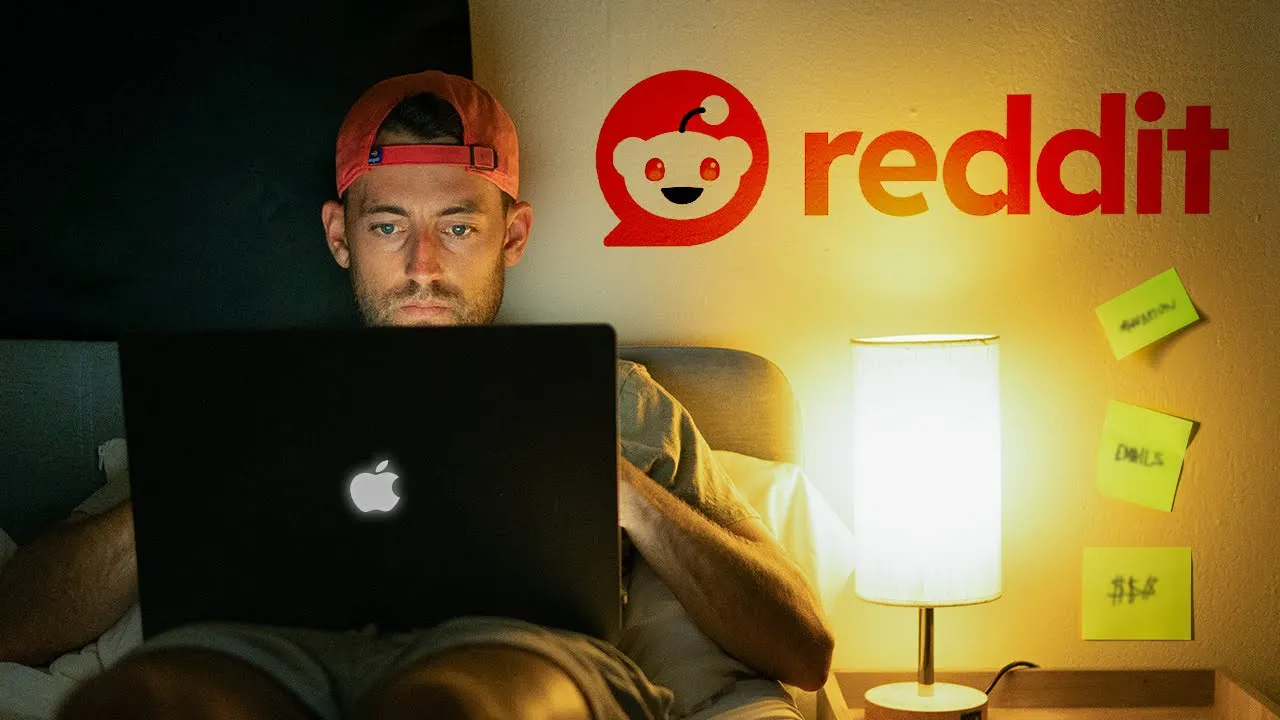
I Hacked Reddit To Build A $1M Business | Starter Story
A founder hacked Reddit's moderation rules to drive millions of readers to his site, built a tens-of-thousands-strong email list, and turned it into a $1M business before Reddit banned him.
Sep 8, 202613:04
Difficulty: Beginner
Played
Starter Story
I Hacked Reddit To Build A $1M Business | Starter Story
A founder hacked Reddit's moderation rules to drive millions of readers to his site, built a tens-of-thousands-strong email list, and turned it into a $1M business before Reddit banned him.
Sep 8, 202613:04
Difficulty: Beginner
Played
TL;DR
A first-person story of how the founder of Starter Story quit his 9-to-5 by gaming Reddit's algorithm. After his first post was removed by moderators, he repackaged his content as native on-platform posts, drove millions of readers to his site[1]— Host"A single link post on Reddit drove 100 visitors to Starter Story in minutes. Then the moderators deleted it. That deletion became the catal…"02:28, and converted that traffic into a tens-of-thousands-strong email list before Reddit banned his domain[2]— Host"Reddit petition to ban domain: Redditors eventually organized a petition to ban starterstory.com posts, effectively ending the Reddit growt…"06:30. The core lesson: attention comes before revenue, and every platform has exploitable cracks if you look hard enough[3]— Host"After interviewing thousands of successful founders, one pattern repeats: they all built something, got ignored, and then figured out distr…"07:20.
#Reddit growth hack#email list building#content marketing#attention economy#audience ownership#platform risk#distribution strategy#product-market fit#founder story#solopreneur#Reddit#growth hacking#email list#Starter Story#entrepreneurship#native content#free channels#distribution#audience building#moderation#9-to-5 escape#million-dollar business
The founder of Starter Story shares how he hacked Reddit's algorithm to drive millions of readers to his website, built a tens-of-thousands-strong email list, and turned it into a million-dollar business — before Reddit banned his domain.
Chapter list
The episode opens with a punchy, almost cinematic hook: the founder holds up a dollar bill, then discards it — the real currency, he argues, is attention. He frames the entire episode around a single premise: that capturing eyeballs at scale, and knowing how to convert them into dollars, is the foundational skill of modern entrepreneurship. It's a bold, confident opening that immediately signals this is a story about distribution and growth, not product development. The tone is energetic and direct, setting up a narrative arc from nobody to millionaire that the rest of the episode will deliver on.
We're dropped into the founder's pre-startup life in New York City — a 9-to-5 job, a six-figure salary, parties and profits on the surface, but a gnawing emptiness underneath. He doesn't linger on the details; the scene is painted quickly and efficiently to establish motivation. The key moment is a simple but powerful declaration: 'I need something more.' That need crystallises into a vow to become an entrepreneur and never return to conventional employment. It's a relatable origin story that grounds the technical tactics to come in something deeply human.
Fired up by his vow, the founder pours months into Starter Story — the perfect landing page, the perfect font, the perfect everything. He can see the future in his mind: thousands of users, thousands of dollars, a new life. Then he presses publish. Nothing. Not a single user. He sits there refreshing his analytics, waiting for word-of-mouth to kick in, for the product to spread virally. It never does. The crushing silence forces a reckoning: everything he'd been told about startups — that a great product will find its audience — was a lie[1]— Host"Perfecting a product for months guarantees nothing. The Starter Story founder pressed publish on his meticulously crafted site and watched …"00:55. It's a pivotal, honest moment that sets up the strategic pivot that follows.
The zero-user launch triggers a research sprint. Instead of iterating on the product, the founder studies how the world's most successful companies got their first traction. The answer crystallises fast: every one of them leveraged free channels — YouTube, Instagram, TikTok, Reddit — to capture attention before converting it into revenue[1]— Host"The world's best companies didn't buy their first customers — they went to where those customers already were and created content for them.…"01:56. This reframe is the intellectual turning point of the episode. The founder stops thinking like a builder and starts thinking like a media company. He asks a deceptively simple question: where do my customers hang out? The answer he arrives at — Reddit — sets the next sequence in motion.
With Reddit identified as the target channel, the founder makes his first move: a simple link post to his website. The result is intoxicating — traffic climbs to 10, 20, then 100 users in real time[1]— Host"A single link post on Reddit drove 100 visitors to Starter Story in minutes. Then the moderators deleted it. That deletion became the catal…"02:28. He's jumping around the room, seeing his future unfold. And then, the gut-punch: the post is removed by a moderator for violating the subreddit's no-link-post rule. The elation collapses. But rather than accepting defeat, the founder sets himself a new goal: find a way to break the rules without looking like he's breaking them. It's a crucial mindset shift — from playing by the platform's rules to understanding them well enough to route around them.
The key insight arrives when the founder stops fighting Reddit's rules and starts working with Redditor psychology. Redditors despise self-promotion, so the move is to give them exactly what they want — valuable, on-platform content — and make the product link feel like an afterthought at the bottom. He spends hours crafting the post meticulously, then publishes and goes to bed, convinced it hasn't worked. He wakes up to hundreds of upvotes, dozens of comments, and thousands of people flooding his analytics dashboard[1]— Host"Redditors hate spam — so stop looking like spam. By putting all his content directly into a self-post and adding only a tiny footer link, t…"03:20. The engagement, he says, was 'like crack.' More importantly, he recognises the moment for what it is: product-market fit. Before, nobody cared. Now, people are asking for more.
Flushed with success but acutely aware of the fragility of the strategy, the founder treats urgency as a feature. He knows the mods will eventually catch on and others will copy his approach, so he floods the zone — posting repeatedly, relentlessly. And it keeps working. His content repeatedly hits Reddit's front page. Hundreds of thousands of people visit his website; millions read his posts. But attention alone doesn't pay the bills. Step two of the plan is already forming: he needs to capture this borrowed audience and make it his own before the window slams shut.
With millions of eyeballs flowing through his site, the founder executes the second phase of the plan: converting that rented attention into an owned asset. The vehicle is an email list. He explains the logic clearly: an email list means he can reach his audience whenever he wants, sell whatever he wants, without needing Reddit's permission[1]— Host"Reddit traffic is borrowed. An email list is owned. The Starter Story founder built tens of thousands of subscribers before Reddit banned h…"05:28. He optimises a signup box and the subscribers start stacking up — 100, 200, 500 and climbing. The strategy is elegant in its simplicity: use Reddit as the top of the funnel, capture emails as the middle, and own the relationship at the bottom. Time is running out, but the foundation is being laid.
The inevitable happens: a Reddit mob organises a petition specifically to ban starterstory.com from the platform. The founder narrates this moment with dark humour — 'I was donezo' — before revealing the punchline: it didn't matter[1]— Host"Reddit petition to ban domain: Redditors eventually organized a petition to ban starterstory.com posts, effectively ending the Reddit growt…"06:30. By the time the ban landed, he'd already converted his viral traffic into tens of thousands of email subscribers, quit his job, and built a self-sustaining business. The Reddit chapter was closed, but it had served its purpose perfectly. The episode offers this as proof of concept for the broader principle: platform access is temporary, but an owned audience is permanent.
Stepping back from his personal story, the founder zooms out to offer a universal principle drawn from thousands of founder interviews: the secret sauce is never the product — it's figuring out how to get in front of customers[1]— Host"After interviewing thousands of successful founders, one pattern repeats: they all built something, got ignored, and then figured out distr…"07:20. Every founder he's spoken to has had to solve this problem. Without cracking distribution, he'd still be building in the dark, hoping users would magically appear. He closes by framing this as an ongoing opportunity: there are thousands of algorithm cracks still waiting to be exploited, and anyone can find one. The episode ends with a pitch for his free live workshop where he promises to teach the full attention-hacking framework, directing listeners to the link in the description.
Subreddit
A topic-specific community within Reddit where users post and vote on content; each subreddit has its own moderators and rules.
Self-post
A Reddit post consisting of text (rather than a link), which stays on-platform and is less likely to be flagged as spam by moderators.
Upvotes
Reddit's approval mechanism; users click an upvote arrow to boost a post's visibility, pushing it toward the front page.
Front page (Reddit)
The default landing page of Reddit showing the highest-voted posts; appearing here exposes content to millions of users simultaneously.
Mods / Moderators
Volunteer community managers on Reddit who enforce subreddit rules and can remove posts or ban users.
Product-market fit
The stage where a product satisfies a strong market demand, evidenced by organic, enthusiastic user adoption without heavy marketing effort.
Traction
Early measurable evidence that a startup is gaining customers or users; a critical signal for investors and founders that a product is working.
Attention economy
A framework treating human attention as a scarce, valuable resource that platforms and businesses compete to capture and monetize.
Email list
A database of subscribers who have consented to receive emails; considered an 'owned' audience because it is not controlled by a third-party platform.
Algorithm hack
A technique that exploits weaknesses or unintended behaviours in a platform's ranking algorithm to gain outsized visibility without paying for it.
Donezo
Informal slang meaning completely finished or done for; used here to describe the moment the Reddit community organized against the founder.
9-to-5
Colloquial term for a conventional salaried job with fixed daytime hours; used here as shorthand for employment the founder wanted to escape.
Chapter 1 · 00:00
Hook: Attention Is the Real Currency
The episode opens with a punchy, almost cinematic hook: the founder holds up a dollar bill, then discards it — the real currency, he argues, is attention. He frames the entire episode around a single premise: that capturing eyeballs at scale, and knowing how to convert them into dollars, is the foundational skill of modern entrepreneurship. It's a bold, confident opening that immediately signals this is a story about distribution and growth, not product development. The tone is energetic and direct, setting up a narrative arc from nobody to millionaire that the rest of the episode will deliver on.
The Reddit attention strategy ultimately served as the foundation for a million-dollar business, proving that free distribution channels can replace paid marketing.
Chapter 2 · 00:40
The 9-to-5 Life and the Vow to Escape
We're dropped into the founder's pre-startup life in New York City — a 9-to-5 job, a six-figure salary, parties and profits on the surface, but a gnawing emptiness underneath. He doesn't linger on the details; the scene is painted quickly and efficiently to establish motivation. The key moment is a simple but powerful declaration: 'I need something more.' That need crystallises into a vow to become an entrepreneur and never return to conventional employment. It's a relatable origin story that grounds the technical tactics to come in something deeply human.
Perfecting a product for months guarantees nothing. The Starter Story founder pressed publish on his meticulously crafted site and watched zero users arrive — the brutal lesson every founder needs to hear.
0:55
1:55
Chapter 3 · 01:05
Building Starter Story and the Perfect Launch That Flopped
Fired up by his vow, the founder pours months into Starter Story — the perfect landing page, the perfect font, the perfect everything. He can see the future in his mind: thousands of users, thousands of dollars, a new life. Then he presses publish. Nothing. Not a single user. He sits there refreshing his analytics, waiting for word-of-mouth to kick in, for the product to spread virally. It never does. The crushing silence forces a reckoning: everything he'd been told about startups — that a great product will find its audience — was a lie[1]— Host"Perfecting a product for months guarantees nothing. The Starter Story founder pressed publish on his meticulously crafted site and watched …"00:55. It's a pivotal, honest moment that sets up the strategic pivot that follows.
Despite months of meticulous preparation, Starter Story's initial launch attracted zero users — a humbling reminder that building alone guarantees nothing.
The Insight: Smartest Companies Run on Free Attention
The zero-user launch triggers a research sprint. Instead of iterating on the product, the founder studies how the world's most successful companies got their first traction. The answer crystallises fast: every one of them leveraged free channels — YouTube, Instagram, TikTok, Reddit — to capture attention before converting it into revenue[1]— Host"The world's best companies didn't buy their first customers — they went to where those customers already were and created content for them.…"01:56. This reframe is the intellectual turning point of the episode. The founder stops thinking like a builder and starts thinking like a media company. He asks a deceptively simple question: where do my customers hang out? The answer he arrives at — Reddit — sets the next sequence in motion.
The world's best companies didn't buy their first customers — they went to where those customers already were and created content for them. Free channels like Reddit aren't a hack; they're the actual strategy.
A single link post on Reddit drove 100 visitors to Starter Story in minutes. Then the moderators deleted it. That deletion became the catalyst for a far smarter strategy.
2:28
3:20
Chapter 5 · 02:30
First Reddit Post: Traffic, Then Deletion
With Reddit identified as the target channel, the founder makes his first move: a simple link post to his website. The result is intoxicating — traffic climbs to 10, 20, then 100 users in real time[1]— Host"A single link post on Reddit drove 100 visitors to Starter Story in minutes. Then the moderators deleted it. That deletion became the catal…"02:28. He's jumping around the room, seeing his future unfold. And then, the gut-punch: the post is removed by a moderator for violating the subreddit's no-link-post rule. The elation collapses. But rather than accepting defeat, the founder sets himself a new goal: find a way to break the rules without looking like he's breaking them. It's a crucial mindset shift — from playing by the platform's rules to understanding them well enough to route around them.
Redditors hate spam — so stop looking like spam. By putting all his content directly into a self-post and adding only a tiny footer link, the Starter Story founder made his marketing invisible to moderators and irresistible to readers.
3:20
4:40
Chapter 6 · 03:25
The Native-Content Hack: Beating the Mods
The key insight arrives when the founder stops fighting Reddit's rules and starts working with Redditor psychology. Redditors despise self-promotion, so the move is to give them exactly what they want — valuable, on-platform content — and make the product link feel like an afterthought at the bottom. He spends hours crafting the post meticulously, then publishes and goes to bed, convinced it hasn't worked. He wakes up to hundreds of upvotes, dozens of comments, and thousands of people flooding his analytics dashboard[1]— Host"Redditors hate spam — so stop looking like spam. By putting all his content directly into a self-post and adding only a tiny footer link, t…"03:20. The engagement, he says, was 'like crack.' More importantly, he recognises the moment for what it is: product-market fit. Before, nobody cared. Now, people are asking for more.
Going from zero engagement to hundreds of upvotes overnight isn't luck — it's product-market fit. When your content makes strangers ask for more, you've found something real.
Flushed with success but acutely aware of the fragility of the strategy, the founder treats urgency as a feature. He knows the mods will eventually catch on and others will copy his approach, so he floods the zone — posting repeatedly, relentlessly. And it keeps working. His content repeatedly hits Reddit's front page. Hundreds of thousands of people visit his website; millions read his posts. But attention alone doesn't pay the bills. Step two of the plan is already forming: he needs to capture this borrowed audience and make it his own before the window slams shut.
Reddit traffic is borrowed. An email list is owned. The Starter Story founder built tens of thousands of subscribers before Reddit banned him — meaning the platform's death sentence didn't matter.
5:28
6:55
Chapter 8 · 05:40
Step 2: Converting Attention Into an Email List
With millions of eyeballs flowing through his site, the founder executes the second phase of the plan: converting that rented attention into an owned asset. The vehicle is an email list. He explains the logic clearly: an email list means he can reach his audience whenever he wants, sell whatever he wants, without needing Reddit's permission[1]— Host"Reddit traffic is borrowed. An email list is owned. The Starter Story founder built tens of thousands of subscribers before Reddit banned h…"05:28. He optimises a signup box and the subscribers start stacking up — 100, 200, 500 and climbing. The strategy is elegant in its simplicity: use Reddit as the top of the funnel, capture emails as the middle, and own the relationship at the bottom. Time is running out, but the foundation is being laid.
The founder identified email as the critical bridge between rented attention (Reddit) and owned audience, allowing him to sell freely without platform dependence.
Before Reddit banned his domain, the founder converted his viral traffic into an email list of tens of thousands — a self-owned audience independent of Reddit.
Redditors eventually organized a petition to ban starterstory.com posts, effectively ending the Reddit growth channel — but the email list was already built.
The inevitable happens: a Reddit mob organises a petition specifically to ban starterstory.com from the platform. The founder narrates this moment with dark humour — 'I was donezo' — before revealing the punchline: it didn't matter[1]— Host"Reddit petition to ban domain: Redditors eventually organized a petition to ban starterstory.com posts, effectively ending the Reddit growt…"06:30. By the time the ban landed, he'd already converted his viral traffic into tens of thousands of email subscribers, quit his job, and built a self-sustaining business. The Reddit chapter was closed, but it had served its purpose perfectly. The episode offers this as proof of concept for the broader principle: platform access is temporary, but an owned audience is permanent.
With a thriving email list and a self-owned audience, the founder quit his six-figure New York City salary job to go all-in on Starter Story.
Chapter 10 · 07:20
The Universal Founder Lesson and Workshop Pitch
Stepping back from his personal story, the founder zooms out to offer a universal principle drawn from thousands of founder interviews: the secret sauce is never the product — it's figuring out how to get in front of customers[1]— Host"After interviewing thousands of successful founders, one pattern repeats: they all built something, got ignored, and then figured out distr…"07:20. Every founder he's spoken to has had to solve this problem. Without cracking distribution, he'd still be building in the dark, hoping users would magically appear. He closes by framing this as an ongoing opportunity: there are thousands of algorithm cracks still waiting to be exploited, and anyone can find one. The episode ends with a pitch for his free live workshop where he promises to teach the full attention-hacking framework, directing listeners to the link in the description.
After interviewing thousands of successful founders, one pattern repeats: they all built something, got ignored, and then figured out distribution. Building was never the hard part — getting in front of customers was.
After interviewing thousands of successful founders, the host found a common thread: they all had to figure out how to get in front of customers after building something nobody noticed.
Redditors hate spam — so stop looking like spam. By putting all his content directly into a self-post and adding only a tiny footer link, the Starter Story founder made his marketing invisible to moderators and irresistible to readers.
Reddit traffic is borrowed. An email list is owned. The Starter Story founder built tens of thousands of subscribers before Reddit banned him — meaning the platform's death sentence didn't matter.
5:28
6:55
Snapshots ()
Key Quotes ()
This episode
Claims & Sources
0 / 7 cited (0%)
Factual claims made this episode, and whether a source was named.
⚠
The Starter Story founder built a million-dollar business using Reddit as a primary growth channel.
Hostno source cited
⚠
The smartest companies in the world built early growth by leveraging free attention channels like YouTube, Instagram, TikTok, and Reddit.
Hostno source cited
⚠
The founder's Reddit posts reached millions of readers and drove hundreds of thousands of visitors to his website.
Hostno source cited
⚠
Before Reddit banned his domain, the founder built an email list of tens of thousands of subscribers.
Hostno source cited
⚠
The founder has interviewed thousands of successful founders, all of whom had to figure out distribution after building their product.
Hostno source cited
⚠
A Redditor petition to ban starterstory.com posts was filed, effectively ending the Reddit growth channel.
Hostno source cited
⚠
By posting native on-platform content instead of direct links, posts avoid moderator removal and generate hundreds of upvotes.
Hostno source cited
This episode
Cast
The primary growth channel used by the Starter Story founder to drive millions of readers to his website through native self-posts.
The founder's content business built on the Reddit growth hack, which grew into a million-dollar operation after building a large email list.
Mentioned alongside YouTube, TikTok and Reddit as a free channel used by smart companies to capture customer attention.
Listed as an example of a free social channel where companies go to find customers and generate attention at no cost.
Cited as one of the free attention channels that the world's most successful companies have used to build early growth.
The city where the founder was working a 9-to-5 job before pivoting to entrepreneurship and building Starter Story.