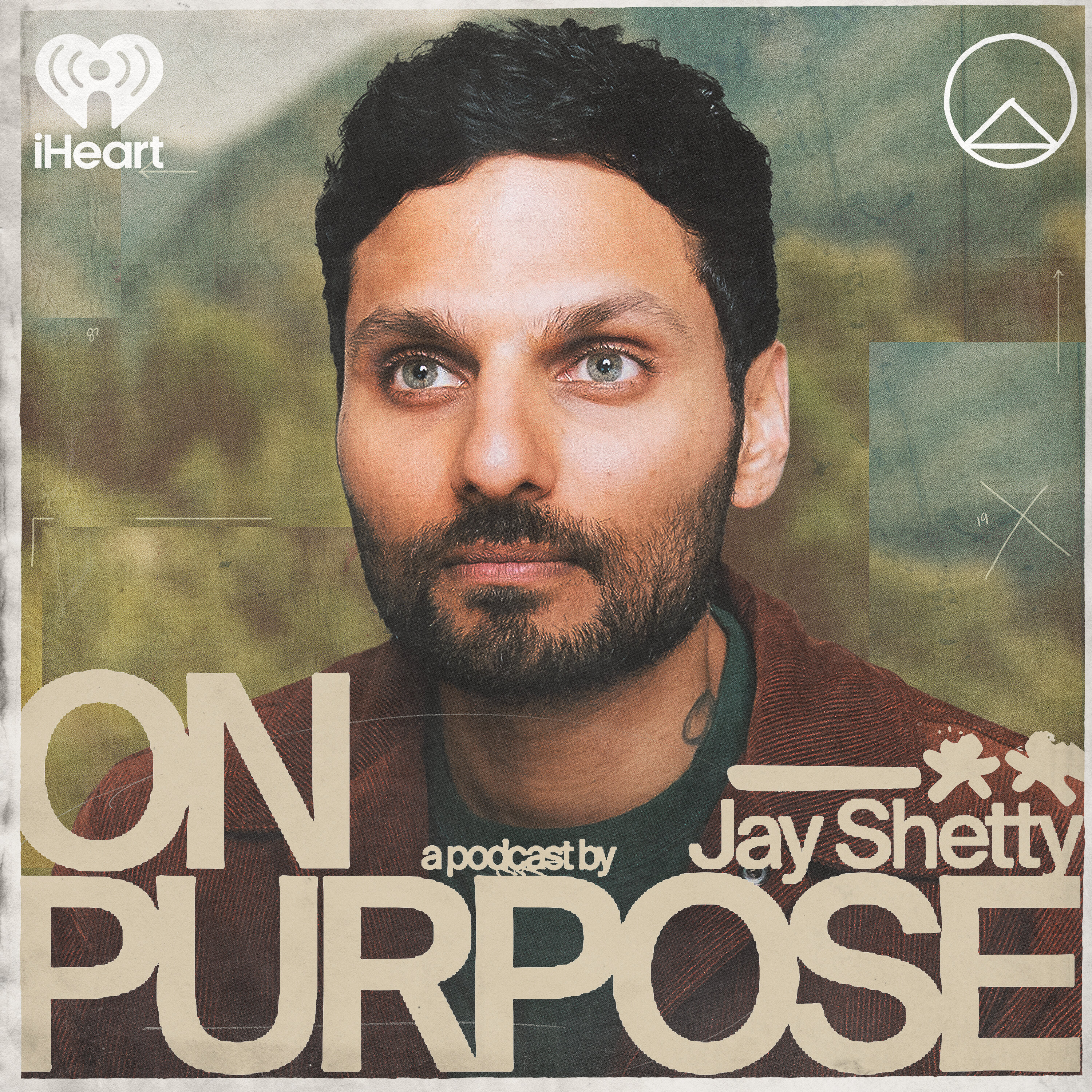
Anxiety and excitement are both high arousal emotional states; the racing heart and sweaty palms don't always mean danger — sometimes it means your body is preparing for growth.
Snapshot · On Purpose with Jay Shetty
Anxiety and excitement are both high arousal emotional states; the racing heart and sweaty palms don't always mean danger — sometimes it means your body is preparing for growth.

Where this was said
At 6:35 · chapter starts 6:12
One of Jay's most counterintuitive points in the episode is about the nature of the body's signals before a scary act. We wait to feel calm before acting, he says, because we assume the racing heart and butterflies mean we are unsafe. But anxiety and excitement are physiologically identical — both high-arousal states produced by the same nervous system [1] — Jay Shetty "Anxiety and excitement are both high-arousal states. The racing heart and sweaty palms your body produces before a scary moment aren't alwa…" 06:25 . The butterflies before asking someone on a date and the butterflies before jumping out of a plane feel the same in your body. Your nervous system, Jay explains, genuinely cannot always distinguish between danger and growth. This reframe has practical power: if you can accept that physical discomfort before a risky action is ambiguous — not necessarily a warning but possibly your body preparing you to do something more expansive — then you no longer need to wait for calm before you act. Confidence, he emphasizes, does not come first. Confidence only accumulates after your brain collects enough evidence that you've repeatedly handled situations you once thought were impossible for you.
Anxiety and excitement are both high-arousal states. The racing heart and sweaty palms your body produces before a scary moment aren't always warning signs — sometimes they're your body preparing you to expand.
Confidence is not a prerequisite for brave action — it's a consequence of it. Your brain only builds genuine confidence after collecting repeated evidence that you can survive hard things.
Dan Gilbert's research found that the psychological immune system — the brain's ability to justify and find satisfaction in choices — activates most powerfully when a decision is perceived as irreversible.
Barry Schwartz's research found that maximizers — people who try to optimize every decision — tend to achieve objectively better outcomes but report lower happiness than satisficers who choose 'good enough.'
Research consistently shows that while people may initially regret poor decisions, in the long run they regret the decisions they didn't make — inaction — far more than the ones they took.
A study showed that men in committed relationships who briefly viewed 10 attractive women's faces reported a measurable decrease in relationship satisfaction immediately afterward, illustrating evolutionary mismatch with modern media.
Harvard psychologist Dan Gilbert, who previously didn't believe in marriage, immediately proposed to his long-term girlfriend after his own research showed that constraints increase satisfaction with choices.
Animals first sensed light 540 million years ago, triggering an evolutionary acceleration known as the Cambrian explosion within 10 million years.
It is estimated that half of all cortical activity in the human brain is involved in visual function, underscoring vision's central role in intelligence.
Cognitive neuroscience literature shows that by age 6, humans can recognize tens of thousands of different object categories — far more data than early AI systems were trained on.
Only about 3% of FDA-approved drugs have genuinely unclear mechanisms of action, making an unknown mechanism a meaningful early red flag for any compound.
We use essential and analytics cookies to run Vuci. To understand how the site is used: Privacy Policy.
Install Vuci on your phone
Add it to your home screen for a faster, app-like experience.
Install Vuci on your phone
Tap the Share button, then “Add to Home Screen”.
A new version is available
Reload to get the latest Vuci.