
45% of researcher time is administrative
A National Academies study found that researchers spend 45% of their time on administrative grant-related work rather than actual science.
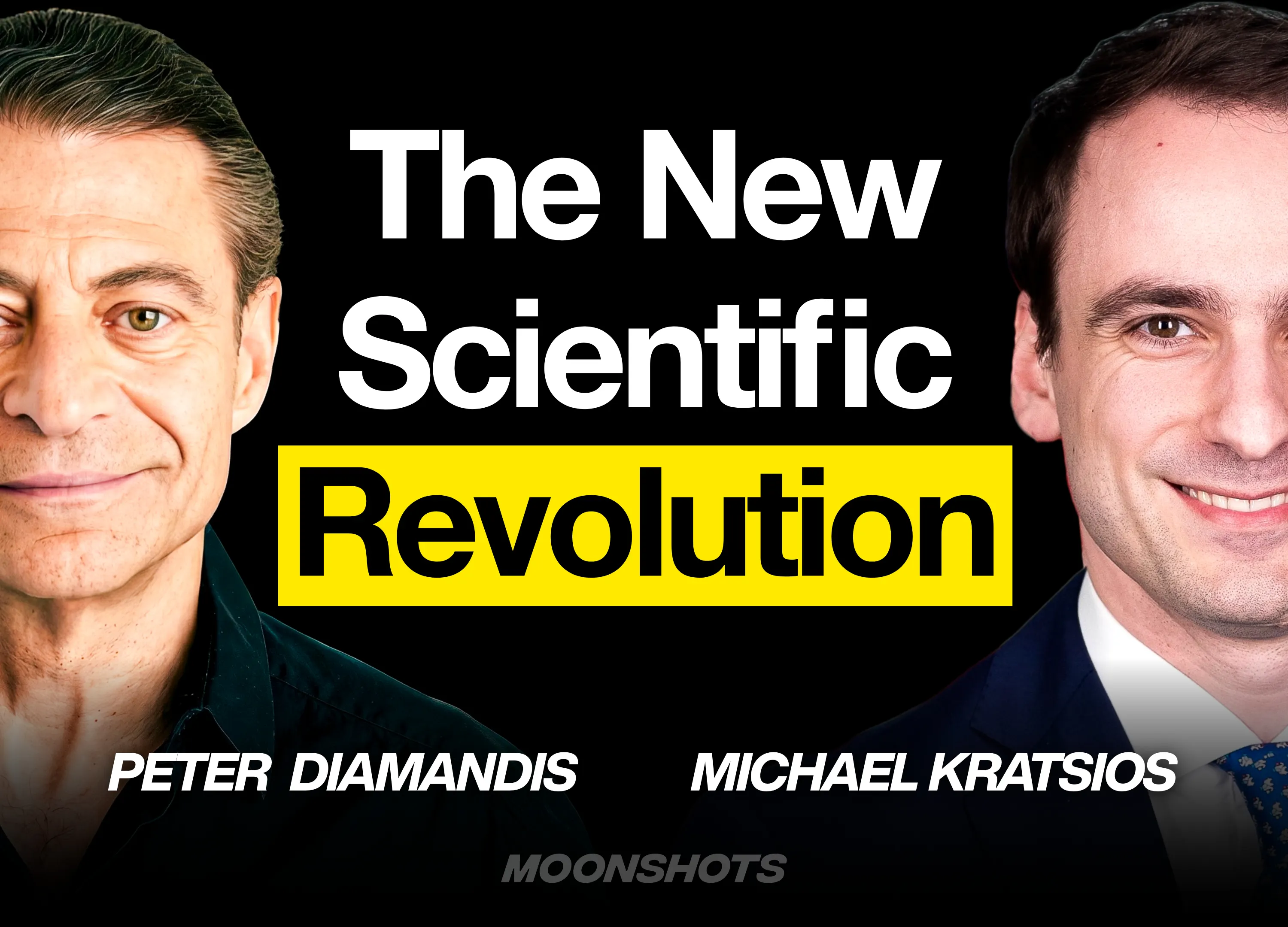
Snapshot · Moonshots with Peter Diamandis
A National Academies study found that researchers spend 45% of their time on administrative grant-related work rather than actual science.
Where this was said
At 34:03 · chapter starts 31:15
The interview pivots to the substantive heart of the Golden Age Report: why, despite record budgets and better tools, is scientific productivity declining? Kratsios traces the problem to institutional inertia — a system designed decades ago that nobody wants to change, especially those who have succeeded within it. [1] — Michael Kratsios "The NIH budget has ballooned to $45 billion yet drugs are more expensive than ever. Researchers spend 45% of their time on grant paperwork.…" 31:30 The data is damning: the NIH budget has swelled to nearly $45 billion yet drugs are more expensive than ever. A National Academies study found researchers spend 45% of their time on grant administration. The median age of an intramural NIH scientist is 71 — while the average age of Nobel-winning scientific work is in a researcher's 20s. The scientific community, Kratsios observes wryly, is perhaps the community least interested in experimenting with new ways of doing science. The irony is not lost on either speaker.
The NIH budget has ballooned to $45 billion yet drugs are more expensive than ever. Researchers spend 45% of their time on grant paperwork. The median intramural NIH scientist is 71. Kratsios argues the problem isn't money — it's that the scientific enterprise refuses to experiment on itself.
Despite NIH's budget growing to nearly $45 billion, the cost of drugs is higher than ever, indicating declining returns on science spending.

The widely cited ego-depletion model — the idea that willpower is a finite resource that gets depleted — failed to replicate in follow-up studies.
Humans are estimated to have 5,000–7,000 thoughts per day, yet can recall essentially none of them afterward, highlighting why in-the-moment emotional tracking matters.
A large Harvard study found that a wandering mind is an unhappy mind — people report greater happiness when their attention is tethered to the present, even if the task is unpleasant.
A key study finding that we have a 'credit card's worth of plastic' in our bodies was likely skewed because researchers used nitrile gloves that shed plastic particles onto the microplastic detector.
Emotionally sensitive people have a hyperactive amygdala, an underactive prefrontal cortex, and a frayed connection between the two — making emotional regulation structurally harder.
Rejection sensitivity can be observed as early as age 2 or 3, suggesting it has strong developmental and likely genetic roots.
A Yale study found that non-judgmental observation of emotions — without rushing to resolve them — reduces activation in the brain, making it a powerful regulation tool.

Dan Gilbert's research found that the psychological immune system — the brain's ability to justify and find satisfaction in choices — activates most powerfully when a decision is perceived as irreversible.
Barry Schwartz's research found that maximizers — people who try to optimize every decision — tend to achieve objectively better outcomes but report lower happiness than satisficers who choose 'good enough.'
We use essential and analytics cookies to run Vuci. To understand how the site is used: Privacy Policy.

Install Vuci on your phone
Add it to your home screen for a faster, app-like experience.
Install Vuci on your phone
Tap the Share button, then “Add to Home Screen”.
A new version is available
Reload to get the latest Vuci.