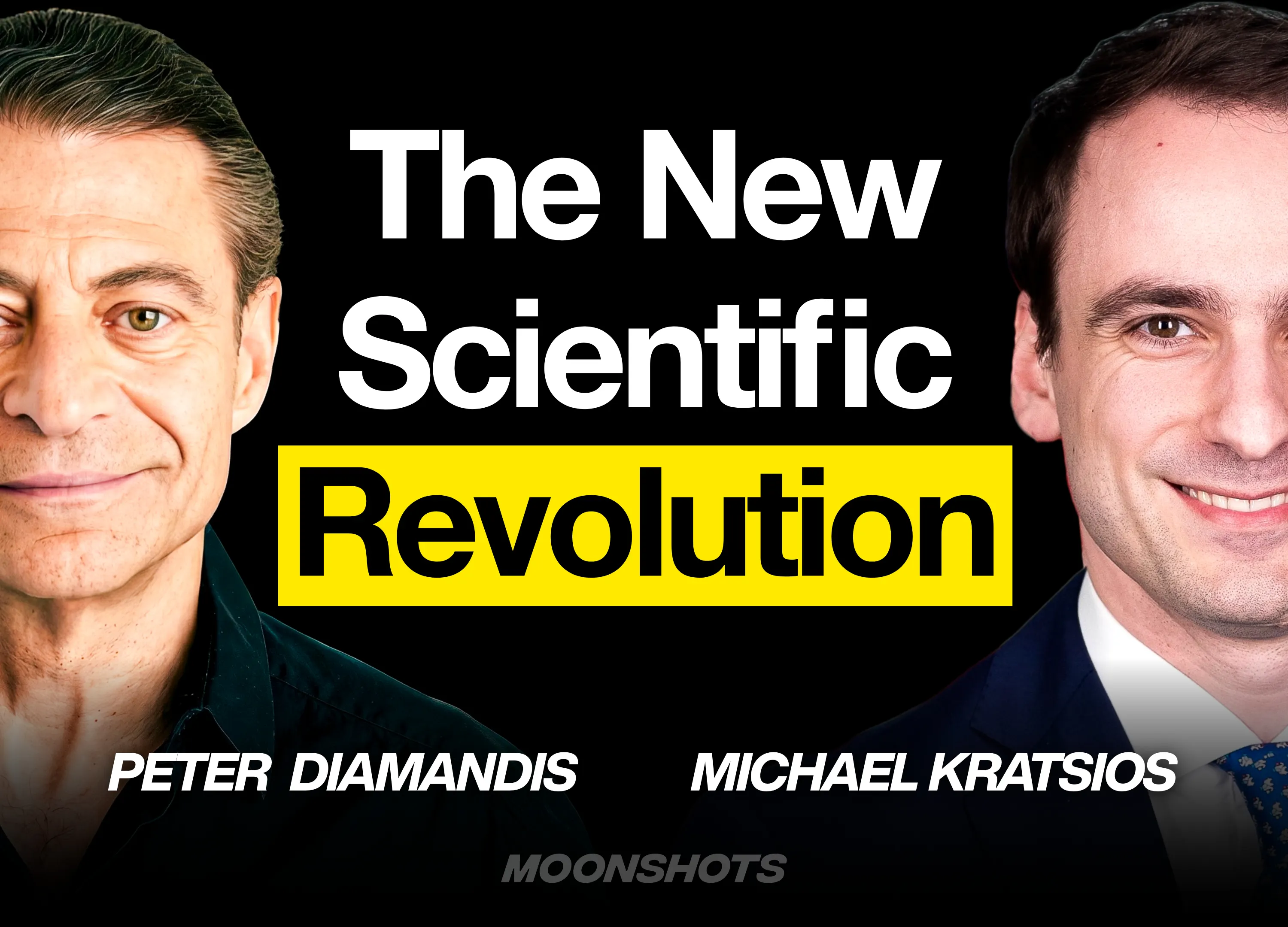
The administration's space missions include returning humans to the Moon by 2028, building the first lunar base elements by 2030, and launching a nuclear reactor in space by 2028.
Snapshot · Moonshots with Peter Diamandis
The administration's space missions include returning humans to the Moon by 2028, building the first lunar base elements by 2030, and launching a nuclear reactor in space by 2028.
Where this was said
At 16:48 · chapter starts 15:05
Peter asks Kratsios to paint the long-term vision for America, pushing beyond incremental healthcare wins. Kratsios frames his answer in terms of national missions — bold, specific goals that generate national pride and inspire young people the way Apollo once did. [1] — Michael Kratsios "Returning humans to the Moon by 2028, building the first elements of a lunar base by 2030, and launching a nuclear reactor into space — all…" 16:25 The list is staggering: humans on the Moon in 2028, the first elements of a lunar base by 2030, a nuclear reactor in space (with Mars propulsion capability) by 2028, a scientifically relevant quantum computer by the end of the president's term (directed through executive order), and an evolving national fusion strategy backed by more private investment than at any point in history — including 37 venture-backed fusion companies. Kratsios is most personally excited about quantum's applications in pharmaceuticals, where the ability to model molecular interactions could be transformational. The conversation reveals a government that is, for the first time in decades, willing to stake out ambitious, falsifiable timelines for moonshot-level achievements.
Returning humans to the Moon by 2028, building the first elements of a lunar base by 2030, and launching a nuclear reactor into space — all within the current administration's timeline. Kratsios frames these as the Apollo-era national missions needed to inspire a new generation into STEM.
Peter Diamandis counted 37 venture-backed fusion energy companies currently operating, reflecting unprecedented private-sector investment in the space.
Animals first sensed light 540 million years ago, triggering an evolutionary acceleration known as the Cambrian explosion within 10 million years.
It is estimated that half of all cortical activity in the human brain is involved in visual function, underscoring vision's central role in intelligence.
Cognitive neuroscience literature shows that by age 6, humans can recognize tens of thousands of different object categories — far more data than early AI systems were trained on.
Only about 3% of FDA-approved drugs have genuinely unclear mechanisms of action, making an unknown mechanism a meaningful early red flag for any compound.
Even compounds that clear preclinical testing often fail in humans: 30 to 50% of drugs entering phase 1 trials do not advance to phase 2, frequently because human behavior differs from animal models.
More than 80% of published BPC-157 research comes from a single academic group whose researchers have IP and commercial interests connected to the molecule, limiting independent replication.
Roughly 100 peptide drugs are already FDA-approved, about 150 more are in clinical trials, and 600–700 are in preclinical development, underscoring the legitimacy of peptide science broadly.
The scientist who discovered BPC-157 refused to disclose the screening method used to identify the compound and has never fully published the parent protein sequence — what Peter Attia calls 'scientific trust me, bro.'
The brain's visual, auditory, and motor cortices light up nearly identically whether an experience is real or imagined, making visualization a form of actual neural training.
We use essential and analytics cookies to run Vuci. To understand how the site is used: Privacy Policy.
Install Vuci on your phone
Add it to your home screen for a faster, app-like experience.
Install Vuci on your phone
Tap the Share button, then “Add to Home Screen”.
A new version is available
Reload to get the latest Vuci.
