Russia's early name: Muscovy
When Peter the Great was born, what is now Russia was called Muscovy — a landlocked Viking slave state centred around Moscow.
Peter the Great hid naked in a cupboard while his family was massacred, then used his childhood trauma to build an empire — and he baked oiled-up dwarves into pies for party tricks.
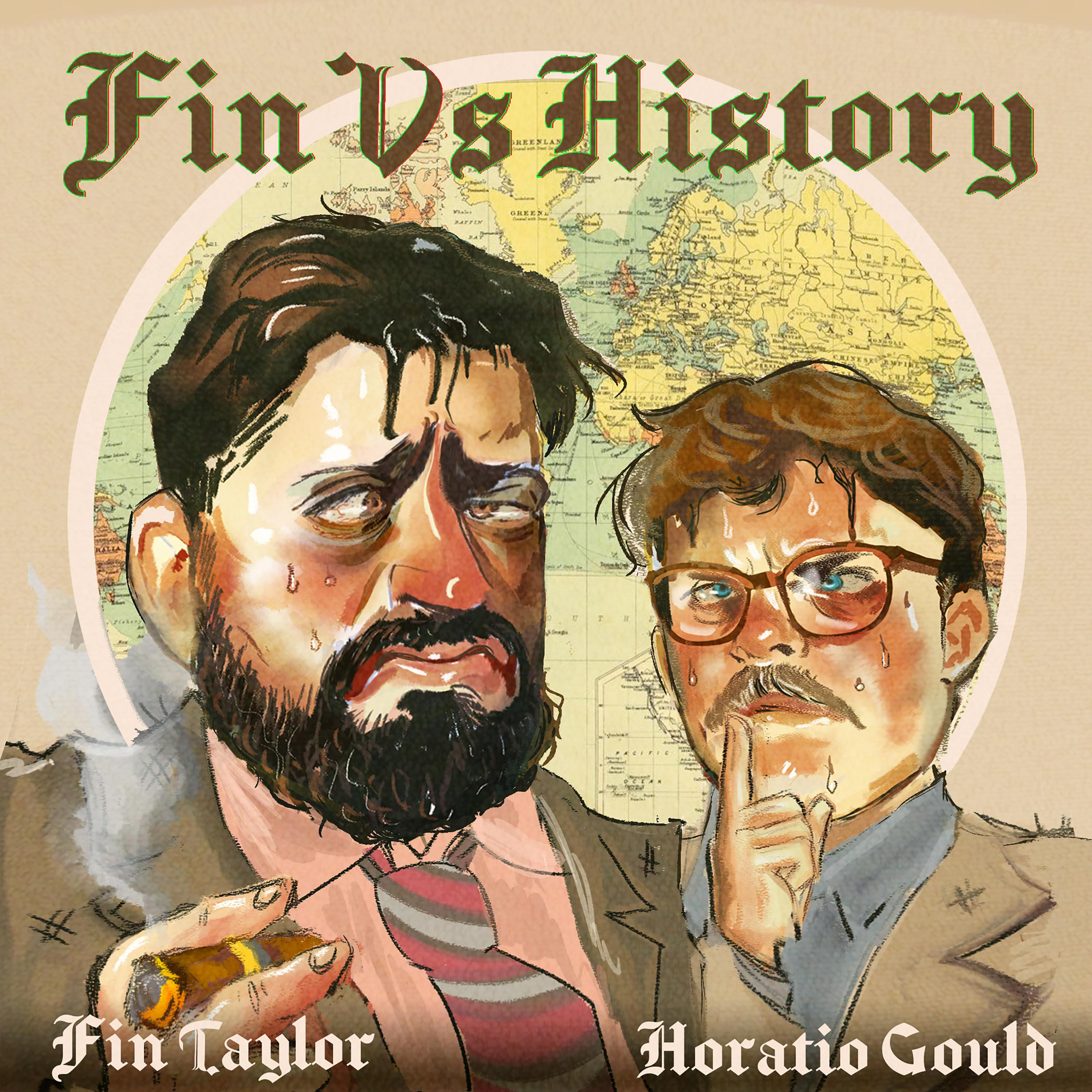
Fin vs History
Peter the Great hid naked in a cupboard while his family was massacred, then used his childhood trauma to build an empire — and he baked oiled-up dwarves into pies for party tricks.
TL;DR
Fin Taylor and Horatio Gould dive into the wild early life of Peter the Great and the run-up to the Great Northern War. From a 9-year-old hiding in a Kremlin cupboard while his family was massacred [1] — Fin Taylor "Peter the Great's go-to party piece was to serve guests an enormous pastry pie at state banquets, from which an oiled, naked dwarf would sl…" 23:10 , to running a mock-religious "All Drunken Synod of Fools" designed to lampoon the Orthodox Church [2] — Fin Taylor "In 1697, aged 25, Peter the Great embarked on an 18-month European tour under the alias 'Sergeant Peter Mikhailov' — with 250 people in tow…" 32:37 , to disguising himself as a common laborer at Dutch shipyards [3] — Fin Taylor "Beards were central to Russian Orthodox masculine identity. Peter the Great returned from Europe, grabbed a pair of shears, and started cut…" 39:48 , Peter's story is packed with outrageous detail. The single best takeaway: Peter the Great effectively invented modern Russia through sheer traumatized willpower.
Fin Taylor and Horatio Gould cover Part One of the Great Northern War, focusing on the extraordinary early life of Peter the Great — from childhood trauma during the Streltsy massacre, to his All Drunken Synod of Fools, his Grand Embassy in disguise across Europe, and the rise of Swedish supremacy under Charles XII.
The episode opens with Fin and Horatio trading their standard pre-history banter — riffing on whether 'Burnham's Britain' will stick the way 'Starmer's Britain' did, and Fin's elaborate bit about white reparations being taxable. A quick nod to Surfshark (coupon code FVH) interrupts before they settle into framing the episode: Peter the Great, 17th-century Russia, and a period of European history both hosts confess they barely know. Horatio notes that Russia wasn't even called Russia when Peter was born — it was Muscovy, a wild Viking slave estate — and both hosts are already giddy about how many dwarves the episode will contain.
With the banter settled, Horatio sketches the backdrop: when Peter the Great is born in the 1680s, Russia is still called Muscovy — a landlocked, river-linked backwater of fur trappers and slavers, nowhere near the European great powers. The hosts try to place the period chronologically, landing somewhere after the English Restoration but before anyone cares. Horatio drops the fascinating aside that Moscow identifies itself as the Third Rome in Orthodox theology — after Rome itself and Constantinople — explaining why Russian religious culture feels so distinct and so grimly accepting of suffering. Fin crystallises the difference: British stoicism is 'bad things will happen, we'll get through it'; Russian Orthodoxy is 'bad things are happening, brilliant, I love it.' [1] — Fin Taylor "Bad things will happen, we'll get through them. Russia, bad things are happening, brilliant, and I'm fucking loving it. I'm hard for the ba…" 06:54
Horatio makes the sharp observation that Peter the Great is the point at which Russia starts behaving like the country we recognise today — pushing into Eastern Europe, asserting dominance, invoking a grand historic mission. The chain runs directly from Peter to Stalin to Putin, all of whom invoke him. The conversation spirals into Russia's sheer physical scale: one country bordering Finland and North Korea, containing all of America and Australia with room left over. Charlie pipes up with a tentatively pro-Putin 'they've been a bit squashed' take, which Fin firmly dismantles. Horatio summarises Siberia: 'They've taken all the space that God didn't finish. It was just auto-generated.' [1] — Horatio Gould "They've taken all the space that God didn't finish. It was just like auto-generated." 08:07
Fin walks through the dysfunctional family tree: Peter's father Tsar Alexei had 16 children across two marriages, making Peter the 14th. The two family branches — the Naryshkins and the Miloslavskys — are already in political tension. Theodore, the first successor, probably had Down syndrome (a 'broad category throughout history', Fin notes), but apparently had sharp intellectual faculties. He dies in 1682, leaving a succession vacuum that the Streltsy — described as women in caftans with pikes, like a hippie trail outfit gone wrong — are ready to exploit. Horatio quips that the episode's arc runs neatly 'from Down syndrome to Stockholm syndrome'. [1] — Fin Taylor "We're going to end up with the Great Northern War. This really is from Down syndrome to Stockholm syndrome." 12:20
The 1682 Moscow uprising is where the episode hits its darkest and most vivid stretch. Horatio recounts how it all started on the Red Stairs of the Kremlin: a Streltsy leader came out to send the mob home but delivered his message with too much attitude, and was immediately thrown onto their pikes. What followed were days of massacres — impalement, beheading, reportedly stamping on children's limbs. Peter the Great, aged 9, hid in a cupboard and only survived because the door was left slightly ajar, making it look already searched. He emerged days later, shaking, and never really stopped shaking. [1] — Fin Taylor "A 9-year-old Peter the Great hid in a cupboard for days while the Streltsy massacred his family on the Kremlin's Red Stairs. He survived by…" 13:28 Fin deadpans: 'He wasn't fine.' His permanent facial tics date from this moment — and so, arguably, does the entire shape of modern Russia.
With the Streltsy exhausted and only two male survivors left — Peter and the mentally disabled Ivan V — a compromise is reached: both boys are crowned co-tsars. Sophia, their formidably ugly and mannish older sister (the hosts spend time on her portrait), takes power as regent in what is an extraordinarily misogynist era: a new husband receiving a whip on his wedding day is considered perfectly practical, not kinky. Peter, whose self-esteem is presumably not enhanced by being made co-ruler with a disabled brother, is sent to the royal retreat at Preobrazhenskoye, where his personality — and his obsession with model soldiers — really begins to develop. [1] — Fin Taylor "After the Streltsy massacre, the two surviving boys — 9-year-old Peter and his mentally disabled half-brother Ivan V — were crowned co-tsar…" 17:53
In exile from Moscow's conservative Orthodox world, Peter gravitates toward the German Quarter — an island of Lutheran, Lutheran modernity that Fin notes is hilariously the 'juicy bit' of an otherwise backwards city. Here he meets Franz Lefort, a Swiss soldier of fortune who becomes his closest companion, and the two build a lavish party mansion extension dedicated to excess. Peter's lifelong fascination with physical difference takes shape: he assembles what he calls a 'menagerie of freaks' — dwarves, giants, people with extreme deformities, all brought to him as gifts. The famous state-banquet party piece crystallises here: a massively oversized pie is placed before guests, the crust is cut, and an oiled, naked dwarf slithers out. [1] — Fin Taylor "Peter the Great's go-to party piece was to serve guests an enormous pastry pie at state banquets, from which an oiled, naked dwarf would sl…" 23:10 Horatio's verdict: timeless physical comedy.
The naked-dwarf-in-a-pie revelation sends the hosts into a digression on the modern dwarf acting industry, noting that there are actually many working dwarf actors who are robbed of roles when tall actors wear shoes on their knees. Fin is unequivocal: give dwarfs the roles. The argument mirrors broader disabled-actor representation debates, with Horatio asking whether dwarfs should be played by dwarves or by 'tall guys with shoes on their knees.' Eddie Redmayne's alleged knee-walking in Snow White is treated as a disgrace. The detour is brief but enthusiastic before Fin pivots to Peter's arranged marriage.
With Sophia ousted and Ivan quietly retired (the hosts debate whether 'gracefully retired from politics' might actually be a typo for something more sinister), Peter makes his satirical war on the Orthodox establishment official. He founds the All Drunken, All Jesting Synod of Fools and Jesters — part Monster Raving Loony Party, part Monty Python — whose members dress in mock religious robes and ride through Moscow's streets on pigs during day-long bacchanalian rampages. The joke is obvious to anyone watching: the Church claims divine authority, Peter claims the right to party harder. It is, the hosts agree, the kind of thing the Patreon WhatsApp group should probably be called. [1] — Fin Taylor "Peter the Great set up an official organisation called the All Drunken, All Jesting Synod of Fools and Jesters. Members dressed in mock rel…" 28:27
Peter's famous Grand Embassy is laid out in full: aged 25, he sets off in 1697 on an 18-month European fact-finding mission under the alias Sergeant Peter Mikhailov, except that he travels with 250 people and gets actively annoyed when Europeans fail to recognise him. He works as a common laborer at the Dutch East India Company shipyards, absorbing everything about Western technology, science, shipbuilding and medicine. The hosts note that Japan did something similar before World War II — sending people out to copy the best of the West — which is exactly what Peter is doing. Horatio launches into a heartfelt defence of massive entourages as a lost cultural institution. 'I wouldn't mind like a huge financially draining entourage. It is quite funny.'
The Dutch segment takes a darker turn when the hosts describe Peter's encounter with Western anatomy and body preservation — a new science that clearly blows his mind. His passion is so intense, sources claim he kisses a perfectly preserved dead infant's face. When any member of his entourage looks queasy, he orders them to take a bite of the corpse — framed as exposure therapy, but clearly also stag-do peer pressure. Fin connects this to a story from his schooldays about a boy who bit the head off a dead pigeon with no peer pressure at all, which everyone agrees is actually sadder. The seeds of Peter's future museum of preserved oddities — including a skeleton of a giant still on display — are planted here.
The Streltsy have risen again in 1698, trying to restore traditional Moscow and Sophia's rule. Peter returns from Europe, and the response is overwhelming: over 1,200 guards are executed — Peter personally wielding an axe — and their corpses are displayed outside the convent where Sophia is confined, permanently ending her political relevance. The Westernisation drive is now in full swing. Peter begins grabbing scissors and cutting off his nobles' beards without warning, because beards represent Orthodox conservatism and the German aesthetic is clean-shaven. Anyone who refuses to shave must pay a beard tax. [1] — Fin Taylor "Beard tax imposed on Russian men: Peter the Great decreed that all Russian men except the clergy must shave their beards or pay a beard tax…" 40:53 Fin riffs on the Schrödinger's nature of his own beard ('we don't know what's under there'), before the segment pivots back to Europe.
With the domestic politics settled, Fin fills in the European context. Peter's wife Eudoxia is sent to a nunnery — not quite a formal divorce, but close enough — while his German mistress Anna Mons receives all the attention. More importantly, the Swedish Empire is now the dominant force in Northern Europe, holding Finland, Estonia, Livonia and northern Germany and making the Baltic effectively a Swedish lake. Peter, who spent his Grand Embassy obsessing over shipyards, stares at this maritime empire with barely concealed longing. Horatio notes that it was short-lived and almost nobody remembers it today — which makes it all the more extraordinary that Sweden was, briefly, the most terrifying military force in Europe. [1] — Horatio Gould "After the Thirty Years' War, Sweden was the most modern and feared military force in Europe. They controlled Finland, Estonia, Livonia, and…" 48:10
The episode closes with the hosts wrapping up their Peter the Great prologue and directing listeners to Patreon (patreon.com/fintaylor) for the next instalment, already available, covering the Great Northern War in full. A bonus episode on the origin of Stockholm Syndrome and the extraordinary story of Patty Hearst is also available there. Fin invites listeners into the 'all-singing, all-dancing community of Finn vs History Jesters' for £3 a month, promising pints of mead and dwarf-throwing. Goodbye.
Chapter 2 · 03:33
With the banter settled, Horatio sketches the backdrop: when Peter the Great is born in the 1680s, Russia is still called Muscovy — a landlocked, river-linked backwater of fur trappers and slavers, nowhere near the European great powers. The hosts try to place the period chronologically, landing somewhere after the English Restoration but before anyone cares. Horatio drops the fascinating aside that Moscow identifies itself as the Third Rome in Orthodox theology — after Rome itself and Constantinople — explaining why Russian religious culture feels so distinct and so grimly accepting of suffering. Fin crystallises the difference: British stoicism is 'bad things will happen, we'll get through it'; Russian Orthodoxy is 'bad things are happening, brilliant, I love it.' [1] — Fin Taylor "Bad things will happen, we'll get through them. Russia, bad things are happening, brilliant, and I'm fucking loving it. I'm hard for the ba…" 06:54
When Peter the Great was born, what is now Russia was called Muscovy — a landlocked Viking slave state centred around Moscow.
Peter the Great was the 14th of his father's 16 children, making him easy to overlook in the political succession.
Russian Orthodox theology holds that Moscow is the Third Rome, following Rome itself and Constantinople, giving Russia a distinct religious identity from both Catholic and Protestant worlds.
Chapter 3 · 07:18
Horatio makes the sharp observation that Peter the Great is the point at which Russia starts behaving like the country we recognise today — pushing into Eastern Europe, asserting dominance, invoking a grand historic mission. The chain runs directly from Peter to Stalin to Putin, all of whom invoke him. The conversation spirals into Russia's sheer physical scale: one country bordering Finland and North Korea, containing all of America and Australia with room left over. Charlie pipes up with a tentatively pro-Putin 'they've been a bit squashed' take, which Fin firmly dismantles. Horatio summarises Siberia: 'They've taken all the space that God didn't finish. It was just auto-generated.' [1] — Horatio Gould "They've taken all the space that God didn't finish. It was just like auto-generated." 08:07
Moscow's Muslim population is estimated at 2–3 million, making it the city with the largest Muslim population in Europe.
Russia is so vast it could fit America and Australia inside it with 2 million square miles to spare. Siberia is just copy-paste terrain — God got bored and auto-filled the gap.
Chapter 4 · 10:56
Fin walks through the dysfunctional family tree: Peter's father Tsar Alexei had 16 children across two marriages, making Peter the 14th. The two family branches — the Naryshkins and the Miloslavskys — are already in political tension. Theodore, the first successor, probably had Down syndrome (a 'broad category throughout history', Fin notes), but apparently had sharp intellectual faculties. He dies in 1682, leaving a succession vacuum that the Streltsy — described as women in caftans with pikes, like a hippie trail outfit gone wrong — are ready to exploit. Horatio quips that the episode's arc runs neatly 'from Down syndrome to Stockholm syndrome'. [1] — Fin Taylor "We're going to end up with the Great Northern War. This really is from Down syndrome to Stockholm syndrome." 12:20
A 9-year-old Peter the Great hid in a cupboard for days while the Streltsy massacred his family on the Kremlin's Red Stairs. He survived by leaving the door slightly ajar so it looked already searched. He was not fine.
The 1682 Streltsy uprising began when one of their leaders came out to send them home and was immediately thrown onto their pikes for not being harsh enough. What followed was days of massacres, beheadings, and stamping on children. Peter was 9 years old.
Chapter 5 · 14:44
The 1682 Moscow uprising is where the episode hits its darkest and most vivid stretch. Horatio recounts how it all started on the Red Stairs of the Kremlin: a Streltsy leader came out to send the mob home but delivered his message with too much attitude, and was immediately thrown onto their pikes. What followed were days of massacres — impalement, beheading, reportedly stamping on children's limbs. Peter the Great, aged 9, hid in a cupboard and only survived because the door was left slightly ajar, making it look already searched. He emerged days later, shaking, and never really stopped shaking. [1] — Fin Taylor "A 9-year-old Peter the Great hid in a cupboard for days while the Streltsy massacred his family on the Kremlin's Red Stairs. He survived by…" 13:28 Fin deadpans: 'He wasn't fine.' His permanent facial tics date from this moment — and so, arguably, does the entire shape of modern Russia.
After the Streltsy massacre, the two surviving boys — 9-year-old Peter and his mentally disabled half-brother Ivan V — were crowned co-tsars. Their older sister Sophia ran the country as regent, accused of being a man in a dress. Peter was meant to be grateful.
Chapter 7 · 20:50
In exile from Moscow's conservative Orthodox world, Peter gravitates toward the German Quarter — an island of Lutheran, Lutheran modernity that Fin notes is hilariously the 'juicy bit' of an otherwise backwards city. Here he meets Franz Lefort, a Swiss soldier of fortune who becomes his closest companion, and the two build a lavish party mansion extension dedicated to excess. Peter's lifelong fascination with physical difference takes shape: he assembles what he calls a 'menagerie of freaks' — dwarves, giants, people with extreme deformities, all brought to him as gifts. The famous state-banquet party piece crystallises here: a massively oversized pie is placed before guests, the crust is cut, and an oiled, naked dwarf slithers out. [1] — Fin Taylor "Peter the Great's go-to party piece was to serve guests an enormous pastry pie at state banquets, from which an oiled, naked dwarf would sl…" 23:10 Horatio's verdict: timeless physical comedy.
Peter the Great stood approximately 6 feet 8 inches tall, making him an imposing and immediately recognizable figure.
Peter the Great's go-to party piece was to serve guests an enormous pastry pie at state banquets, from which an oiled, naked dwarf would slither out when the crust was cut. Comedy that is, genuinely, 300 years old and still works.
Peter the Great's favourite party piece at state banquets was to serve an oversized pastry pie, from which an oiled, naked dwarf would emerge when the crust was cut.
Chapter 8 · 23:52
The naked-dwarf-in-a-pie revelation sends the hosts into a digression on the modern dwarf acting industry, noting that there are actually many working dwarf actors who are robbed of roles when tall actors wear shoes on their knees. Fin is unequivocal: give dwarfs the roles. The argument mirrors broader disabled-actor representation debates, with Horatio asking whether dwarfs should be played by dwarves or by 'tall guys with shoes on their knees.' Eddie Redmayne's alleged knee-walking in Snow White is treated as a disgrace. The detour is brief but enthusiastic before Fin pivots to Peter's arranged marriage.
Peter the Great built a genuine military force by starting with toy soldiers — actual peasant boys in real uniforms with real guns who trained like soldiers. When his sister Sophia sent assassins, he rode out with this 'play army' and her support collapsed instantly.
Chapter 9 · 27:35
With Sophia ousted and Ivan quietly retired (the hosts debate whether 'gracefully retired from politics' might actually be a typo for something more sinister), Peter makes his satirical war on the Orthodox establishment official. He founds the All Drunken, All Jesting Synod of Fools and Jesters — part Monster Raving Loony Party, part Monty Python — whose members dress in mock religious robes and ride through Moscow's streets on pigs during day-long bacchanalian rampages. The joke is obvious to anyone watching: the Church claims divine authority, Peter claims the right to party harder. It is, the hosts agree, the kind of thing the Patreon WhatsApp group should probably be called. [1] — Fin Taylor "Peter the Great set up an official organisation called the All Drunken, All Jesting Synod of Fools and Jesters. Members dressed in mock rel…" 28:27
Peter the Great set up an official organisation called the All Drunken, All Jesting Synod of Fools and Jesters. Members dressed in mock religious robes, rode through streets on pigs, and threw day-long bacchanalian rages — all designed to ridicule the Orthodox Church's grip on Russia.
Chapter 10 · 30:09
Peter's famous Grand Embassy is laid out in full: aged 25, he sets off in 1697 on an 18-month European fact-finding mission under the alias Sergeant Peter Mikhailov, except that he travels with 250 people and gets actively annoyed when Europeans fail to recognise him. He works as a common laborer at the Dutch East India Company shipyards, absorbing everything about Western technology, science, shipbuilding and medicine. The hosts note that Japan did something similar before World War II — sending people out to copy the best of the West — which is exactly what Peter is doing. Horatio launches into a heartfelt defence of massive entourages as a lost cultural institution. 'I wouldn't mind like a huge financially draining entourage. It is quite funny.'
In 1697, aged 25, Peter the Great embarked on an 18-month European tour under the alias 'Sergeant Peter Mikhailov' — with 250 people in tow. He was disguised but still expected everyone to know who he was, and got annoyed when they didn't.
In 1697, aged 25, Peter the Great spent 18 months travelling Europe incognito under the pseudonym Sergeant Peter Mikhailov.
Peter the Great travelled incognito across Europe on his Grand Embassy with an entourage of 250 people.
Chapter 11 · 34:48
The Dutch segment takes a darker turn when the hosts describe Peter's encounter with Western anatomy and body preservation — a new science that clearly blows his mind. His passion is so intense, sources claim he kisses a perfectly preserved dead infant's face. When any member of his entourage looks queasy, he orders them to take a bite of the corpse — framed as exposure therapy, but clearly also stag-do peer pressure. Fin connects this to a story from his schooldays about a boy who bit the head off a dead pigeon with no peer pressure at all, which everyone agrees is actually sadder. The seeds of Peter's future museum of preserved oddities — including a skeleton of a giant still on display — are planted here.
Peter the Great became so enthralled by Western science and anatomy that he reportedly kissed the face of a perfectly preserved dead infant. Any companions who looked squeamish were ordered to take a bite. He called it exposure therapy.
Peter the Great's entourage caused approximately £3 million worth of property damage (in today's money) to the house in Deptford, England.
After the Streltsy mounted a second uprising in 1698, Peter the Great had over 1,200 guards brutally executed in Moscow.
Chapter 12 · 39:28
The Streltsy have risen again in 1698, trying to restore traditional Moscow and Sophia's rule. Peter returns from Europe, and the response is overwhelming: over 1,200 guards are executed — Peter personally wielding an axe — and their corpses are displayed outside the convent where Sophia is confined, permanently ending her political relevance. The Westernisation drive is now in full swing. Peter begins grabbing scissors and cutting off his nobles' beards without warning, because beards represent Orthodox conservatism and the German aesthetic is clean-shaven. Anyone who refuses to shave must pay a beard tax. [1] — Fin Taylor "Beard tax imposed on Russian men: Peter the Great decreed that all Russian men except the clergy must shave their beards or pay a beard tax…" 40:53 Fin riffs on the Schrödinger's nature of his own beard ('we don't know what's under there'), before the segment pivots back to Europe.
Beards were central to Russian Orthodox masculine identity. Peter the Great returned from Europe, grabbed a pair of shears, and started cutting off his nobles' beards without warning. Anyone who refused had to pay a beard tax.
Peter the Great decreed that all Russian men except the clergy must shave their beards or pay a beard tax, as part of his Westernisation drive.
Chapter 13 · 41:21
With the domestic politics settled, Fin fills in the European context. Peter's wife Eudoxia is sent to a nunnery — not quite a formal divorce, but close enough — while his German mistress Anna Mons receives all the attention. More importantly, the Swedish Empire is now the dominant force in Northern Europe, holding Finland, Estonia, Livonia and northern Germany and making the Baltic effectively a Swedish lake. Peter, who spent his Grand Embassy obsessing over shipyards, stares at this maritime empire with barely concealed longing. Horatio notes that it was short-lived and almost nobody remembers it today — which makes it all the more extraordinary that Sweden was, briefly, the most terrifying military force in Europe. [1] — Horatio Gould "After the Thirty Years' War, Sweden was the most modern and feared military force in Europe. They controlled Finland, Estonia, Livonia, and…" 48:10
After the Thirty Years' War, Sweden was the most modern and feared military force in Europe. They controlled Finland, Estonia, Livonia, and northern Germany — making the Baltic effectively a Swedish lake. It was short-lived, and almost nobody remembers it.
At the time of the Great Northern War, Sweden controlled Finland, Estonia, Livonia (Latvia), and northern Germany, effectively making the Baltic Sea a Swedish lake.
Russia was effectively landlocked because its only northern port, Archangel, was only ice-free and accessible for about six months of the year.
In 1697, the Swedish Empire's stability cracked when 15-year-old Charles XII took the throne. What followed launched the Great Northern War — the first in a long line of disastrous Western invasions of Russia that runs through Napoleon and Hitler's Barbarossa.
The Swedish Empire faced uncertainty when Charles XII ascended to the throne at only 15 years old in 1697.
No indexed bits in this chapter.
Peter the Great's go-to party piece was to serve guests an enormous pastry pie at state banquets, from which an oiled, naked dwarf would slither out when the crust was cut. Comedy that is, genuinely, 300 years old and still works.
A 9-year-old Peter the Great hid in a cupboard for days while the Streltsy massacred his family on the Kremlin's Red Stairs. He survived by leaving the door slightly ajar so it looked already searched. He was not fine.
This episode
Factual claims made this episode, and whether a source was named.
Moscow has an estimated Muslim population of 2–3 million, making it the European city with the largest Muslim population.
Russia could contain both America and Australia within its borders and still have approximately 2 million square miles left over.
Mainland Europe can fit inside Russia approximately 5–6 times.
Peter the Great was the 14th of 16 children fathered by Tsar Alexei.
Moscow considers itself the Third Rome in Russian Orthodox theology, following Rome and Constantinople.
Peter the Great stood approximately 6 feet 8 inches tall.
Peter the Great travelled on his Grand Embassy in 1697 aged 25, spending 18 months in Europe under the pseudonym Sergeant Peter Mikhailov with 250 people in his entourage.
Peter the Great's entourage caused property damage equivalent to approximately £3 million in today's money to the house in Deptford, England during his visit.
After the 1698 Streltsy uprising, Peter the Great had over 1,200 guards executed in Moscow.
After the Thirty Years' War, Sweden controlled Finland, Estonia, Livonia (modern Latvia), and Northern Germany, effectively making the Baltic Sea a Swedish lake.
Russia's only northern port, Archangel, is only accessible for approximately 6 months of the year due to ice.
Charles XII of Sweden ascended to the throne in 1697 at the age of 15.
Peter the Great hanged corpses of executed Streltsy guards outside the convent windows where his half-sister Sophia was confined.
This episode
The central subject of the episode — the Russian tsar who modernised Russia through sheer will and extraordinary personal trauma.
Peter the Great's older sister who served as regent and attempted to have him assassinated, eventually exiled to a convent.
The 15-year-old Swedish king whose ascension in 1697 destabilised the Swedish Empire and triggered the Great Northern War.
Peter the Great's mentally disabled half-brother who was crowned as co-tsar alongside him after the 1682 Streltsy massacre.
Peter the Great's first wife, a conservative Russian aristocrat whom he sent to a nunnery in 1698 after returning from his Grand Embassy.
Peter the Great's Swiss partner-in-crime, with whom he built a party mansion extension and caroused in Moscow's German Quarter.
Russian military/police corps that massacred Peter the Great's family in 1682 and were later executed by Peter in 1698.
The Russian Orthodox Church, whose conservative grip over Russian society Peter the Great mocked and tried to undermine through his All Drunken Synod.
The Russian royal family of which Peter the Great was a member, beginning shortly after Ivan the Terrible and ending with the Russian Revolution.
One of the largest empires in Europe at the time, discussed as a major power neighbouring Muscovy and allied with Sweden.
Peter the Great worked incognito at its Amsterdam shipyards during his Grand Embassy to learn Western shipbuilding.
Discussed as the backdrop for Peter the Great's life and reforms, including its origins as the backwards state of Muscovy.
The Russian capital and centre of Orthodox conservatism that Peter the Great despised and sought to modernise.
Discussed as the dominant post-Thirty Years' War European military power whose Baltic empire Peter the Great sought to challenge.
Where Peter the Great worked as a laborer at the Dutch East India Company shipyards during his Grand Embassy, fascinated by Western science and anatomy.
Stats
We use essential and analytics cookies to run Vuci. To understand how the site is used: Privacy Policy.

Install Vuci on your phone
Add it to your home screen for a faster, app-like experience.
Install Vuci on your phone
Tap the Share button, then “Add to Home Screen”.
A new version is available
Reload to get the latest Vuci.