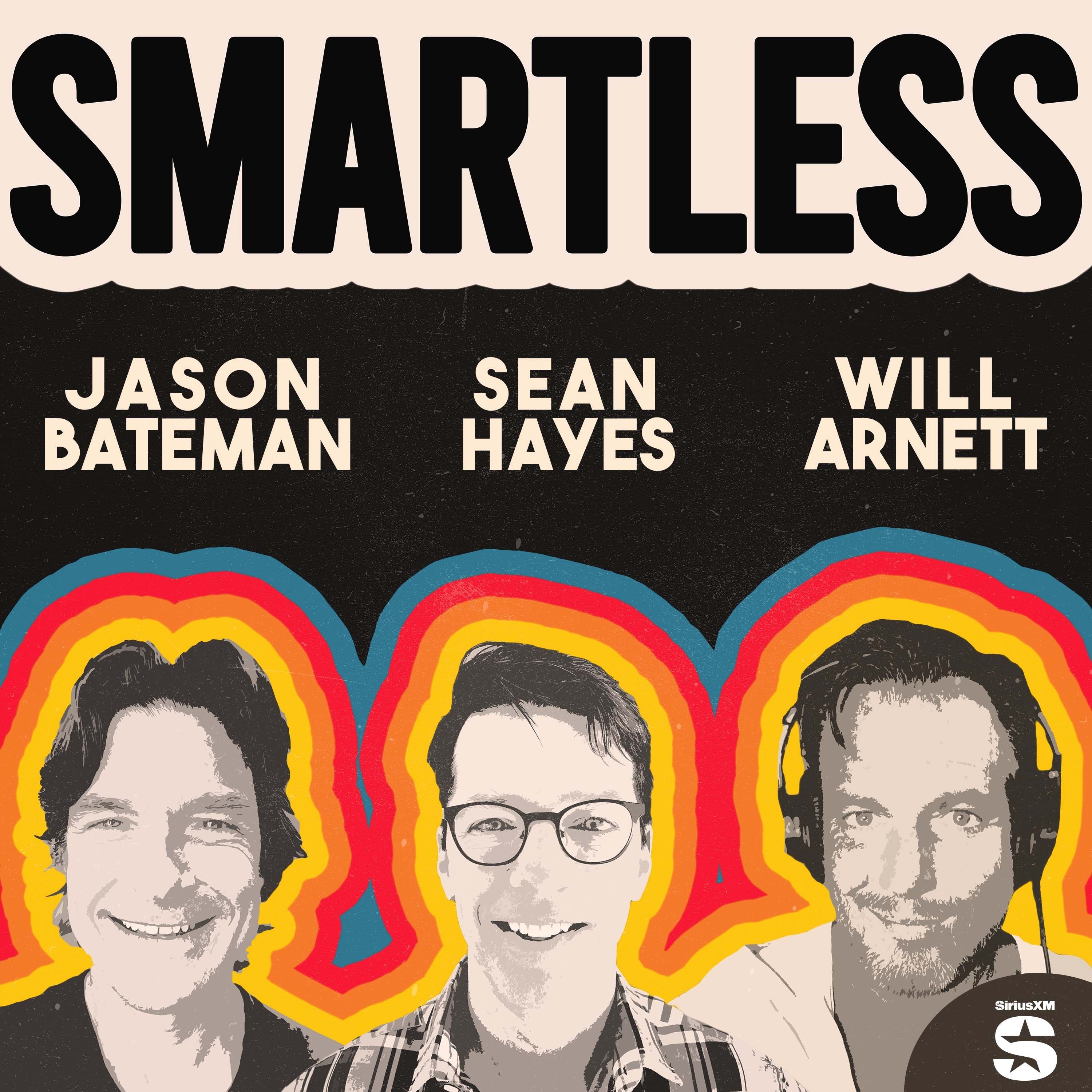
Tom Hanks reveals that Wilson the volleyball in Cast Away was deliberately named after his wife Rita Wilson, and that the film took six years from concept to shooting.
Jun 11, 20261:04:27
Difficulty: Beginner
Played
SmartLess
"RE-RELEASE: Tom Hanks"
Tom Hanks reveals that Wilson the volleyball in Cast Away was deliberately named after his wife Rita Wilson, and that the film took six years from concept to shooting.
Jun 11, 20261:04:27
Difficulty: Beginner
Played
TL;DR
Tom Hanks joins Jason Bateman, Sean Hayes, and Will Arnett for a wide-ranging conversation that ranges from the chaos of filming Saving Private Ryan's Omaha Beach sequence in Ireland[1]— Tom Hanks"At the Great Lakes Shakespeare Festival, director Dan Sullivan exploded at a hungover, post-opening-night cast: show up on time, know your …"34:10 to the slow pivot from comedy to dramatic films, and why Hanks believes the best career advice is simply "show up on time, know your lines, and have an idea in your pocket"[2]— Tom Hanks"The pressure remains absolute. The pressure is the speed of light in order to make a great story."52:33. Hanks reveals Wilson the volleyball in Cast Away was named after his wife Rita Wilson[3]— Tom Hanks"VHS player cost ~$4,000 in 1980: When Tom Hanks was filming Bosom Buddies around 1980, a VHS player cost approximately $4,000, making home …"53:08, and that he turned 27 the day Splash wrapped. The most useful takeaway: authenticity and consistency outlast any single role.
#Tom Hanks career#Saving Private Ryan production#Cast Away secrets#Hollywood comedy era#VHS vs streaming#career advice#Shakespeare performance#World War II storytelling#Bosom Buddies#film directing#Playtone Productions#iHeartMedia podcast awards#Tom Hanks#Saving Private Ryan#Cast Away#World War II#Hollywood#acting career#Splash#Shakespeare#filmmaking#streaming#VHS#SmartLess#Sean Hayes#comedy to drama
Tom Hanks surprises the SmartLess hosts — Jason Bateman, Sean Hayes, and Will Arnett — in a wide-ranging conversation covering his WWII obsession, the chaos of filming Saving Private Ryan, the Wilson volleyball secret, his comedy-to-drama career pivot, and why he still has the fire in the belly for filmmaking.
Chapter list
Before the hosts even get a word of their own in, the episode's pre-roll sponsor slate arrives. Jason Bateman handles Hotels.com, noting member prices deliver up to 20% savings on booking and that rewards accumulate with every stay. Sean Hayes then takes ACANA pet food, describing whole ingredients like pasture-raised beef, cranberries, and turmeric, and directing listeners to acana.com. Both reads are polished, brief, and over before the trio's competitive intro jostling begins.
The intro barely gets off the ground before Jason, Sean, and Will argue about who has the right to start it — a genuinely petty dispute that sets the comic tone for the hour. Once they settle, Jason reveals he's been quality-controlling past episodes on long drives and admits he'd 'like to be more of a part of it.' The real news arrives: SmartLess was nominated for multiple iHeartMedia podcast awards, and Sean Hayes scored a Best Host nomination. Will reads the thread's 'Congrats for us!' as an ominous kiss of death — now the jury will actually pay attention to Sean's hosting, which historically involves questions like 'Where are you from?' The ribbing accelerates: Jason suggests the iHeart people 'made a bunch of mistakes,' and Will reveals he told Sean 'congrats' and then texted that he didn't mean it.
Jason's guest introduction is a masterclass in misdirection: he opens with a fictional career in rugby in New Zealand and South Africa, a pivot to hīlai and dog racing in Florida, and a failed attempt to mend the San Andreas Fault before pivoting to two Academy Awards, seven Emmy Awards, a Tony nomination, an AFI Lifetime Achievement Award, a BAFTA, the Golden Globes' Cecil B. DeMille Award, Kennedy Center Honors, and the Presidential Medal of Freedom. Will correctly identifies this as 'the most highly decorated guest we've ever had.' Tom Hanks arrives and immediately says that had he known Sean Hayes was the host, he would have bailed — and that he had been telling friends the podcast was called 'HelpLess,' based on the Neil Young song. The playful tone is established: Tom is as sharp and warm as the hosts hoped.
Tom Hanks opens the first real conversational thread with a loaded question: friends of his have noticed that Will Arnett's voice seems to have shifted since he went off and voiced Batman, and now Will walks around with a 'self-imposed EQ.' Will acknowledges his voice has gotten lower — possibly from smoking, maybe from ageing — but deflects with politician-like evasiveness and a Howard Stern comparison. The smoking tangent then opens the door to Will referencing cigarettes as 'nails' in the Bernie Gunther novels — Philip Kerr's acclaimed WWII-era detective series. Tom lights up: he's read every book in the series and blurbed the jacket of Prussian Blue. Both men agree the series is remarkable for its historically accurate detail of the Nazi period, and Tom notes it follows a non-Nazi private investigator from 1928 Berlin through the post-war years. It's a genuine literary conversation that catches Jason off-guard.
With Jason gently prodding Sean to actually host, Sean asks the question he's wanted to ask for years: why is Tom Hanks so obsessed with war? Tom's answer is precise and personal. Every caregiver and adult figure in his childhood spoke about 'the war' in three phases — before, during, and after — as though it were a Black Plague walking among them. They had no certainty about the future and lived inside a historical moment of total existential uncertainty. The second driver is moral: the bad guys lost. Tom invokes Bill Moyers and Joseph Campbell's Power of Myth to describe the rarity of a world quest that defeated people who were 'undeniably evil.' He contrasts it with the present day, where 'there is no shame left anymore' and truth has become malleable. It's the episode's most thoughtful stretch, with Hanks moving fluidly between personal memory and cultural analysis.
Jason asks whether filming Saving Private Ryan ever gave Tom a visceral sense of what the soldiers must have felt. Tom's answer begins with the bracing disclaimer 'it was all fake' — but then he walks through what happened anyway. The Omaha Beach sequences were shot at County Wexford, Ireland, a location partly used in actual D-Day rehearsals. With 500 members of the real Irish Army, landing craft, and a special effects crew that had planted hidden air mortars under tiny flags on the beach — then removed the flags — the chaos was genuine even if the danger was controlled. Multiple cameras ran simultaneously. Tom was wet, cold, and disoriented. Out of one eye he'd see a stuntman catch fire; out of the other, a stunt amputee blown 40 feet into the air. He described it as 'an odd, fake, and yet at the same time terror.' He relayed to the other cast members — Barry Pepper, Eddie Burns, Vin Diesel — waiting at the top of the bluffs that they should hold on to their hats.
Will Arnett zeroes in on the quality he finds most powerful in Saving Private Ryan: Tom's character is a schoolteacher, an ordinary man who was called to do something extraordinary not because he was built for it but because that's what was required. This is the film's moral argument — the entire world was at war, and regular people rose to it. Will says this is what gives him reverence, not for war itself, but for the bravery of ordinary people in an extraordinary moment. Tom agrees and adds that the goal was always to make an anti-war movie at the same time as a war movie, holding both impulses in tension.
Tom Hanks sets the scene: he's 18, working as a bellman at the Royal Hotel in Oakland, California. The hotel dry cleaner — he calls him Mike — is absent for two weeks every June. When Mike returns, Tom asks where he went. Mike says they visited a place they first saw as kids: the north of France. He was a paratrooper in the 82nd Airborne who jumped into Normandy on D-Day in 1944. By 1974 he's in his 50s, delivering hotel laundry. Tom felt 'stupid and small.' The punchline: Mike said they go back 'to visit the buddies that didn't make it home.' The cemeteries. Will Arnett responds with his own story: his grandfather, who served with the Canadian Army attached to the Royal Air Force, told him late in life that a tentmate stepped out of his tent in the dark during the war and walked into a plane propeller. Will asked what his grandfather did. 'I got a new tent mate,' he said. The matter-of-factness was devastating.
Sean Hayes takes the ACANA read again, then the block includes Allstate's home insurance pitch around memorable family moments, and SNHU's online degree programs positioned around busy pet owners. Will Arnett delivers the BetterHelp read as a personal testimonial: he describes finding real value in talking to someone else about a difficult conversation before having it. He acknowledges that even in 2026, stigma around mental health keeps people from seeking support, and positions therapy as a place to slow down before things feel unmanageable. BetterHelp offers 10% off at betterhelp.com/smartless via its industry-leading therapist matching system.
Jason opens this segment by asking whether the sitcom schedule — rehearse Monday through Wednesday, camera block Thursday, shoot Friday, or some version thereof — is the best job in show business. Tom confirms it is 'kind of a skate' and a 'great hang.' Jason then reveals the Jimmy Burrows version: a 4-day work week, only 3 weeks per month, 12 working days total, 6 hours a day, with food and climate control. Tom is genuinely alarmed that Jason is broadcasting this to civilians. The conversation is playful but also grounded — it sets up the contrast with what Tom was earning before TV.
Tom paints a vivid picture of the financial precariousness before Bosom Buddies: a full year as a Shakespearean actor earning less than $10,000, a wife, a child, and no clear path forward. When the sitcom came through, it was genuinely life-changing — two weeks' pay matched an entire year of stage work. The show also introduced the dynamic that would define Tom's on-set personality: he and Peter Scolari goofed around so relentlessly during video camera blocking that the director would come over the intercom from the booth — the Voice of God — to tell them to stick to the lines. Tom describes their mutual indifference to these warnings with obvious fondness.
Tom Hanks describes performing Falstaff with the Shakespeare Center Los Angeles in an outdoor VA Center garden in West Los Angeles, among eucalyptus trees. Midway through the nearly three-hour show, a man had a medical episode. EMTs arrived, the lights came up, and a 30-minute hold began. Tom and the cast waited backstage wondering whether to do something — and then Tom saw a woman reach for her purse. He sprinted out and started improvising Shakespearean commands and ridicule, telling people to sit down using whatever old-English phrasings he could summon, threatening and cajoling and ridiculing in equal measure until enough people stayed. Sean Hayes confirms it was hilarious and that Tom improvised it entirely in Shakespearean English — the thing that most impressed him.
This is the episode's philosophical centerpiece. Tom Hanks sets the scene: the Great Lakes Shakespeare Festival, 1977, the morning after Hamlet opened. All the Equity company members have been out partying, and the 10 a.m. Taming of the Shrew rehearsal is populated by somnambulistic, half-present professionals. Dan Sullivan explodes: three weeks to get the show on its feet, and nobody is even trying. He tells them they need to show up on time, know their lines, and have an idea — he can't provide everything. Tom, 20 years old and barely a spear-carrier, watches experienced professionals get torn apart and thinks: if these 20-year veterans can fall this short, the bar is not about talent — it's about reliability and preparation. He carried those three rules through every job, every hit, and every miss for the rest of his career.
Sean Hayes frames his question diplomatically — he asks about the 'pivot to more important films' — and Will and Jason razz him for it. Tom doesn't take offense; instead he describes the era with sharp self-awareness. A $15 million film called a comedy seemed to do 'some brand of business' whether it was funny or not. Everybody who had said 'action' and 'cut' was trusted to direct comedies, and the real comedy talent was coming from the Second City and SNL ecosystem. Tom and his projects lived in the margins of that world — doing imitations of better films, using location as concept. Every dailies screening, regardless of the actual material, was proclaimed 'the funniest film ever made.' Will loyally notes that regardless of the material, Hanks was always good — always committed.
Tom tells the story of the last day of Splash: they were in the Bahamas, and a wrap cake appeared. Someone discovered it was Tom's birthday and used a tube of toothpaste to add a birthday message in icing. That's the image: 27 years old, celebrating the completion of his breakthrough comedy while someone scrawled 'Happy Birthday, Tom' in toothpaste. From there, Splash was well-reviewed and then came a long drought — six or seven films without a decent notice. The punchline is that the culture has retroactively rehabilitated them: they are all now called cult classics. Tom seems simultaneously bewildered and amused.
Jason asks whether the scripts started getting confusing once Philadelphia happened — Tom's answer goes to a conversation with his CAA representative. When asked what he wanted to do, Tom said: 'I want to play grown-ups. I want to play people who have been through bitter compromise.' He was in his mid-30s. Will interjects with a fake-solemn explanation of what compromise means — for Jason's benefit — and the moment captures the easy comedic chemistry of the group. But Tom's core insight stands: the pivot wasn't driven by a sudden artistic vision, it was driven by age. He got older. The roles he could authentically inhabit changed.
Sean sets up his question with ostentatious self-deprecation, and it turns out to be the episode's most quotable revelation: the volleyball was absolutely named after Rita Wilson, and Tom and Rita are approaching 34 years of marriage. Bill Broyles wrote the name in as a tribute. The film took six years from the first conversation between Hanks and Broyles to cameras rolling. Then Sean pivots to one of the episode's funniest stories: working on Will & Grace, he and a colleague got extremely high and decided to watch the Cast Away plane crash sequence on DVD. The friend had a brand-new Sony setup and couldn't get it to work. Sean, completely stoned, told him with total authority that Sony had a new voice-activated system — you just say the name of the movie into the machine. The friend turned around and said 'Cast Away' into the DVD player. Twice. Tom Hanks notes that Bob Zemeckis never cut to an exterior shot of the plane during the crash, keeping the tension entirely from the passenger perspective.
Jason asks whether Tom was drawn to directing partly because he knew more than many directors he worked with. Tom firmly deflects: directing is 'a bit of an ego thing' and the moment you try it, you realize how hard it is. He argues every actor should try directing and every director should act — just to understand the other job. He then describes the frustration of being an actor with an idea in his pocket while a director says 'meh, try it again' without appreciating the difficulty of weeping on a horse while remembering six pages of dialogue. As for directing himself, Tom is honest: he has the instincts of an actor, not a director. Directors need fidelity, patience, and a belief that this is the greatest job in the world. 'And oftentimes it's not.'
Jason pushes back against Tom's habit of shrugging off his own producing work — pointing out that Playtone has employed enormous numbers of people and put out vast amounts of product, which is no small thing. Tom's response is characteristically disarming: they operate like a clubhouse, leaning into each other's doorways and asking whether an idea is really a feature or should be a 12-part miniseries. The real producers — the ones doing the actual heavy lifting — spend every day convincing people to do things they don't want to do, or flatly refusing what others desperately want. That's not Tom. Tom's answer is always yes. He says it with obvious self-awareness and a touch of pride.
Will Arnett leads the Audible read for the Kate McKinnon-starring Heads Will Roll: Heir Apparent on Audible, a medieval comedy sequel with a star-studded cast. Jason and Will co-read a Whole Foods Market spot for summer grilling season. Sean Hayes handles Muscle Milk, noting its new formula has no artificial sweeteners, flavors, or colors, and comes in four flavors. Will handles Principal's employer benefits pitch and Jason reads for Harvey, an AI legal platform trusted by more than 60% of the AmLaw 100.
Jason opens the streaming conversation by asking whether Tom finds the lack of opening-weekend pressure liberating. Tom's answer cuts through the industry noise: movies are binary — zero or one, they work or they don't — and no amount of streaming distribution or marketing changes that fundamental truth. The audience doesn't care where they see it. Only the business cares. He then draws a historical parallel: in 1980, when Bosom Buddies was filming, a VHS player cost $4,000. The neighborhood video shoppe was just emerging, with VHS on one wall and Betamax on the other. Kids started waking up on Saturday mornings and putting in Dumbo without waking their parents. This was the first streaming revolution, just slower. Sean reveals Tom told him years ago that the business is always changing and fighting it is pointless. Gary Goetzman's line: sitting at home watching something on your TV 'is not that bad.'
Tom describes Playtone's early HBO deal as a creative gold standard: no commercials, no language restrictions, total freedom, and at the time, being on HBO was the aspirational peak. That freedom now extends everywhere in streaming — but the basic requirement remains: put out great product or disappear. Will asks whether Marvel has ever called — Tom says they never have, not once, though he imagines someday they might cast him as the Secretary of Defense, the man who comes in to say humanity is doomed. Will makes the broader point that Tom stands apart as someone still making grown-up, non-IP films in an era when the feature market is increasingly dominated by franchise titles. Tom is generous about those films but honest that not all of them are great.
Jason builds toward a question about Tom's groundedness and thanks his parents for it — only for Tom to note, flatly and with dry timing, that his parents divorced when he was five. The room deflates comically. Will asks instead what Tom's parents thought of him pursuing acting: both were supportive, seeing it as 'look what Tommy found.' Tom then turns it back on Sean, referencing Promises Promises on Broadway, where Sean played piano onstage and did eight shows a week for a year. Tom says Sean said to him what Laurence Olivier said late in his career when asked if he'd return to the stage: 'I'm not sure I have the fire in the belly.' Olivier's version referred to the 'stronger heart' required — not medically, but emotionally. Both Tom and Sean agree the commitment is total and demanding in a way that film simply is not.
The goodbye is extended and genuinely warm. Tom asks if there's a podcast award for second bananas — Will and Jason can fight over that one. Tom declares that in Canada, the show is known as 'Will Arnett's SmartLess,' and that it's the number-one podcast there, which Will receives with characteristic mock dignity. After Tom disconnects, Jason articulates what the conversation confirmed: Hanks is 'us' — completely personable, authentic, never arrogant, and a leader you'd want to follow. Sean's one borderline political remark gets immediately shot down. The group agrees Tom is one of the few public figures 'both sides' can agree on. They discuss Finch, coming to Apple TV+ on November 5th, and wonder if he'll keep making a film a year. The episode closes with the standard SmartLess credits roll.
Will Arnett delivers the show's standard production credit — SmartLess is '100% organic and artisanally handcrafted' by Bennett Barber, Michael Grant Terry, and Rob Armcharf. The final sponsor slots go to Principal, positioned around retaining key employees with retirement and benefits plans, and to Harvey, the AI legal agent platform built specifically for law firms. The episode then fades out with the show's signature outro, closing one of the most decorated guest conversations in SmartLess's run.
Rotating rep (repertory)
A theater company that alternates multiple productions in a season, so a different show is performed each night; Hanks explains this to Sean Hayes mid-anecdote.
Defilade
Military term for a sheltered position protected from enemy fire, typically behind a ridge or embankment; Hanks uses it to describe the shale at the top of the Omaha Beach bluffs.
Squibs
Small pyrotechnic devices used in film production to simulate bullet impacts or explosions; Hanks mentions them in the Saving Private Ryan beach shoot.
Camera blocking
The process of choreographing actor and camera movements before the actual performance shoot; Hanks describes the video-camera blocking day on Bosom Buddies as unusually demanding.
Line cut
A live edit switching between multiple camera feeds; on Bosom Buddies, the director had to line-cut in real time, requiring actors to be present and on-script during blocking.
Dailies (rushes)
Unedited footage from the previous day's shooting, reviewed by the cast and crew; Hanks jokes that every set called their dailies the funniest footage ever shot.
Somnambulistic
Moving or acting as if sleepwalking; Hanks uses it to describe the hung-over, zombie-like state of the Shakespeare company the morning after opening night.
Zeitgeist
The defining spirit or mood of a particular era; Hanks uses it to argue that no marketing campaign can change a film's cultural reception.
Fidelity (in directing)
Here, unwavering loyalty and sustained focus on a singular creative vision over a long production — Hanks says directors need this in a way actors do not.
Playtone Productions
Tom Hanks and Gary Goetzman's production company, responsible for Band of Brothers, The Pacific, and other projects; named after the fictional record label in That Thing You Do.
Pontifcate
To express one's opinions in a pompously authoritative way; Hanks uses it self-deprecatingly when offering his thoughts on the film industry's future.
Aorta
Jason Bateman's comic suggestion for the name of the iHeartMedia podcast award, riffing on the word 'iHeart' — since the aorta is the heart's main artery.
Prussian Blue
The tenth novel in Philip Kerr's Bernie Gunther historical detective series, set in Nazi Germany; Will Arnett mentions it as the book he was reading.
82nd Airborne
A U.S. Army airborne division that parachuted into Normandy on D-Day, June 6, 1944; Hanks's dry-cleaning acquaintance was a paratrooper in this unit.
Fire in the belly
A strong, sustained drive or ambition to do something demanding; Sean Hayes uses it (echoing Laurence Olivier) to explain why he may not do another Broadway run.
VHS (Video Home System)
A consumer-level magnetic tape home video format dominant from the late 1970s through the 1990s, competing with Sony's Betamax format before becoming the universal standard.
Betamax
Sony's proprietary home video cassette format, a direct competitor to VHS in the late 1970s and 1980s that ultimately lost the format war.
EQ (equalizer)
Audio engineering shorthand for equalization — adjusting the balance of frequency components in a sound signal; Tom Hanks jokes that Will Arnett now walks around with a self-imposed EQ on his voice since voicing Batman.
Chapter 2 · 01:21
The Hosting Wars: Sean's iHeart Nomination Embarrassment
The intro barely gets off the ground before Jason, Sean, and Will argue about who has the right to start it — a genuinely petty dispute that sets the comic tone for the hour. Once they settle, Jason reveals he's been quality-controlling past episodes on long drives and admits he'd 'like to be more of a part of it.' The real news arrives: SmartLess was nominated for multiple iHeartMedia podcast awards, and Sean Hayes scored a Best Host nomination. Will reads the thread's 'Congrats for us!' as an ominous kiss of death — now the jury will actually pay attention to Sean's hosting, which historically involves questions like 'Where are you from?' The ribbing accelerates: Jason suggests the iHeart people 'made a bunch of mistakes,' and Will reveals he told Sean 'congrats' and then texted that he didn't mean it.
SmartLess received multiple podcast award nominations, including a Best Host nomination for Sean Hayes from iHeartMedia, which the hosts found both flattering and embarrassing.
Chapter 5 · 12:24
Tom Hanks's Lifelong Fascination With World War II
With Jason gently prodding Sean to actually host, Sean asks the question he's wanted to ask for years: why is Tom Hanks so obsessed with war? Tom's answer is precise and personal. Every caregiver and adult figure in his childhood spoke about 'the war' in three phases — before, during, and after — as though it were a Black Plague walking among them. They had no certainty about the future and lived inside a historical moment of total existential uncertainty. The second driver is moral: the bad guys lost. Tom invokes Bill Moyers and Joseph Campbell's Power of Myth to describe the rarity of a world quest that defeated people who were 'undeniably evil.' He contrasts it with the present day, where 'there is no shame left anymore' and truth has become malleable. It's the episode's most thoughtful stretch, with Hanks moving fluidly between personal memory and cultural analysis.
Every adult in Hanks's childhood spoke about World War II as the great dividing line of their lives — before, during, and after, like a Black Plague walking among them. Add the moral clarity that the bad guys lost, and you have a storytelling well he keeps returning to.
Filming Saving Private Ryan: Omaha Beach in Ireland
Jason asks whether filming Saving Private Ryan ever gave Tom a visceral sense of what the soldiers must have felt. Tom's answer begins with the bracing disclaimer 'it was all fake' — but then he walks through what happened anyway. The Omaha Beach sequences were shot at County Wexford, Ireland, a location partly used in actual D-Day rehearsals. With 500 members of the real Irish Army, landing craft, and a special effects crew that had planted hidden air mortars under tiny flags on the beach — then removed the flags — the chaos was genuine even if the danger was controlled. Multiple cameras ran simultaneously. Tom was wet, cold, and disoriented. Out of one eye he'd see a stuntman catch fire; out of the other, a stunt amputee blown 40 feet into the air. He described it as 'an odd, fake, and yet at the same time terror.' He relayed to the other cast members — Barry Pepper, Eddie Burns, Vin Diesel — waiting at the top of the bluffs that they should hold on to their hats.
The Omaha Beach sequence was filmed in County Wexford, Ireland, with 500 actual Irish Army soldiers. Special effects crews planted hidden air mortars under tiny flags on the sand — then removed the flags. Hanks describes wandering blind, wet, cold, while stuntmen caught fire and flew 40 feet into the air.
The Omaha Beach sequence in Saving Private Ryan was filmed at County Wexford, Ireland, using 500 actual members of the Irish Army as extras.
Chapter 7 · 19:15
The Moral Logic of Saving Private Ryan and WWII Stories
Will Arnett zeroes in on the quality he finds most powerful in Saving Private Ryan: Tom's character is a schoolteacher, an ordinary man who was called to do something extraordinary not because he was built for it but because that's what was required. This is the film's moral argument — the entire world was at war, and regular people rose to it. Will says this is what gives him reverence, not for war itself, but for the bravery of ordinary people in an extraordinary moment. Tom agrees and adds that the goal was always to make an anti-war movie at the same time as a war movie, holding both impulses in tension.
Saving Private Ryan was released in 1997, a fact that surprised the hosts given how vivid and timeless the film still feels.
Chapter 8 · 20:05
The D-Day Dry Cleaner: An 18-Year-Old Tom Hanks Meets a Paratrooper
Tom Hanks sets the scene: he's 18, working as a bellman at the Royal Hotel in Oakland, California. The hotel dry cleaner — he calls him Mike — is absent for two weeks every June. When Mike returns, Tom asks where he went. Mike says they visited a place they first saw as kids: the north of France. He was a paratrooper in the 82nd Airborne who jumped into Normandy on D-Day in 1944. By 1974 he's in his 50s, delivering hotel laundry. Tom felt 'stupid and small.' The punchline: Mike said they go back 'to visit the buddies that didn't make it home.' The cemeteries. Will Arnett responds with his own story: his grandfather, who served with the Canadian Army attached to the Royal Air Force, told him late in life that a tentmate stepped out of his tent in the dark during the war and walked into a plane propeller. Will asked what his grandfather did. 'I got a new tent mate,' he said. The matter-of-factness was devastating.
While working as a hotel bellman in Oakland at age 18, Hanks struck up a conversation with a dry cleaner named Mike who casually mentioned taking a vacation every June — to Normandy, to visit the graves of the buddies who didn't make it home from D-Day.
Tom Hanks Before Fame: Bosom Buddies, Shakespeare, and Being Broke
Tom paints a vivid picture of the financial precariousness before Bosom Buddies: a full year as a Shakespearean actor earning less than $10,000, a wife, a child, and no clear path forward. When the sitcom came through, it was genuinely life-changing — two weeks' pay matched an entire year of stage work. The show also introduced the dynamic that would define Tom's on-set personality: he and Peter Scolari goofed around so relentlessly during video camera blocking that the director would come over the intercom from the booth — the Voice of God — to tell them to stick to the lines. Tom describes their mutual indifference to these warnings with obvious fondness.
Before booking Bosom Buddies, Hanks spent a full year as a Shakespearean actor earning less than $10,000, married with a kid. Two weeks on the show matched that annual salary. He and co-star Peter Scolari were so comfortable goofing off that the director had to yell at them through the intercom from the control booth.
Tom Hanks performed Shakespeare as Falstaff with the Shakespeare Center Los Angeles roughly two years before this 2021 interview.
Chapter 12 · 31:28
Tom Hanks Plays Falstaff: The Medical Emergency and the Shakespeare Improv
Tom Hanks describes performing Falstaff with the Shakespeare Center Los Angeles in an outdoor VA Center garden in West Los Angeles, among eucalyptus trees. Midway through the nearly three-hour show, a man had a medical episode. EMTs arrived, the lights came up, and a 30-minute hold began. Tom and the cast waited backstage wondering whether to do something — and then Tom saw a woman reach for her purse. He sprinted out and started improvising Shakespearean commands and ridicule, telling people to sit down using whatever old-English phrasings he could summon, threatening and cajoling and ridiculing in equal measure until enough people stayed. Sean Hayes confirms it was hilarious and that Tom improvised it entirely in Shakespearean English — the thing that most impressed him.
During a nearly 3-hour outdoor Shakespeare performance at the VA Center in Los Angeles, a man had a medical episode. When Hanks saw a woman picking up her purse to leave, he sprinted onstage and started improvising Shakespearean insults to shame the audience into staying.
The Dan Sullivan Lesson and Young Tom Hanks's Professional Code
This is the episode's philosophical centerpiece. Tom Hanks sets the scene: the Great Lakes Shakespeare Festival, 1977, the morning after Hamlet opened. All the Equity company members have been out partying, and the 10 a.m. Taming of the Shrew rehearsal is populated by somnambulistic, half-present professionals. Dan Sullivan explodes: three weeks to get the show on its feet, and nobody is even trying. He tells them they need to show up on time, know their lines, and have an idea — he can't provide everything. Tom, 20 years old and barely a spear-carrier, watches experienced professionals get torn apart and thinks: if these 20-year veterans can fall this short, the bar is not about talent — it's about reliability and preparation. He carried those three rules through every job, every hit, and every miss for the rest of his career.
At the Great Lakes Shakespeare Festival, director Dan Sullivan exploded at a hungover, post-opening-night cast: show up on time, know your lines, have an idea. Hanks, 20 years old and barely a spear-carrier, decided that day that those three rules would define his entire career.
The Comedy Era: Imitating Other People's Funny Movies
Sean Hayes frames his question diplomatically — he asks about the 'pivot to more important films' — and Will and Jason razz him for it. Tom doesn't take offense; instead he describes the era with sharp self-awareness. A $15 million film called a comedy seemed to do 'some brand of business' whether it was funny or not. Everybody who had said 'action' and 'cut' was trusted to direct comedies, and the real comedy talent was coming from the Second City and SNL ecosystem. Tom and his projects lived in the margins of that world — doing imitations of better films, using location as concept. Every dailies screening, regardless of the actual material, was proclaimed 'the funniest film ever made.' Will loyally notes that regardless of the material, Hanks was always good — always committed.
In the era when Hanks was churning out comedies, a $15 million budget and a comedy label was essentially a license to print money. The genre was dominated by Second City and SNL alumni, and Hanks describes his films as 'doing imitations of other people's funny movies' — yet every single daily screening was called the funniest movie ever made.
Splash, the Cult Classic Arc, and Tom Hanks Turning 27 on Set
Tom tells the story of the last day of Splash: they were in the Bahamas, and a wrap cake appeared. Someone discovered it was Tom's birthday and used a tube of toothpaste to add a birthday message in icing. That's the image: 27 years old, celebrating the completion of his breakthrough comedy while someone scrawled 'Happy Birthday, Tom' in toothpaste. From there, Splash was well-reviewed and then came a long drought — six or seven films without a decent notice. The punchline is that the culture has retroactively rehabilitated them: they are all now called cult classics. Tom seems simultaneously bewildered and amused.
Tom Hanks turned 27 on the last day of shooting Splash in the Bahamas; the wrap cake was amended with toothpaste-icing to wish him happy birthday.
Chapter 16 · 40:55
The Pivot to Drama: 'I Want to Play Grown-Ups'
Jason asks whether the scripts started getting confusing once Philadelphia happened — Tom's answer goes to a conversation with his CAA representative. When asked what he wanted to do, Tom said: 'I want to play grown-ups. I want to play people who have been through bitter compromise.' He was in his mid-30s. Will interjects with a fake-solemn explanation of what compromise means — for Jason's benefit — and the moment captures the easy comedic chemistry of the group. But Tom's core insight stands: the pivot wasn't driven by a sudden artistic vision, it was driven by age. He got older. The roles he could authentically inhabit changed.
In his mid-30s, Hanks told his CAA agent he wanted to play grown-ups who had been through bitter compromise. That declaration marked the end of the comedy era and the beginning of Philadelphia, Forrest Gump, and everything that followed.
Wilson Was Named After Rita Wilson — and the Cast Away Prank Story
Sean sets up his question with ostentatious self-deprecation, and it turns out to be the episode's most quotable revelation: the volleyball was absolutely named after Rita Wilson, and Tom and Rita are approaching 34 years of marriage. Bill Broyles wrote the name in as a tribute. The film took six years from the first conversation between Hanks and Broyles to cameras rolling. Then Sean pivots to one of the episode's funniest stories: working on Will & Grace, he and a colleague got extremely high and decided to watch the Cast Away plane crash sequence on DVD. The friend had a brand-new Sony setup and couldn't get it to work. Sean, completely stoned, told him with total authority that Sony had a new voice-activated system — you just say the name of the movie into the machine. The friend turned around and said 'Cast Away' into the DVD player. Twice. Tom Hanks notes that Bob Zemeckis never cut to an exterior shot of the plane during the crash, keeping the tension entirely from the passenger perspective.
Cast Away took six years from the first conversation between Hanks and screenwriter Bill Broyles to cameras rolling. Broyles came up with the volleyball and named it Wilson as a tribute to Hanks's wife Rita Wilson — a detail Hanks revealed nearly broke Sean Hayes.
Completely stoned, Sean Hayes convinced a friend who had just bought a new Sony DVD player that it was voice-activated. The friend earnestly said 'Cast Away' into the machine — twice — while Hayes suffocated with laughter behind him.
Hanks has directed two feature films and several miniseries episodes, but concludes that true directors are born into the belief that it's the greatest job in the world. He is not. He also believes every director should be required to act, and every actor should produce — just to understand how hard the other job is.
45:42
47:50
Chapter 18 · 45:56
Directing, Acting, and Tom Hanks on the Limits of His Own Talent
Jason asks whether Tom was drawn to directing partly because he knew more than many directors he worked with. Tom firmly deflects: directing is 'a bit of an ego thing' and the moment you try it, you realize how hard it is. He argues every actor should try directing and every director should act — just to understand the other job. He then describes the frustration of being an actor with an idea in his pocket while a director says 'meh, try it again' without appreciating the difficulty of weeping on a horse while remembering six pages of dialogue. As for directing himself, Tom is honest: he has the instincts of an actor, not a director. Directors need fidelity, patience, and a belief that this is the greatest job in the world. 'And oftentimes it's not.'
Tom Hanks has directed two feature films and a number of episodes for miniseries, but says directors are born to it in a way he is not.
Chapter 19 · 49:38
Producing, Playtone, and the Business of Saying Yes
Jason pushes back against Tom's habit of shrugging off his own producing work — pointing out that Playtone has employed enormous numbers of people and put out vast amounts of product, which is no small thing. Tom's response is characteristically disarming: they operate like a clubhouse, leaning into each other's doorways and asking whether an idea is really a feature or should be a 12-part miniseries. The real producers — the ones doing the actual heavy lifting — spend every day convincing people to do things they don't want to do, or flatly refusing what others desperately want. That's not Tom. Tom's answer is always yes. He says it with obvious self-awareness and a touch of pride.
Hanks draws a sharp line between himself and real producers: producers spend all day convincing people to do things they don't want to do, or telling people they won't get what they want. Hanks just says yes to everything.
49:38
50:50
Chapter 21 · 52:00
Streaming vs. Theatrical: The Audience Never Cared
Jason opens the streaming conversation by asking whether Tom finds the lack of opening-weekend pressure liberating. Tom's answer cuts through the industry noise: movies are binary — zero or one, they work or they don't — and no amount of streaming distribution or marketing changes that fundamental truth. The audience doesn't care where they see it. Only the business cares. He then draws a historical parallel: in 1980, when Bosom Buddies was filming, a VHS player cost $4,000. The neighborhood video shoppe was just emerging, with VHS on one wall and Betamax on the other. Kids started waking up on Saturday mornings and putting in Dumbo without waking their parents. This was the first streaming revolution, just slower. Sean reveals Tom told him years ago that the business is always changing and fighting it is pointless. Gary Goetzman's line: sitting at home watching something on your TV 'is not that bad.'
Hanks dismisses the idea that streaming removes pressure from filmmakers. Movies are binary — zero or one, they work or they don't — and no marketing, interview, or distribution strategy changes that fundamental truth. The audience doesn't care where they see it; the business does.
In 1980, a VHS player cost $4,000 and only the very wealthy had one. Within two years, the price dropped enough to trigger mass adoption. Hanks argues the current streaming transition is no different — the audience never cared where they watched; only the industry did.
When Tom Hanks was filming Bosom Buddies around 1980, a VHS player cost approximately $4,000, making home video an extreme luxury.
Chapter 23 · 1:00:30
Tom Hanks on Being an Everyman: Parents, High School Drama, and the Fire in the Belly
Jason builds toward a question about Tom's groundedness and thanks his parents for it — only for Tom to note, flatly and with dry timing, that his parents divorced when he was five. The room deflates comically. Will asks instead what Tom's parents thought of him pursuing acting: both were supportive, seeing it as 'look what Tommy found.' Tom then turns it back on Sean, referencing Promises Promises on Broadway, where Sean played piano onstage and did eight shows a week for a year. Tom says Sean said to him what Laurence Olivier said late in his career when asked if he'd return to the stage: 'I'm not sure I have the fire in the belly.' Olivier's version referred to the 'stronger heart' required — not medically, but emotionally. Both Tom and Sean agree the commitment is total and demanding in a way that film simply is not.
At the Great Lakes Shakespeare Festival, director Dan Sullivan exploded at a hungover, post-opening-night cast: show up on time, know your lines, have an idea. Hanks, 20 years old and barely a spear-carrier, decided that day that those three rules would define his entire career.
While working as a hotel bellman in Oakland at age 18, Hanks struck up a conversation with a dry cleaner named Mike who casually mentioned taking a vacation every June — to Normandy, to visit the graves of the buddies who didn't make it home from D-Day.
Factual claims made this episode, and whether a source was named.
⚠
Saving Private Ryan's Omaha Beach sequences were filmed at County Wexford, Ireland, not at the actual Omaha Beach.
Tom Hanksno source cited
⚠
The Saving Private Ryan Omaha Beach shoot used 500 actual members of the Irish Army as extras.
Tom Hanksno source cited
⚠
Saving Private Ryan was released in 1997.
Tom Hanksno source cited
⚠
Before Bosom Buddies, Tom Hanks earned less than $10,000 in an entire year as a Shakespearean actor while married with a child.
Tom Hanksno source cited
⚠
The volleyball in Cast Away was named Wilson by screenwriter Bill Broyles as a tribute to Tom Hanks's wife Rita Wilson.
Tom Hanksno source cited
⚠
Cast Away took approximately six years from the first conversations between Tom Hanks and Bill Broyles to the start of filming.
Tom Hanksno source cited
⚠
Tom Hanks turned 27 on the last day of shooting Splash in the Bahamas.
Tom Hanksno source cited
⚠
A VHS player cost approximately $4,000 in 1980, the first year of Bosom Buddies.
Tom Hanksno source cited
⚠
Tom Hanks has directed two feature films and several episodes of miniseries.
Tom Hanksno source cited
⚠
That Thing You Do was Tom Hanks's first feature film as director.
Tom Hanksno source cited
⚠
Tom Hanks played Falstaff with the Shakespeare Center Los Angeles approximately two years before this 2021 episode was recorded.
Tom Hanksno source cited
⚠
Tom Hanks performed at the Great Lakes Shakespeare Festival in rotating repertory in 1977 as a spear-carrier while also playing Grumio in Taming of the Shrew.
Tom Hanksno source cited
⚠
Sean Hayes performed in Promises Promises on Broadway for approximately one year.
Will Arnettno source cited
⚠
Tom Hanks performed at the VA Center in the Japanese Garden in West Los Angeles during his Shakespeare Center LA run of Falstaff.
Tom Hanksno source cited
⚠
Bob Zemeckis never cut to an exterior shot of the plane during the Cast Away plane crash sequence, keeping the entire sequence from the passengers' inside perspective.
Tom Hanksno source cited
This episode
Cast
Guest and subject of the episode — Oscar-winning actor and producer discussing his career, WWII fascination, and upcoming film Finch.
Late British author of the Bernie Gunther WWII detective series, recommended by Tom Hanks and enthusiastically seconded by Will Arnett.
Tom Hanks's wife, after whom the volleyball Wilson in Cast Away was named by screenwriter Bill Broyles.
Director at the Great Lakes Shakespeare Festival whose infamous dressing-down of a hung-over cast gave Tom Hanks his lifelong professional code.
Tom Hanks's co-star on Bosom Buddies, described as a dear old pal and the person with whom Hanks first started his on-set goofing-around dynamic.
Director of Splash who had already left Happy Days when Hanks guest-starred; Hanks corrects the hosts' assumption that they met on Happy Days.
Director of Cast Away, praised by Tom Hanks for never cutting to an exterior shot during the plane crash sequence, keeping the audience inside the terror.
Lakewood, Ohio theater festival where Tom Hanks began his professional acting career in rotating repertory, key setting for the Dan Sullivan anecdote.
Tom Hanks and Gary Goetzman's production company, discussed as a collaborative 'clubhouse' operation responsible for HBO miniseries and feature films.
Premium cable network that was Playtone's first major deal partner, described by Hanks as the gold standard for creative freedom before the streaming era.
Streaming platform releasing Tom Hanks's film Finch in November 2021, discussed as part of the broader streaming vs. theatrical conversation.
Los Angeles theater organization where Tom Hanks performed as Falstaff approximately two years before this 2021 interview.
Tom Hanks's 1997 WWII film, discussed at length in terms of its production, the Omaha Beach shoot, and its emotional impact.
Tom Hanks's 2000 survival film, discussed for the Wilson volleyball revelation, Bob Zemeckis's directing choices, and Sean Hayes's prank story.
The ABC sitcom that launched Tom Hanks's career, discussed for its financial impact on a broke young Hanks and the on-set chemistry with Peter Scolari.
Tom Hanks's 1984 romantic comedy film, discussed as the only well-reviewed film in a long comedy streak and the day he turned 27 on set.
Tom Hanks's 2021 Apple TV+ film about a man, a dog, and a robot, discussed as an example of Hanks continuing to make non-franchise films.
Tom Hanks's 1996 directorial feature debut, cited as one of his most personally enjoyable filmmaking experiences and the founding project of Playtone.