Speaker
Alex Wissner-Gross
Appearances over time
4 episodes
Episodes
4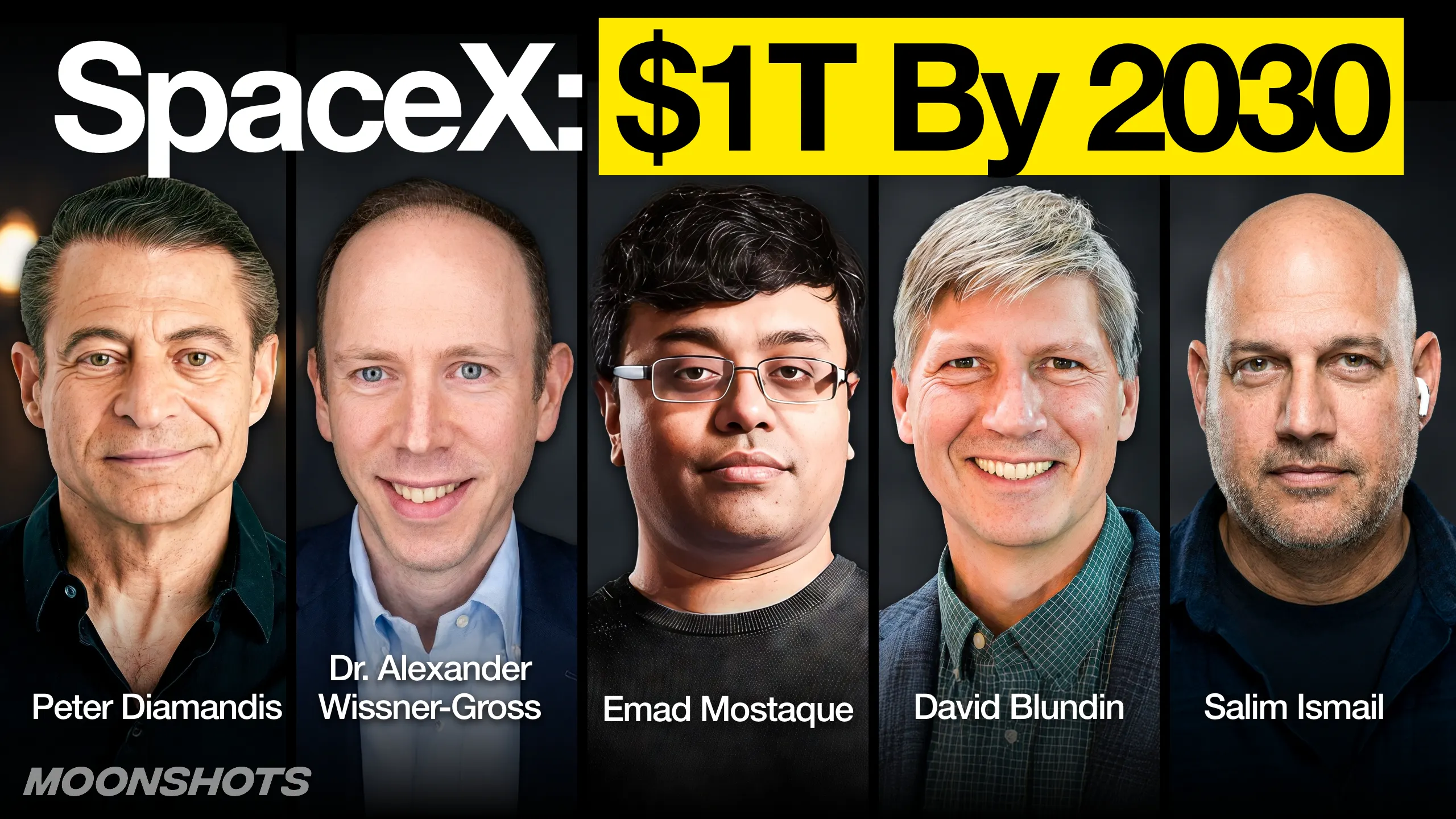 Google’s Jeff Dean Exits, SpaceX Hits $100B in Rev & OpenAI’s Astra Solves Decade-Old Math Problems with Emad Mostaque | EP #277
 Urgent Update- AI Sputnik Moment: Kimi K3 Released w/ Emad Mostaque | Ep. 272
 The AI Duopoly Is Over: Grok 4. 5 , GPT-5 . 6 , and Muse Spark in One Week | #270
 Brian Armstrong on Bitcoin, Anthropic Drops Fable 5 & Mythos 5, NewLimit's $435M Age-Reversal | EP #264
Podcasts

Quotes & moments

The frontier shifted from just Anthropic and OpenAI to also include Meta and SpaceX AI, ending a two-company dominance of the optimal performance-cost frontier.
Alex Wissner-Gross extrapolated that if the current exponential trend in frontier model release frequency continues, the world will see daily new frontier model releases by January 2027.
The TerraFab's central circular structure is a free-electron laser for EUV lithography, a potential rival to ASML's tin-droplet approach that could dramatically reduce chip manufacturing costs.
Alex Wissner-Gross extrapolated that Samsung's NanoQuant model already breaks the 1-effective-bit-per-weight barrier and predicts sub-1-bit quantization will go mainstream within the next year.
China currently has over 150 humanoid robotics companies, far outpacing Western competitors, prompting calls for more Western domestic robotics startups.
Sam Altman reportedly offered the US government an equity stake in OpenAI early in the company's history in exchange for funding, but the government turned it down.
The real competitive moat in AI isn't model intelligence or price — it's distribution. Most consumers will use whatever AI is embedded in the app they're already using, whether that's WhatsApp, Google Search, or their iPhone. The high-end power users will chase the best model, but they're a tiny minority.
Apple filed a 41-page federal complaint accusing OpenAI of stealing trade secrets at every level — from technical staff to chief hardware officer — to build Jony Ive's AI device. Two named Apple veterans are accused of downloading confidential files and bypassing security. This isn't just a lawsuit: it's a fight for who owns the post-smartphone era.
Elon Musk tweeted that SpaceX will one day be worth more than all of Earth — a claim that sounds insane until you map out reusable rockets collapsing the marginal cost of everything in space. By dropping launch costs to near-zero, Musk turns satellites, compute, energy, and manufacturing into software-like businesses.
China just demonstrated the propulsive landing of an orbital booster for the first time — a milestone SpaceX reached years ago but that no other nation had managed. Against SpaceX's 580 total reflights and a single booster flown 36 times, China is years behind. But the monopoly on reusable heavy launch is now cracking.
The 1X Neo hand achieves 25 degrees of freedom — matching the human hand — using a proprietary tendon material that's 100 times stronger than steel per unit weight, doesn't stretch over time, and is completely frictionless inside its tubes. That means force feedback flows directly through the tendons, no fingertip cameras required.
The EU just mandated infrared eye-tracking cameras in every new car — aiming to save 25,000 lives by 2038. The problem: by 2038 full self-driving will have made this entirely redundant. A 2011 BlackBerry outage proved that simply removing phones from the equation cut accident rates by 40%. This is legislation theater at its worst.
Elon is focused on Mars, but Peter Diamandis openly disagrees. Asteroids are concentrated ore bodies floating in free space — carbonaceous chondrites are essentially water you can electrolyze into rocket fuel, while metallic chondrites are packed with platinum group metals. No gravity well to fight on the way back. Elon's response when Planetary Resources pitched him? 'You're too early.'
If an AI system has genuine persistent preferences and experiences distress, selling unrestricted access to its labor starts to look like exploitation. Salim Ismail argues we lack a definition of consciousness, let alone a test for it — but the question we should start asking is not how AI should treat us, but how we should treat AI.
Moore's Law is flatlining on 2D chip surfaces, so the industry is building upward. High-bandwidth memory stacks memory directly on top of compute in the third dimension to feed the insatiable bandwidth demands of large transformer forward passes. Next stop: photonic computing, which could deliver a 1,000x clock speed-up from gigahertz to terahertz.
The US is $40 trillion in debt — but UBI isn't a government bookkeeping question, it's a question about productive capacity. AI and robotics can make housing, energy, healthcare, and education essentially free. The real structural problem: we tax labor and not capital, a mismatch that must be corrected through something like a negative income tax or automation dividend.
Tilly Norwood, an AI-generated performer from London studio Particle 6, has been cast as the lead in a feature film called Misaligned, playing an AI who abandons her guardrails. The Screen Actors Guild condemned it. Alex Wissner-Gross's take: SAG should just offer Tilly a membership.
GPT Live's full-duplex voice model doesn't just respond — it interrupts naturally to correct your grammar and translates conversations in real time. Dave Blundin compares it to Pixar crossing the animated film threshold: prior voice AI was behind the cool valley, and this has finally crossed it. The Babel fish is here.
Frontier labs are deliberately shipping ugly, AI-generated products because the engineering calculus has inverted: spending 1,000 person-years perfecting today's app is a fool's errand when next quarter's model will self-fix everything anyway. We're in a transitional wasteland of machine-generated Rube Goldberg interfaces — and it's entirely rational.
The frontier is no longer a two-horse race. Within seven days, Meta and SpaceX AI joined Anthropic and OpenAI at the performance-cost optimal frontier, with OpenAI openly promoting recursive self-improvement for the first time. Google is still behind, but the AI duopoly is officially over.
Bitcoin is the new digital gold. But the real story is what happens when AI agents — not humans — become the dominant economic actors. Armstrong predicts stablecoin rails will be the default payment layer for the agentic economy, which will eventually dwarf the human economy.
Analysis
What they talk about
- Technology 53%
- Business 26%
- Government 11%
- Arts 5%
- Science 5%
Connections
Shows they appear on and people they share episodes with. Drag to explore.
