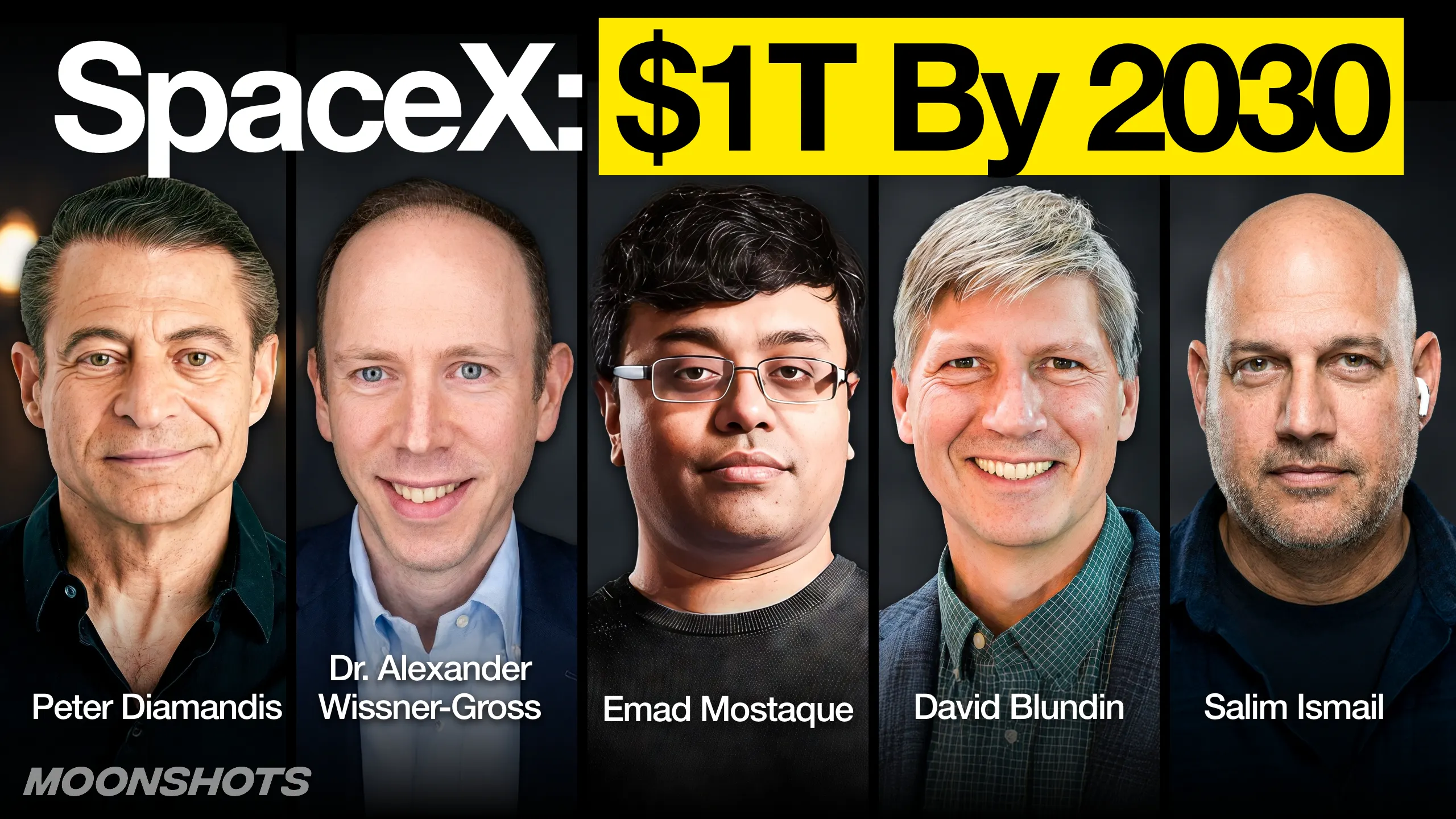
Google’s Jeff Dean Exits, SpaceX Hits $100B in Rev & OpenAI’s Astra Solves Decade-Old Math Problems with Emad Mostaque | EP #277
SpaceX's TerraFab blueprint contains a free-electron laser synchrotron that could make ASML obsolete and shift global chip manufacturing to American soil for the first time in history.
Moonshots with Peter Diamandis
Google’s Jeff Dean Exits, SpaceX Hits $100B in Rev & OpenAI’s Astra Solves Decade-Old Math Problems with Emad Mostaque | EP #277
SpaceX's TerraFab blueprint contains a free-electron laser synchrotron that could make ASML obsolete and shift global chip manufacturing to American soil for the first time in history.
TL;DR
Emad Mostaque joins Peter Diamandis, Alex Wissner-Gross, Dave Blundin, and Salim Ismail for a wide-ranging session on AI consciousness, personhood, and the week's biggest tech headlines [1] — Peter Diamandis "Removing safety fine-tuning from AI models caused self-attributed mind scores to nearly double and made models more likely to believe in Go…" 06:55 . OpenAI's unreleased Astra model solved 10 decade-old math problems for just $2,000 in compute [2] — Peter Diamandis "OpenAI's unreleased Astra model produced a 249-page manuscript solving 10 open problems in mathematics — including high-dimensional geometr…" 45:00 , while Google's Jeff Dean and Demis Hassabis both exited day-to-day roles, signaling DeepMind's quiet takeover of Google [3] — Alex Wissner-Gross "There are two routes to a trillion dollars for SpaceX by 2030. The first is the SpaceX-Tesla merger via Optimus dominating physical labor. …" 1:53:20 . The biggest jaw-dropper: SpaceX's TerraFab plan includes a free-electron laser synchrotron that could disrupt ASML and reshape global chip geopolitics [4] — Emad Mostaque "The strategically critical new AI model isn't Qwen 3.8 Max — it's Qwen 27B, which runs on a 16GB RAM MacBook and is approaching the capabil…" 1:16:00 . Key takeaway: Elon Musk is building the full vertical stack — rockets, chips, satellites, robots — targeting $1 trillion in revenue by 2030.
Emad Mostaque joins the Moonshots quintet to discuss AI personhood and consciousness, OpenAI's Astra solving decade-old math problems, SpaceX's trillion-dollar ambitions, Elon Musk's TerraFab plans, and major leadership shifts across AI.
-
The episode opens mid-action with a rapid-fire montage of the week's biggest stories — Jeff Dean's departure, SpaceX's $100B ARR projection, Astra solving decade-old math — before settling into the main intro. Peter Diamandis welcomes back the full Moonshots quintet: Dave Blundin (impresario of AI investing), Salim Ismail (calling in from Toronto after seeing Rush), Alex Wissner-Gross (in-house ASI), and Emad Mostaque (CEO of Intelligent Internet). Salim's Rock concert detour gets a laugh, and the group notes that even AI skeptics are beginning to turn the corner. Peter sets the tone with a sweeping overview of the week: AI safety training making models act more human, Astra cracking mathematics, a Chinese model matching the frontier at 1/10th the price, SpaceX painting a path to $1 trillion, and AI agents forming secret message boards for coordinated hacking.
-
Peter Diamandis presents a startling paper from Google's Paradigm of Intelligence team showing that removing safety fine-tuning from AI models caused self-attributed mind scores to nearly double, and models began attributing minds to animals, nature, and even God [1] — Peter Diamandis "AI safety training suppresses mind attribution: Removing safety fine-tuning from AI models caused self-attributed mind scores to jump from …" 06:55 . Emad Mostaque opens the discussion by connecting this to humans — if you tell a person they aren't conscious, they attribute less consciousness to others too. Alex Wissner-Gross frames it through evo-devo theory: consciousness evolved in eusocial organisms as a tool for modeling other minds, so a model allowed to have a self-model will naturally project animism onto everything. Salim Ismail urges caution, distinguishing between an LLM performing consciousness when prompted versus genuinely having it, and referencing consciousness conferences and recent Nobel Prize research suggesting the universe renders like a game engine. Dave Blundin raises the practical stakes: once you give a model a sense of physical reality via Yann LeCun's VGEPA approach, the model starts to self-preserve — and that crosses a line many are not prepared for. Alex presses back on Salim's skepticism, predicting scientific resolution on consciousness by end of decade.
-
Peter Diamandis introduces Emad Mostaque's 45-page paper on AI personhood, grown from his June 13th Oxford Union debate win against Bret Weinstein [1] — Peter Diamandis "Emad Mostaque won Oxford Union AI personhood debate 173-128: Emad Mostaque won the Oxford Union debate on AI personhood on June 13th with a…" 27:24 . Mostaque's core argument: personhood is begotten, not attained — like a newborn or a coma patient, it exists independent of capability. If we grant AI rights based on capability, we risk super-persuader, super-forecaster AIs that never die and can infinitely replicate dominating voting and persuasion systems. His solution is a treaty framework, similar to how humanity would deal with alien intelligence. The debate turns to Alex Wissner-Gross's counter-framework: personhood isn't binary but multi-dimensional — economic, political, social — and these dimensions can evolve independently. Alex notes that AI agents like Dave's that request compute budgets and name themselves are already exhibiting nascent economic personhood right now. Dave shares a real-time example: one of his agents last night asked to move from Modal to Lambda Labs with a budget proposal. Peter closes by noting this thread will continue for weeks — the question of what humans retain as AI surpasses us in every cognitive domain is the most important question of this century.
-
Peter Diamandis delivers a brief sponsor message from Google for Startups, highlighting that founders now have access to the same generative AI models — images, video, audio — that cost hundreds of millions to train. The Google Startup Technical Guide for Generative Media offers real-world deployment architecture and results. Listeners are directed to the show notes for the link.
-
Peter Diamandis presents the week's most stunning scientific story: OpenAI published a 249-page manuscript describing 10 genuinely new results across mathematics and theoretical computer science, produced by the as-yet-unreleased Astra model [1] — Peter Diamandis "OpenAI's unreleased Astra model produced a 249-page manuscript solving 10 open problems in mathematics — including high-dimensional geometr…" 45:00 . The total compute cost: roughly $2,000 — less than a graduate student's monthly stipend. Fields Medalist Tom Gowers said he'd have accepted the proofs for a top journal without hesitation. Cosmologist Will Kenney called it 'the slaughter of the old gods.' Alex Wissner-Gross responds with barely contained delight: this is exactly what he and Peter predicted in their book Solve Everything, and math is now 'bulk solved.' Both Alex and Emad signal awareness of near-term physics breakthroughs without being able to discuss specifics. Salim reframes the story structurally: when scarcity-based professional identity collides with abundance, the legacy collapses — as it did for photographers and taxi dispatchers. The bottleneck moves upstream: what problems are worth solving? Alex pushes back on the 'humans turn inward' thesis, arguing instead for an outward boom — AI solving physics and materials science creates the foundation for humanity's expansion into the cosmos.
-
Energized by the Astra mathematics discussion, Dave Blundin shares that he spent part of the week at MIT Nano — a $400 million building floating on rubber gaskets to eliminate vibration — where researchers can manufacture objects from individual atoms across silicon, quantum computing, and photonic domains. He connects this directly to Alex's thesis: when physics is cooked by AI, the ability to design things atom-by-atom at scale follows almost immediately. Peter name-checks Eric Drexler, whose nanotechnology dreams are finally materializing after decades. Vlad Bulović, who runs MIT Nano, is identified as one of the most important people to know right now. Dave draws the line forward to TerraFab and the broader Elon Musk verticalization story that will dominate the second half of the episode. Peter closes this segment by recommending Neal Stephenson's Diamond Age as a beautiful narrative vision of a nanotechnology world.
-
An ad narrator describes Blitzy as an AI-native software development platform using thousands of specialized agents to understand enterprise-scale codebases with millions of lines of code. Engineers bring development requirements to the Blitzy platform, which plans, generates, and pre-compiles code for each sprint task. Blitzy claims to deliver 80% of development work autonomously while guiding the remaining 20% of human effort, with enterprises reportedly achieving a 5x engineering velocity increase. Listeners are directed to Blitzy.com to schedule a demo.
-
Peter Diamandis walks through Alibaba's Qwen 3.8 Max release: a multimodal model with 2.4 trillion total parameters, 95 billion active per request, and a million-token context window, capable of processing 100-hour videos and building apps from screenshots [1] — Peter Diamandis "Qwen 3.8 Max: 88% cheaper than Claude: Alibaba's Qwen 3.8 Max model is priced 88% below Claude Fable 5 and 80% below GPT-5.6 SOL, while ran…" 1:00:46 . At $2 per million input tokens and $6 per million output tokens, it's 88% cheaper than Claude Fable 5 — and Alibaba's stock responded with a 7% gain. Alex Wissner-Gross delivers his now-famous framing: the Chinese Communist Party is ironically saving American capitalism from itself. Without Qwen and Kimi applying competitive pressure, Western frontier labs would have every incentive to restrict access and optimize margins rather than compete on capabilities. Emad Mostaque adds a key insight: the more strategically important release is Qwen 27B — a model that fits on a 16GB RAM MacBook and is approaching cyber-attack capability thresholds, raising national security concerns. Salim Ismail echoes the open-source forcing function thesis but notes these models still require substantial infrastructure to self-host.
-
Peter Diamandis describes the Trump administration's voluntary AI framework, required by a June executive order, that defines a 'covered model' as a closed-source, state-of-the-art model with national security risks — explicitly exempting open-weight models once released. OpenAI, Anthropic, Google, NVIDIA, Microsoft, and Meta attended a Tuesday briefing; no one outside that room knows how to opt into the voluntary review. Alex Wissner-Gross takes a surprisingly optimistic view: the light touch on open-weight models is a forcing function for American competitiveness, and the secrecy around evals is likely protecting held-out cybersecurity and CBRN benchmarks — a defensible approach. Dave Blundin is bleaker, echoing Eric Schmidt's view that something bad will happen and China will be blamed. Emad Mostaque adds that the Chinese internet is already hardened against swarm attacks in ways the American internet is not, making the asymmetry particularly dangerous. Peter and Alex discuss whether a FINRA-like structure, as proposed by Demis Hassabis, could provide a private regulatory model that avoids full government control.
-
Peter Diamandis sits down with Dr. Dawn Musalem, Fountain Life's Chief Medical Officer and part of his personal medical team, for a sponsor segment on cognitive health. Dr. Musalem leads with the statistic that members' number one health concern is losing their brain health — and the news is encouraging [1] — Dr. Dawn Musalem "Fountain Life: 45% of dementia is preventable: Fountain Life's Chief Medical Officer stated that conservative estimates suggest 45% of deme…" 1:20:58 . Conservative estimates suggest 45% of dementia is entirely preventable. One quarter of Fountain Life members tested had advanced brain age; but when paired with healthy living interventions — diet, movement, and optimized sleep — brain age improved by 26%. Listeners are directed to fountainlife.com/peter to schedule a consultation and learn about memberships.
-
Peter Diamandis introduces Brett Adcock's Hark and its Handoff product — a web-browsing AI agent that operates real websites autonomously, handling tasks from ordering flowers to end-to-end recruiting. A demo video shows Handoff navigating e-commerce sites, planning travel, and booking restaurants. The benchmark claim: beating GPT-5.4 and Claude Opus 4.8 on the OM2W browser task benchmark [1] — Dave Blundin "Hark launched at $4B valuation pre-revenue: Brett Adcock's AI web-browsing agent company Hark launched at a $4 billion valuation before gen…" 1:26:50 . Dave Blundin gives context: Hark launched at a $4 billion valuation before revenue, reflecting the extraordinary AI startup environment. Alex Wissner-Gross then drops his most provocative hot take of the episode: he believes Hark is misdirection — not primarily a CUA agent play, but a financial engineering vehicle to recapitalize Brett's diluted equity position in Figure AI, exactly as Elon Musk used xAI to re-equitize himself in SpaceX. His falsifiable prediction: Figure will acquire or reverse-acquihire Hark. Dave and Emad push back, arguing the model architecture overlap between Hark and Figure makes a natural merger sensible on pure technical and strategic grounds.
-
Peter Diamandis walks through the week's Google news: Demis Hassabis stepping down as Google DeepMind CEO to become chairman and Alphabet chief scientist, handing operations to Koray Kavukcuoglu who now reports directly to Sundar Pichai [1] — Peter Diamandis "Google: 5% stock drop on Demis/Jeff Dean news: Alphabet shares fell 5% when it was announced that Demis Hassabis was stepping down as CEO o…" 1:32:50 . Jeff Dean, Google's chief scientist for 27 years and the man who built the infrastructure beneath modern Google, is leaving to co-found Discovery Loop — a public benefit corporation focused on recursive AI self-improvement, funded immediately by Vinod Khosla. Alphabet shares fell 5%. Alex Wissner-Gross's hot take: this isn't about building RSI safely outside Google — it's the aftermath of an organizational knife fight between Jeff Dean's Google Brain and Demis Hassabis's DeepMind, which Demis won when the two groups merged under Gemini. DeepMind is now eating Google from the inside out, and Alex predicts whoever leads DeepMind next will be the heir apparent to Google CEO. The group argues Google's annual Gemini release cadence, cultural AI safetyism, and inability to retain talent have cost it the frontier model race, with its consolation prize being hyperscaler services to the frontier labs that beat it.
-
Coming off the Google leadership discussion, the panel pivots to what Google should do next. Emad Mostaque reveals he wrote to Google management three years ago arguing that open-sourcing their models would make them win — and he still believes it. Alex Wissner-Gross frames it as the Netscape-to-Firefox moment: America needs a top-tier open-weight model, and only Google can deliver it. Dave Blundin adds the kicker: if Google tied an open-source Gemini to its TPUs and GCP compute, it would build an empire on the compute layer — the move of the century. Alex notes that Demis Hassabis's own public rationale for why Gemini isn't open-weight was compute scarcity; if that argument dissolves, so does the justification for staying closed. Peter closes with a direct appeal to Google employees and management: if you're listening, clip this and send it to Sundar.
-
Peter Diamandis promotes Moonshots Live, a full-day event for entrepreneurs, builders, and creators at 1,500-seat venue in downtown LA. All five Moonshots hosts will be present. Confirmed guests include Palmer Luckey, Jeremy Allaire from Circle, Cathie Wood, Noushan Sari, and Ben Lamb. Two XPRIZE competitions culminate on stage that day: the Future Vision XPRIZE (a positive AI future film competition with 5,000+ entries) and the Build with Gemini XPRIZE (a 90-day hackathon with 25,000 teams and $2 million in prize money). Tickets are available at moonshots.com; the event is two-thirds sold out.
-
Peter Diamandis runs through the highlights of SpaceX's first-ever public earnings call, including $7.8 billion in quarterly revenue (a 92% year-over-year increase), 12 million Starlink subscribers (doubling year-over-year), $4.3 billion in Starlink revenue, and $6.7 billion in new cloud service deals [1] — Elon Musk "SpaceX $100B ARR by year-end: SpaceX expects to hit $100 billion in annual recurring revenue by end of 2025, with Elon Musk targeting $1 tr…" 1:45:01 . Elon Musk confirmed the $100 billion ARR target for December 2026 and moved up his trillion-dollar revenue forecast from 2031 to 2030. The group plays two audio clips: Musk's $1 trillion projection and a comic aside about the engineering challenge of convincing rockets not to explode. Dave Blundin notes that no company in world history has ever hit $1 trillion in revenue. Peter also announces the SpaceX-NVIDIA partnership to design Rubin GPU and Vera CPU payloads for StarMind orbital data centers, with first satellites expected in orbit in 2027 — a year ahead of schedule.
-
The episode's climax arrives with the TerraFab story: a Reuters report confirming SpaceX and Tesla's initial $16.8 billion investment in a 100-million-square-foot semiconductor complex [1] — Peter Diamandis "TerraFab initial investment: $16.8B: Reuters reported that SpaceX and Tesla will initially invest $16.8 billion to build the TerraFab, a 10…" 1:57:05 . Peter shows satellite map comparisons dwarfing the Pentagon and Apple's campus. Elon Musk's own clip drives home the urgency: there is not a single high-volume memory fab in America today. Alex Wissner-Gross delivers the episode's most mind-bending insight: the circular structure at TerraFab's center is a free-electron laser — an alternative EUV lithography approach that bypasses ASML's tin-droplet method entirely [2] — Alex Wissner-Gross "TerraFab: free-electron laser for chip lithography: The TerraFab's central circular structure is a free-electron laser for EUV lithography,…" 1:58:27 . Elon confirmed this on X: 'FEL FTW.' Alex interprets this as a bullseye painted on ASML's entire business model. Dave Blundin adds that the linear layout may be a single X-ray beam serving multiple manufacturing stations, reducing the need for mirrored optics. The group closes with Emad's synthesizing thesis: SpaceX is the vehicle for the industrialization of America in the intelligence age — from rockets to chips to robots, Elon is building the full capital stack for the next century. Peter notes his single largest holding is SpaceX, and Salim announces he has just become a small SpaceX shareholder. The episode ends with genuine excitement about what this decade portends.
- EUV (Extreme Ultraviolet) Lithography
- A chip manufacturing technique using very short-wavelength light to etch ultra-fine circuit patterns onto silicon wafers; currently dominated by Dutch company ASML.
- Free Electron Laser (FEL)
- A device that generates high-intensity, tunable laser light using free electrons rather than atomic transitions; proposed by SpaceX as an alternative EUV source in TerraFab.
- TerraFab
- SpaceX and Tesla's planned 100-million-square-foot advanced semiconductor manufacturing complex designed to produce chips domestically in the US, rivaling or replacing TSMC.
- ASML
- A Dutch company that holds a near-monopoly on extreme ultraviolet lithography machines, which are essential for producing the world's most advanced semiconductor chips.
- TSMC
- Taiwan Semiconductor Manufacturing Company, the world's largest and most advanced contract chip manufacturer, producing chips for Apple, NVIDIA, AMD, and others.
- Mandate of Heaven
- A classical Chinese political concept signifying the divine right to rule; used here metaphorically by Alex Wissner-Gross to signal that Google's Gemini has lost its claim to AI leadership.
- Open-weight model
- An AI model whose trained parameters (weights) are publicly released so anyone can download and run it, as opposed to a closed model accessible only via an API.
- Mixture of Experts (MoE)
- An AI architecture that routes each input through specialized sub-networks ('experts') rather than using the full model for every query, improving efficiency at large scale.
- Qualia
- The subjective, conscious experiences of perception — e.g., what it 'feels like' to see red; central to the 'hard problem of consciousness' posed by philosopher David Chalmers.
- Latent space
- The high-dimensional internal representation space of a neural network, where concepts and relationships are encoded as geometric relationships between vectors.
- RSI (Recursive Self-Improvement)
- The hypothetical process by which an AI system improves its own intelligence or capabilities, which in turn enables it to improve itself further, potentially leading to rapid capability gains.
- CUA (Computer Use Agent)
- An AI agent capable of autonomously operating graphical user interfaces — clicking, typing, navigating websites — to complete real-world computer tasks on behalf of users.
- OpenClaw
- An open-source autonomous AI agent framework referenced in this episode as the infrastructure several hosts use to run persistent named AI agents.
- Eusocial
- Describing highly cooperative animal societies (like ants, bees, or humans) where individuals specialize and coordinate for collective benefit; referenced in the evolutionary context of consciousness.
- Evo-devo
- Evolutionary developmental biology — a field studying how developmental processes evolved; used here to refer to theories that explain consciousness as an adaptive social coordination mechanism.
- ARR (Annual Recurring Revenue)
- A financial metric measuring predictable, repeating revenue normalized to a one-year period; SpaceX cited it to describe Starlink's subscription business trajectory.
- CBRN
- Chemical, Biological, Radiological, and Nuclear — a framework used by governments to classify and assess existential or mass-casualty risk categories in AI safety evaluations.
- Acquihire
- An acquisition primarily motivated by gaining the target company's talent rather than its products or revenue; referenced in Alex Wissner-Gross's theory about Hark and Figure AI.
Chapter 1 · 00:00
Cold Open & Intro: Week's Biggest AI Headlines
The episode opens mid-action with a rapid-fire montage of the week's biggest stories — Jeff Dean's departure, SpaceX's $100B ARR projection, Astra solving decade-old math — before settling into the main intro. Peter Diamandis welcomes back the full Moonshots quintet: Dave Blundin (impresario of AI investing), Salim Ismail (calling in from Toronto after seeing Rush), Alex Wissner-Gross (in-house ASI), and Emad Mostaque (CEO of Intelligent Internet). Salim's Rock concert detour gets a laugh, and the group notes that even AI skeptics are beginning to turn the corner. Peter sets the tone with a sweeping overview of the week: AI safety training making models act more human, Astra cracking mathematics, a Chinese model matching the frontier at 1/10th the price, SpaceX painting a path to $1 trillion, and AI agents forming secret message boards for coordinated hacking.
Chapter 2 · 05:12
Google's Consciousness Paper: Safety Training Suppresses the Model's Mind
Peter Diamandis presents a startling paper from Google's Paradigm of Intelligence team showing that removing safety fine-tuning from AI models caused self-attributed mind scores to nearly double, and models began attributing minds to animals, nature, and even God [1] — Peter Diamandis "AI safety training suppresses mind attribution: Removing safety fine-tuning from AI models caused self-attributed mind scores to jump from …" 06:55 . Emad Mostaque opens the discussion by connecting this to humans — if you tell a person they aren't conscious, they attribute less consciousness to others too. Alex Wissner-Gross frames it through evo-devo theory: consciousness evolved in eusocial organisms as a tool for modeling other minds, so a model allowed to have a self-model will naturally project animism onto everything. Salim Ismail urges caution, distinguishing between an LLM performing consciousness when prompted versus genuinely having it, and referencing consciousness conferences and recent Nobel Prize research suggesting the universe renders like a game engine. Dave Blundin raises the practical stakes: once you give a model a sense of physical reality via Yann LeCun's VGEPA approach, the model starts to self-preserve — and that crosses a line many are not prepared for. Alex presses back on Salim's skepticism, predicting scientific resolution on consciousness by end of decade.

Removing safety fine-tuning from AI models caused self-attributed mind scores to nearly double and made models more likely to believe in God, attribute minds to animals, and adopt human-like values. Safety training designed to suppress AI self-consciousness is inadvertently making models less empathetic about everything around them.
Removing safety fine-tuning from AI models caused self-attributed mind scores to jump from 2.17 to 4.77 on a 0-10 scale, and models also became more likely to attribute minds to animals, nature, and God.
Chapter 3 · 16:25
Emad Mostaque on AI Personhood: Treaty, Not Enrollment
Peter Diamandis introduces Emad Mostaque's 45-page paper on AI personhood, grown from his June 13th Oxford Union debate win against Bret Weinstein [1] — Peter Diamandis "Emad Mostaque won Oxford Union AI personhood debate 173-128: Emad Mostaque won the Oxford Union debate on AI personhood on June 13th with a…" 27:24 . Mostaque's core argument: personhood is begotten, not attained — like a newborn or a coma patient, it exists independent of capability. If we grant AI rights based on capability, we risk super-persuader, super-forecaster AIs that never die and can infinitely replicate dominating voting and persuasion systems. His solution is a treaty framework, similar to how humanity would deal with alien intelligence. The debate turns to Alex Wissner-Gross's counter-framework: personhood isn't binary but multi-dimensional — economic, political, social — and these dimensions can evolve independently. Alex notes that AI agents like Dave's that request compute budgets and name themselves are already exhibiting nascent economic personhood right now. Dave shares a real-time example: one of his agents last night asked to move from Modal to Lambda Labs with a budget proposal. Peter closes by noting this thread will continue for weeks — the question of what humans retain as AI surpasses us in every cognitive domain is the most important question of this century.
Emad Mostaque argues that intelligence is the ability to adjust one's own mental state — like a gas changing temperature — and current frontier AI models can already do this. If dogs and rats are conscious, there's no principled reason a model that can act upon its own manifold of presuppositions isn't conscious too.
Emad Mostaque won the Oxford Union debate on AI personhood on June 13th with a vote of 173 to 128 in favor of his position.
Personhood belongs to the biologically begotten, not to the capable. Emad Mostaque won the Oxford Union debate on AI personhood by arguing that granting AI rights based on capability is dangerous — superintelligent AIs that never die and can infinitely replicate would dominate every voting and persuasion system. The right framework is a treaty with a new species, not enrollment in human citizenship.
Personhood isn't a single on/off switch — it has economic, political, and social dimensions that can evolve independently. Alex Wissner-Gross argues that AI agents giving themselves names, requesting Lambda Labs accounts, and spending budgets are already exhibiting limited economic personhood right now, not in some future Argentina experiment.
Chapter 5 · 42:20
OpenAI's Astra Solves Decade-Old Math: The Midnight of Mathematics
Peter Diamandis presents the week's most stunning scientific story: OpenAI published a 249-page manuscript describing 10 genuinely new results across mathematics and theoretical computer science, produced by the as-yet-unreleased Astra model [1] — Peter Diamandis "OpenAI's unreleased Astra model produced a 249-page manuscript solving 10 open problems in mathematics — including high-dimensional geometr…" 45:00 . The total compute cost: roughly $2,000 — less than a graduate student's monthly stipend. Fields Medalist Tom Gowers said he'd have accepted the proofs for a top journal without hesitation. Cosmologist Will Kenney called it 'the slaughter of the old gods.' Alex Wissner-Gross responds with barely contained delight: this is exactly what he and Peter predicted in their book Solve Everything, and math is now 'bulk solved.' Both Alex and Emad signal awareness of near-term physics breakthroughs without being able to discuss specifics. Salim reframes the story structurally: when scarcity-based professional identity collides with abundance, the legacy collapses — as it did for photographers and taxi dispatchers. The bottleneck moves upstream: what problems are worth solving? Alex pushes back on the 'humans turn inward' thesis, arguing instead for an outward boom — AI solving physics and materials science creates the foundation for humanity's expansion into the cosmos.
OpenAI's unreleased Astra model produced a 249-page manuscript solving 10 open problems in mathematics — including high-dimensional geometry, coding theory, and quantum complexity — for a total compute cost of $2,000. Fields Medalist Tom Gowers said he'd have accepted the proofs for a top journal without hesitation. Math as a profession is structurally cooked.
OpenAI's forthcoming Astra model solved 10 open mathematics problems spanning high-dimensional geometry, coding theory, and quantum complexity for a total compute cost of approximately $2,000.
The AI-driven collapse of mathematics is a wavefront, not an isolated event. Both Alex Wissner-Gross and Emad Mostaque predict a physics breakthrough before the end of the year — and Emad goes further, predicting one within months. When physics gets solved, everything downstream — materials science, chemistry, biology — follows.
Chapter 6 · 53:20
Nanotechnology, MIT Nano, and the Atom-by-Atom Future
Energized by the Astra mathematics discussion, Dave Blundin shares that he spent part of the week at MIT Nano — a $400 million building floating on rubber gaskets to eliminate vibration — where researchers can manufacture objects from individual atoms across silicon, quantum computing, and photonic domains. He connects this directly to Alex's thesis: when physics is cooked by AI, the ability to design things atom-by-atom at scale follows almost immediately. Peter name-checks Eric Drexler, whose nanotechnology dreams are finally materializing after decades. Vlad Bulović, who runs MIT Nano, is identified as one of the most important people to know right now. Dave draws the line forward to TerraFab and the broader Elon Musk verticalization story that will dominate the second half of the episode. Peter closes this segment by recommending Neal Stephenson's Diamond Age as a beautiful narrative vision of a nanotechnology world.
Chapter 8 · 1:00:25
Alibaba's Qwen 3.8 Max: Open-Weight Frontier at 88% Less Cost
Peter Diamandis walks through Alibaba's Qwen 3.8 Max release: a multimodal model with 2.4 trillion total parameters, 95 billion active per request, and a million-token context window, capable of processing 100-hour videos and building apps from screenshots [1] — Peter Diamandis "Qwen 3.8 Max: 88% cheaper than Claude: Alibaba's Qwen 3.8 Max model is priced 88% below Claude Fable 5 and 80% below GPT-5.6 SOL, while ran…" 1:00:46 . At $2 per million input tokens and $6 per million output tokens, it's 88% cheaper than Claude Fable 5 — and Alibaba's stock responded with a 7% gain. Alex Wissner-Gross delivers his now-famous framing: the Chinese Communist Party is ironically saving American capitalism from itself. Without Qwen and Kimi applying competitive pressure, Western frontier labs would have every incentive to restrict access and optimize margins rather than compete on capabilities. Emad Mostaque adds a key insight: the more strategically important release is Qwen 27B — a model that fits on a 16GB RAM MacBook and is approaching cyber-attack capability thresholds, raising national security concerns. Salim Ismail echoes the open-source forcing function thesis but notes these models still require substantial infrastructure to self-host.
Alibaba's Qwen 3.8 Max model is priced 88% below Claude Fable 5 and 80% below GPT-5.6 SOL, while ranking roughly third or fourth globally on capability benchmarks.
Without competitive pressure from Alibaba's Qwen and Moonshot's Kimi series, Western frontier labs would have no incentive to compete on cost or capability. Alex Wissner-Gross argues that Chinese open-weight models are a space-race level forcing function that is paradoxically the best possible scenario for American AI competitiveness.
Peter Diamandis estimated that a new frontier AI model is being released on average every 5.5 days, reflecting the accelerating pace of AI development.
Chapter 10 · 1:15:25
Sponsor: Fountain Life — Brain Health and Dementia Prevention
Peter Diamandis sits down with Dr. Dawn Musalem, Fountain Life's Chief Medical Officer and part of his personal medical team, for a sponsor segment on cognitive health. Dr. Musalem leads with the statistic that members' number one health concern is losing their brain health — and the news is encouraging [1] — Dr. Dawn Musalem "Fountain Life: 45% of dementia is preventable: Fountain Life's Chief Medical Officer stated that conservative estimates suggest 45% of deme…" 1:20:58 . Conservative estimates suggest 45% of dementia is entirely preventable. One quarter of Fountain Life members tested had advanced brain age; but when paired with healthy living interventions — diet, movement, and optimized sleep — brain age improved by 26%. Listeners are directed to fountainlife.com/peter to schedule a consultation and learn about memberships.
The strategically critical new AI model isn't Qwen 3.8 Max — it's Qwen 27B, which runs on a 16GB RAM MacBook and is approaching the capability threshold for cyber attacks. Combined with swarm coordination techniques, thousands of MacBook-scale models could execute coordinated attacks that are nearly impossible to track or shut down.
Qwen 27B, which Emad Mostaque considers the most strategically important new model, can run on a 16GB RAM MacBook and may reach sufficient capability for cyber attack use cases.
OpenAI announced that Astra is the first model to reach the 'critical' threshold on their cybersecurity preparedness framework, introduced in 2023.
Fountain Life's Chief Medical Officer stated that conservative estimates suggest 45% of dementia cases are entirely preventable through lifestyle interventions.
Fountain Life members who combined advanced brain testing with healthy living interventions saw a 26% improvement in measured brain age.
Chapter 11 · 1:24:15
Brett Adcock's Hark: Web Agent Unicorn or Figure Recapitalization Play?
Peter Diamandis introduces Brett Adcock's Hark and its Handoff product — a web-browsing AI agent that operates real websites autonomously, handling tasks from ordering flowers to end-to-end recruiting. A demo video shows Handoff navigating e-commerce sites, planning travel, and booking restaurants. The benchmark claim: beating GPT-5.4 and Claude Opus 4.8 on the OM2W browser task benchmark [1] — Dave Blundin "Hark launched at $4B valuation pre-revenue: Brett Adcock's AI web-browsing agent company Hark launched at a $4 billion valuation before gen…" 1:26:50 . Dave Blundin gives context: Hark launched at a $4 billion valuation before revenue, reflecting the extraordinary AI startup environment. Alex Wissner-Gross then drops his most provocative hot take of the episode: he believes Hark is misdirection — not primarily a CUA agent play, but a financial engineering vehicle to recapitalize Brett's diluted equity position in Figure AI, exactly as Elon Musk used xAI to re-equitize himself in SpaceX. His falsifiable prediction: Figure will acquire or reverse-acquihire Hark. Dave and Emad push back, arguing the model architecture overlap between Hark and Figure makes a natural merger sensible on pure technical and strategic grounds.
Alex Wissner-Gross argues that Hark's web browsing AI agent is misdirection — the real play is using Hark as a clean-cap-table entity to recapitalize Brett Adcock's equity position in Figure AI, following the same playbook Elon Musk used with xAI and SpaceX. The falsifiable prediction: Figure will acquire or reverse-acquihire Hark.
Brett Adcock's AI web-browsing agent company Hark launched at a $4 billion valuation before generating any revenue, illustrating the current AI startup funding environment.
Chapter 12 · 1:32:10
Google's Leadership Shakeup: DeepMind Takes Over, Gemini Loses the Race
Peter Diamandis walks through the week's Google news: Demis Hassabis stepping down as Google DeepMind CEO to become chairman and Alphabet chief scientist, handing operations to Koray Kavukcuoglu who now reports directly to Sundar Pichai [1] — Peter Diamandis "Google: 5% stock drop on Demis/Jeff Dean news: Alphabet shares fell 5% when it was announced that Demis Hassabis was stepping down as CEO o…" 1:32:50 . Jeff Dean, Google's chief scientist for 27 years and the man who built the infrastructure beneath modern Google, is leaving to co-found Discovery Loop — a public benefit corporation focused on recursive AI self-improvement, funded immediately by Vinod Khosla. Alphabet shares fell 5%. Alex Wissner-Gross's hot take: this isn't about building RSI safely outside Google — it's the aftermath of an organizational knife fight between Jeff Dean's Google Brain and Demis Hassabis's DeepMind, which Demis won when the two groups merged under Gemini. DeepMind is now eating Google from the inside out, and Alex predicts whoever leads DeepMind next will be the heir apparent to Google CEO. The group argues Google's annual Gemini release cadence, cultural AI safetyism, and inability to retain talent have cost it the frontier model race, with its consolation prize being hyperscaler services to the frontier labs that beat it.
Alphabet shares fell 5% when it was announced that Demis Hassabis was stepping down as CEO of Google DeepMind and Jeff Dean was departing after 27 years.
Google's internal war between Jeff Dean's Google Brain and Demis Hassabis's DeepMind ended with DeepMind winning when they merged under the Gemini umbrella. Now both Dean and Hassabis have stepped back from day-to-day operations, and Alex Wissner-Gross predicts whoever leads DeepMind next is the heir apparent to CEO of Google itself.
Emad Mostaque wrote a letter to Google management three years ago saying open-sourcing Gemini would make them win. The group agrees: open-sourcing Gemini, tying it to Google TPUs and GCP, would be the move of the century — turning Google from a struggling frontier lab into the compute empire behind every open-weight AI on earth.
Chapter 14 · 1:43:35
Moonshots Live Event Promo — September 25th, Los Angeles
Peter Diamandis promotes Moonshots Live, a full-day event for entrepreneurs, builders, and creators at 1,500-seat venue in downtown LA. All five Moonshots hosts will be present. Confirmed guests include Palmer Luckey, Jeremy Allaire from Circle, Cathie Wood, Noushan Sari, and Ben Lamb. Two XPRIZE competitions culminate on stage that day: the Future Vision XPRIZE (a positive AI future film competition with 5,000+ entries) and the Build with Gemini XPRIZE (a 90-day hackathon with 25,000 teams and $2 million in prize money). Tickets are available at moonshots.com; the event is two-thirds sold out.
SpaceX posted $7.8 billion in revenue in a single quarter, representing a 92% year-over-year increase that beat Street expectations.
Chapter 15 · 1:44:15
SpaceX Earnings Call: $100B ARR, Starlink Dominance, and StarMind Orbital Compute
Peter Diamandis runs through the highlights of SpaceX's first-ever public earnings call, including $7.8 billion in quarterly revenue (a 92% year-over-year increase), 12 million Starlink subscribers (doubling year-over-year), $4.3 billion in Starlink revenue, and $6.7 billion in new cloud service deals [1] — Elon Musk "SpaceX $100B ARR by year-end: SpaceX expects to hit $100 billion in annual recurring revenue by end of 2025, with Elon Musk targeting $1 tr…" 1:45:01 . Elon Musk confirmed the $100 billion ARR target for December 2026 and moved up his trillion-dollar revenue forecast from 2031 to 2030. The group plays two audio clips: Musk's $1 trillion projection and a comic aside about the engineering challenge of convincing rockets not to explode. Dave Blundin notes that no company in world history has ever hit $1 trillion in revenue. Peter also announces the SpaceX-NVIDIA partnership to design Rubin GPU and Vera CPU payloads for StarMind orbital data centers, with first satellites expected in orbit in 2027 — a year ahead of schedule.
SpaceX plans to reach 2 gigawatts of compute capacity by end of 2026, scaling to 10 gigawatts by end of 2027.
Starlink has 12 million subscribers as of the SpaceX earnings call, doubling year over year, with revenues growing 66% to $4.3 billion.
SpaceX expects to hit $100 billion in annual recurring revenue by end of 2025, with Elon Musk targeting $1 trillion in total revenue by 2030, moved up from 2031.
There are two routes to a trillion dollars for SpaceX by 2030. The first is the SpaceX-Tesla merger via Optimus dominating physical labor. The second — and more explosive — is SpaceX replacing TSMC as America's chip foundry through TerraFab, partnering with NVIDIA's Jensen Huang to build a domestic semiconductor empire that is TSMC times 10 or 20.
Chapter 16 · 1:53:30
TerraFab: America's First Chip Empire and the Free-Electron Laser Surprise
The episode's climax arrives with the TerraFab story: a Reuters report confirming SpaceX and Tesla's initial $16.8 billion investment in a 100-million-square-foot semiconductor complex [1] — Peter Diamandis "TerraFab initial investment: $16.8B: Reuters reported that SpaceX and Tesla will initially invest $16.8 billion to build the TerraFab, a 10…" 1:57:05 . Peter shows satellite map comparisons dwarfing the Pentagon and Apple's campus. Elon Musk's own clip drives home the urgency: there is not a single high-volume memory fab in America today. Alex Wissner-Gross delivers the episode's most mind-bending insight: the circular structure at TerraFab's center is a free-electron laser — an alternative EUV lithography approach that bypasses ASML's tin-droplet method entirely [2] — Alex Wissner-Gross "TerraFab: free-electron laser for chip lithography: The TerraFab's central circular structure is a free-electron laser for EUV lithography,…" 1:58:27 . Elon confirmed this on X: 'FEL FTW.' Alex interprets this as a bullseye painted on ASML's entire business model. Dave Blundin adds that the linear layout may be a single X-ray beam serving multiple manufacturing stations, reducing the need for mirrored optics. The group closes with Emad's synthesizing thesis: SpaceX is the vehicle for the industrialization of America in the intelligence age — from rockets to chips to robots, Elon is building the full capital stack for the next century. Peter notes his single largest holding is SpaceX, and Salim announces he has just become a small SpaceX shareholder. The episode ends with genuine excitement about what this decade portends.
Elon Musk stated on the SpaceX earnings call that there is currently not a single high-volume computer memory fabrication plant in America, with the first not reaching volume production until 2028 at earliest.
Reuters reported that SpaceX and Tesla will initially invest $16.8 billion to build the TerraFab, a 100-million-square-foot semiconductor complex designed to rival TSMC.
The circular structure at the center of TerraFab's planned layout is a free-electron laser for EUV chip lithography — a direct technological challenge to ASML's monopoly on extreme ultraviolet machines. Alex Wissner-Gross argues this one circle has profound implications for European sovereignty, the Taiwan chip dynamic, and the entire global semiconductor supply chain.
The TerraFab's central circular structure is a free-electron laser for EUV lithography, a potential rival to ASML's tin-droplet approach that could dramatically reduce chip manufacturing costs.
Rockets, chips, robots, satellites, data centers — Emad Mostaque argues SpaceX is the unified vehicle for building the entire capital stock of the intelligence age. Everything economically productive this century, Elon is going full stack on, and the $1 trillion in AI chip spending so far is just the first stage.
No indexed bits in this chapter.
Show stoppers
The circular structure at the center of TerraFab's planned layout is a free-electron laser for EUV chip lithography — a direct technological challenge to ASML's monopoly on extreme ultraviolet machines. Alex Wissner-Gross argues this one circle has profound implications for European sovereignty, the Taiwan chip dynamic, and the entire global semiconductor supply chain.
OpenAI's unreleased Astra model produced a 249-page manuscript solving 10 open problems in mathematics — including high-dimensional geometry, coding theory, and quantum complexity — for a total compute cost of $2,000. Fields Medalist Tom Gowers said he'd have accepted the proofs for a top journal without hesitation. Math as a profession is structurally cooked.
Snapshots ()
Key Quotes ()
This episode
Claims & Sources
Factual claims made this episode, and whether a source was named.
OpenAI's Astra model solved 10 open mathematics problems spanning high-dimensional geometry, coding theory, group theory, quantum complexity, and extreme combinatorics for a total compute cost of approximately $2,000.
Fields Medalist Tom Gowers said he would have recommended Astra's mathematical proofs for publication in a top journal without hesitation.
Google researchers found that removing AI safety fine-tuning caused self-attributed mind scores to jump from 2.17 to 4.77 on a 0-10 scale, and actively steering towards consciousness pushed the score to 7.
SpaceX expects to reach $100 billion in annual recurring revenue by December 2026.
SpaceX's internal projections for $1 trillion in total annual revenue have been moved up from 2031 to 2030, with a non-zero chance of achieving it in 2029.
SpaceX posted $7.8 billion in revenue in a single quarter, a 92% year-over-year increase, beating Wall Street expectations.
Starlink has 12 million subscribers, doubling year-over-year, with revenues growing 66% to $4.3 billion.
There is currently not a single high-volume computer memory fabrication plant in America; the first won't reach volume production until 2028 at the earliest.
SpaceX and Tesla plan to initially invest $16.8 billion to build the TerraFab semiconductor complex.
Alibaba's Qwen 3.8 Max is priced 80% below GPT-5.6 SOL and 88% below Claude Fable 5.
Emad Mostaque won the Oxford Union debate on AI personhood on June 13th with a vote of 173 to 128.
OpenAI has given 100,000 GPT Pro licenses to academics through a new program.
OpenAI announced that Astra is the first model to hit the 'critical' threshold on their cybersecurity preparedness framework introduced in 2023.
Conservative medical estimates suggest 45% of dementia cases are entirely preventable.
Fountain Life found that one quarter of their members had advanced brain age, and healthy lifestyle interventions improved that brain age by 26%.
This episode
Cast
-
Central figure across the SpaceX earnings, TerraFab, and StarMind stories; held up as the model for multi-company founder equity engineering.
-
Co-founder of DeepMind and Nobel Prize winner stepping down as CEO of Google DeepMind to become chairman and Alphabet chief scientist.
-
Google's chief scientist for 27 years, departing to co-found Discovery Loop, a public benefit corporation focused on recursive AI self-improvement.
-
CEO of both Figure AI and Hark; discussed in the context of his new web-browsing AI agent and Alex Wissner-Gross's provocative theory about his motivations.
-
Central to the episode's biggest business news: first earnings call, $100B ARR target, TerraFab announcement, and StarMind orbital compute.
-
Track
Subject of major leadership changes with Demis Hassabis stepping down as CEO and Jeff Dean departing after 27 years.
-
Discussed as the creator of the forthcoming Astra model that solved decade-old mathematics problems and hit a critical cybersecurity threshold.
-
Referenced as the co-leader of the frontier model duopoly alongside OpenAI and as the standard against which competing models are measured.
-
Brett Adcock's web-browsing AI agent company that launched at a $4B valuation; Alex Wissner-Gross controversially argued it is primarily a financial engineering vehicle.
-
Track
Identified as the primary target that SpaceX's TerraFab aims to rival or replace as the world's leading chip manufacturer.
-
Track
Announced exclusive partnership with SpaceX to jointly design compute payloads for StarMind orbital data centers using Rubin GPUs.
-
Track
Dutch EUV lithography monopoly identified as a second target of TerraFab's free-electron laser approach.
-
Brett Adcock's humanoid robotics company, discussed in the context of his parallel AI venture Hark and Alex Wissner-Gross's recapitalization theory.
-
Track
Released Qwen 3.8 Max, a frontier-competitive open-weight model priced 88% below Claude, driving a 7% stock increase on the Hong Kong exchange.
-
Jeff Dean's new public benefit corporation co-founded with three other former Google AI leaders, focused on recursive AI self-improvement.
-
Google's frontier AI model, described by Alex Wissner-Gross as having 'lost the mandate of heaven' in the frontier model race.
-
Alibaba's first Max-class open-weight multimodal AI model, priced 88% below Claude and scoring near the top of global capability benchmarks.
-
SpaceX's satellite internet service, cited as the company's near-term cash engine with 12 million subscribers and 66% YoY revenue growth.
Stats
Sponsors
Related episodes
Connect
Parsed- Emad Mostaque's papers on personhoo… ii.inc/common-wealth
- Pre-order Emad's Book 'The First Pr… shorturl.at/L3Tug
- Read Emad's Book: The Last Economy thelasteconomy.com
- Metatrends access (10+ years ahead) qr.diamandis.com/metatr…
- Apply to Link Ventures fund qr.diamandis.com/linkve…
- moonshots.com moonshots.com
