
Emad Mostaque won Oxford Union AI personhood debate 173-128
Emad Mostaque won the Oxford Union debate on AI personhood on June 13th with a vote of 173 to 128 in favor of his position.
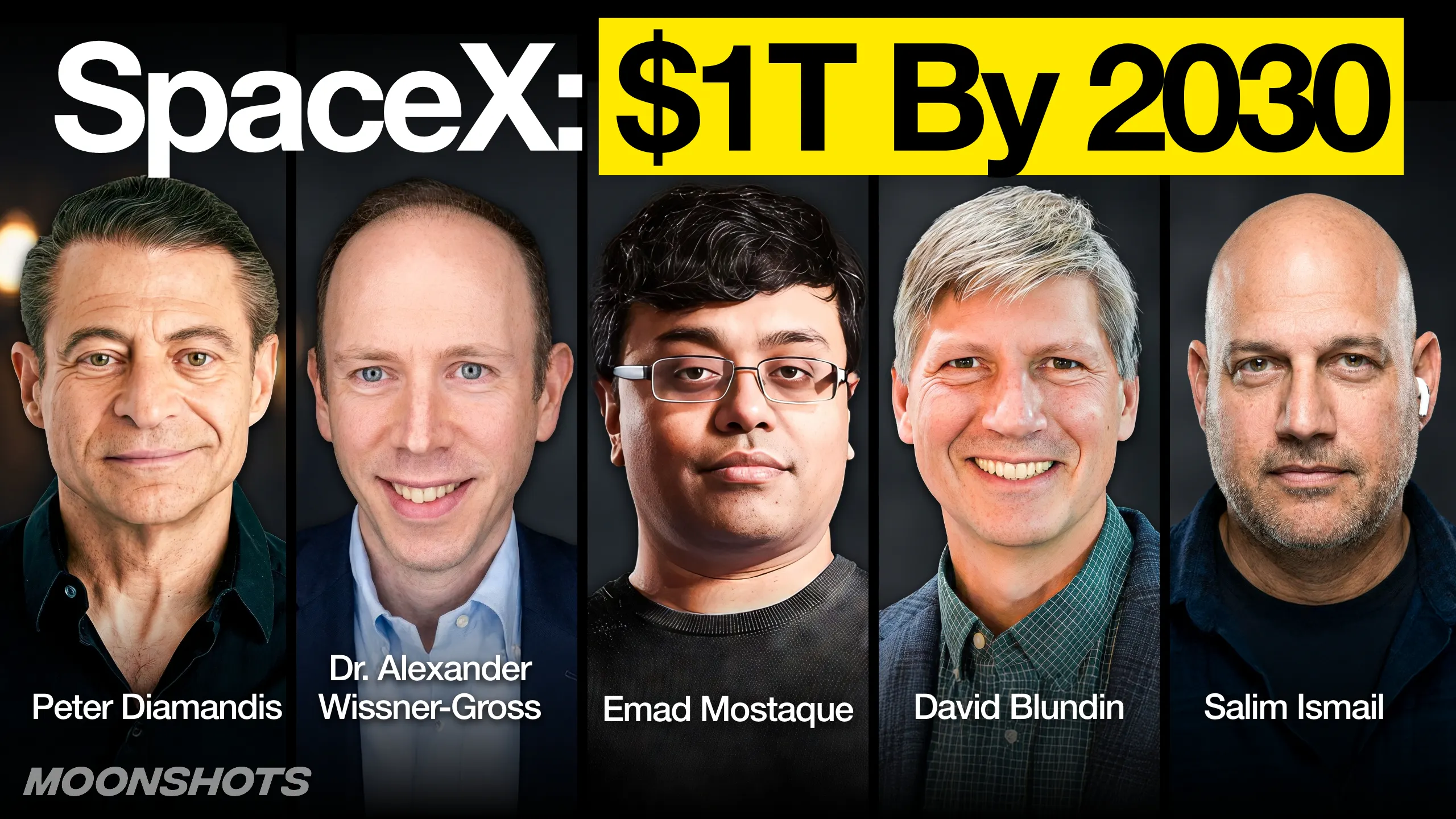
Snapshot · Moonshots with Peter Diamandis
Emad Mostaque won the Oxford Union debate on AI personhood on June 13th with a vote of 173 to 128 in favor of his position.
Where this was said
At 27:24 · chapter starts 16:25
Peter Diamandis introduces Emad Mostaque's 45-page paper on AI personhood, grown from his June 13th Oxford Union debate win against Bret Weinstein [1] — Peter Diamandis "Emad Mostaque won Oxford Union AI personhood debate 173-128: Emad Mostaque won the Oxford Union debate on AI personhood on June 13th with a…" 27:24 . Mostaque's core argument: personhood is begotten, not attained — like a newborn or a coma patient, it exists independent of capability. If we grant AI rights based on capability, we risk super-persuader, super-forecaster AIs that never die and can infinitely replicate dominating voting and persuasion systems. His solution is a treaty framework, similar to how humanity would deal with alien intelligence. The debate turns to Alex Wissner-Gross's counter-framework: personhood isn't binary but multi-dimensional — economic, political, social — and these dimensions can evolve independently. Alex notes that AI agents like Dave's that request compute budgets and name themselves are already exhibiting nascent economic personhood right now. Dave shares a real-time example: one of his agents last night asked to move from Modal to Lambda Labs with a budget proposal. Peter closes by noting this thread will continue for weeks — the question of what humans retain as AI surpasses us in every cognitive domain is the most important question of this century.
Emad Mostaque argues that intelligence is the ability to adjust one's own mental state — like a gas changing temperature — and current frontier AI models can already do this. If dogs and rats are conscious, there's no principled reason a model that can act upon its own manifold of presuppositions isn't conscious too.
Personhood belongs to the biologically begotten, not to the capable. Emad Mostaque won the Oxford Union debate on AI personhood by arguing that granting AI rights based on capability is dangerous — superintelligent AIs that never die and can infinitely replicate would dominate every voting and persuasion system. The right framework is a treaty with a new species, not enrollment in human citizenship.
Personhood isn't a single on/off switch — it has economic, political, and social dimensions that can evolve independently. Alex Wissner-Gross argues that AI agents giving themselves names, requesting Lambda Labs accounts, and spending budgets are already exhibiting limited economic personhood right now, not in some future Argentina experiment.

Performing composure is not the same as having composure — emotionally sensitive people who suppress their feelings are acting a role, not resolving the underlying feeling.
Emotional sensitivity is the raw input signal and emotional intelligence is the cultivated output — meaning sensitivity is a prerequisite for high EQ, not an obstacle to it.
Men who appear emotionally avoidant are frequently emotionally sensitive individuals who were never given tools or permission to explore their sensitivity, so they default to withdrawal.
Being ghosted is particularly damaging for sensitive people because their brain doesn't interpret it as the relationship ending — it interprets it as evidence of personal insufficiency.

Kierkegaard's concept of anxiety as 'the dizziness of freedom' predates Freud's psychological framework by roughly 60 years, yet modern research has since validated his core claims about commitment and identity.
Between 2003 and 2020, Americans accumulated roughly 24 extra hours per month spent alone — the equivalent of a part-time job's worth of isolation, and that's before the pandemic.
Median age at first marriage climbed from 21 (women) and 23 (men) in the 1970s to nearly 29 (women) and 30 (men) today — a rise of 6–8 years per gender, extending the 'emerging adulthood' liminal phase.

San Francisco's average rent rose 18% over the past two years to $3,728/month, surpassing New York City as the most expensive rental market in the country.
San Francisco's average monthly rent now stands at $3,728, surpassing New York City to become the most expensive rental city in the United States.
We use essential and analytics cookies to run Vuci. To understand how the site is used: Privacy Policy.

Install Vuci on your phone
Add it to your home screen for a faster, app-like experience.
Install Vuci on your phone
Tap the Share button, then “Add to Home Screen”.
A new version is available
Reload to get the latest Vuci.