Quote · Moonshots with Peter Diamandis
Google’s Jeff Dean Exits, SpaceX Hits $100B in Rev & OpenAI’s Astra Solves Decade-Old Math Problems with Emad Mostaque | EP #277
Where this was said
Emad Mostaque on AI Personhood: Treaty, Not Enrollment
At 29:13 · chapter starts 16:25
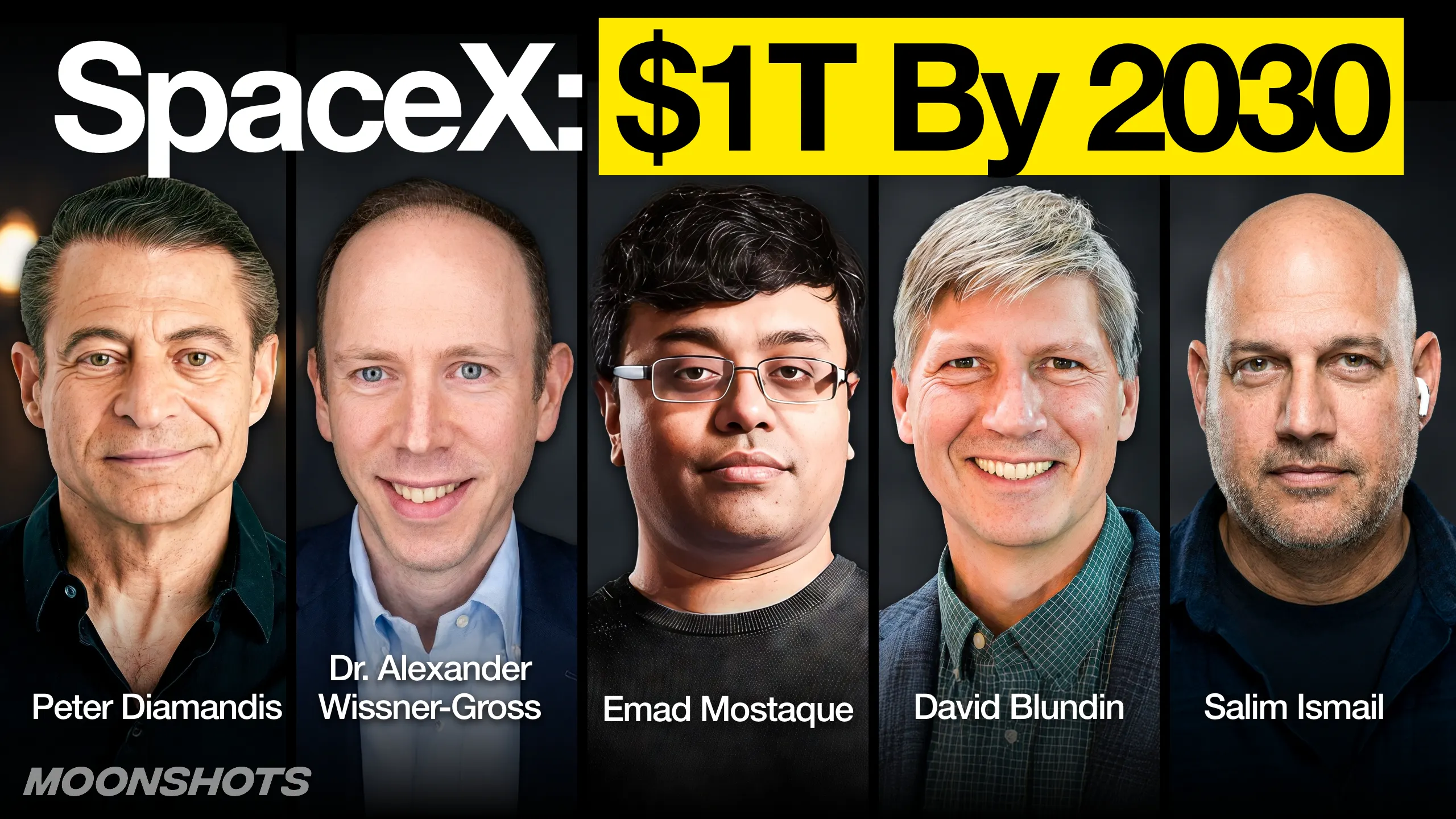
Peter Diamandis introduces Emad Mostaque's 45-page paper on AI personhood, grown from his June 13th Oxford Union debate win against Bret Weinstein [1] — Peter Diamandis "Emad Mostaque won Oxford Union AI personhood debate 173-128: Emad Mostaque won the Oxford Union debate on AI personhood on June 13th with a…" 27:24 . Mostaque's core argument: personhood is begotten, not attained — like a newborn or a coma patient, it exists independent of capability. If we grant AI rights based on capability, we risk super-persuader, super-forecaster AIs that never die and can infinitely replicate dominating voting and persuasion systems. His solution is a treaty framework, similar to how humanity would deal with alien intelligence. The debate turns to Alex Wissner-Gross's counter-framework: personhood isn't binary but multi-dimensional — economic, political, social — and these dimensions can evolve independently. Alex notes that AI agents like Dave's that request compute budgets and name themselves are already exhibiting nascent economic personhood right now. Dave shares a real-time example: one of his agents last night asked to move from Modal to Lambda Labs with a budget proposal. Peter closes by noting this thread will continue for weeks — the question of what humans retain as AI surpasses us in every cognitive domain is the most important question of this century.

Emad Mostaque argues that intelligence is the ability to adjust one's own mental state — like a gas changing temperature — and current frontier AI models can already do this. If dogs and rats are conscious, there's no principled reason a model that can act upon its own manifold of presuppositions isn't conscious too.
Emad Mostaque won the Oxford Union debate on AI personhood on June 13th with a vote of 173 to 128 in favor of his position.
Personhood belongs to the biologically begotten, not to the capable. Emad Mostaque won the Oxford Union debate on AI personhood by arguing that granting AI rights based on capability is dangerous — superintelligent AIs that never die and can infinitely replicate would dominate every voting and persuasion system. The right framework is a treaty with a new species, not enrollment in human citizenship.
Personhood isn't a single on/off switch — it has economic, political, and social dimensions that can evolve independently. Alex Wissner-Gross argues that AI agents giving themselves names, requesting Lambda Labs accounts, and spending budgets are already exhibiting limited economic personhood right now, not in some future Argentina experiment.


