Speaker
Mark Manson
Appearances over time
21 episodes
Episodes
21 Finding Your Life Path, Solved
 How to Get Lucky, Solved
 How to Build Confidence, Solved
 How to Change Your Life, Solved
 Why We Stay in Bad Relationships, Solved
 How to Overcome Anxiety, Solved
 Your Questions On Manifestation, Confidence, and Getting Over Your Ex, Solved
 Passion, Solved: Is It Really Worth Pursuing?
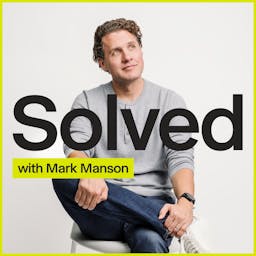
 Self-Help, Solved
 Meditation, Solved: Is It Actually Worth It?
 Focus, Solved
 Romantic Love, Solved
 Dating, Solved: Why Finding the Right Person Feels So Hard
 How to Quiet Your Ego (Without Losing Yourself), Solved
 How to Set (And Keep) Your Boundaries, Solved
 Solved, Answers: Finding Purpose, Failing Better, and the AI Future
 Finding Your Purpose, Solved
 Comparing Yourself to Others, Solved
 How to Make Friends as an Adult, Solved
 Stoicism (ft. Ryan Holiday), Solved
 How to Become Resilient, Solved
Podcasts
Quotes & moments

Kierkegaard's concept of anxiety as 'the dizziness of freedom' predates Freud's psychological framework by roughly 60 years, yet modern research has since validated his core claims about commitment and identity.
The self operates on three layers: immutable personality traits, malleable adaptations (habits/beliefs/narratives), and easily changed behaviors — and most people fail because they target the wrong layer.
SOLVED podcast reached over 13 million downloads across platforms in only 7 months with just 8 episodes released.
The number of people reporting no close friend has quadrupled over the last 30 years, signalling a dramatic erosion of deep social bonds.
Norman Vincent Peale's 'The Power of Positive Thinking' spent 186 consecutive weeks on the New York Times bestseller list, including 48 weeks at number 1, selling over 5 million copies in 40+ languages.
Most addiction relapses happen not because of the feelings themselves, but because people never build a system or accountability structure to handle those feelings when willpower wanes.
A Gallup poll found nearly 60% of US workers are either disengaged or actively dislike their jobs, going through the motions emotionally and mentally absent.
Morgan Housel's book notes that 99% of Warren Buffett's wealth was accumulated after he turned 65, illustrating the compounding power of longevity.
The free PDF guide for this episode contains 164 citations; the research team originally compiled over 250 before cutting.
Helen Fisher's 2005 fMRI study found that intensely in-love participants showed the same dopamine-region activation as cocaine addicts viewing their drug.
Seven interlocking psychological mechanisms — normalization, identity trap, slot machine effect, cognitive dissonance, sunk cost fallacy, guilt, and terror of the void — keep people stuck in bad relationships.
Napoleon led 600,000 troops into Russia in 1812; only 10,000 returned, a catastrophic example of an ego so rigid it could no longer process reality.
Research finds that couples who split home responsibilities exactly 50/50 across the board are among the most miserable and most likely to divorce, likely because each person is stuck doing tasks they're bad at.
Mark Manson's podcast is one of the ~300 biggest shows in the world, not the top 50 as previously thought — and that single data correction caused real distress.
Alcohol reduces anxiety short-term but creates a rebound effect that worsens anxiety over time, making it the single most counterproductive intervention on the list.
Western culture has never had a satisfying account of luck — fatalism, God's will, probability theory all fall short. Ancient China had three words for it: heaven luck (what you're born into), earth luck (the environment you choose), and human luck (how you play your cards). This framework is the backbone of the entire episode and finally resolves the tension between 'it's all luck' and 'it's all skill.'
Western culture has never had a satisfying account of luck — fatalism, God's will, probability theory all fall short. Ancient China had three words for it: heaven luck (what you're born into), earth luck (the environment you choose), and human luck (how you play your cards). This framework is the backbone of the entire episode and finally resolves the tension between 'it's all luck' and 'it's all skill.'
The greatest investor of all time says luck is his #1 success factor. Buffett's insight goes deeper than being born in America: he argues his two smarter sisters got the same ambition but not the same opportunities because of gender. And the factor nobody talks about? Longevity — 99% of his wealth was made after he turned 65, making compounding time arguably his biggest edge of all.
Two babies born the same day: one in Oslo, one in Freetown. One gets 83 years of life expectancy, free healthcare, and a $82,000 GDP per capita. The other gets 62 years, a 47-times-higher childhood mortality risk, and $800 per year. This is what heaven luck looks like in raw data — and then comes the harder question of what we're supposed to do with that information.
A poor farmer loses his horse (unlucky), gets five back (lucky), his son breaks his leg training them (unlucky), then avoids being drafted into a deadly war because of the injury (lucky). The story never ends because each 'lucky' or 'unlucky' event only has meaning relative to whatever comes next. Luck is always a comparison — lucky compared to what?
Gratitude isn't a feel-good affirmation. It's the mental exercise of generating all the potential worse realities you could be living in — and then feeling the relief that you're not. That emotional relief is real and it compounds: positive emotions literally broaden your attentional scope, making you spot more opportunities, which makes you feel luckier, which opens you up to even more opportunities.
After 10 years studying luck, Richard Wiseman found lucky people do four things: they maximise chance opportunities (big social networks, openness to new experiences), they listen to their intuition, they expect good outcomes, and they transform bad luck into good. The crucial finding: this is behaviour, not personality. Introverts can practise all four just as effectively as extroverts.
Personality traits like openness and extraversion barely predict who experiences serendipity. The environment almost entirely does. High-variance environments — a city like New York, an industry hub, even a coffee shop — produce dramatically more chance encounters than low-variance ones, regardless of who you are. Mark Manson's six months in New York generated more career-defining connections than five prior years of global travel.
Annie Duke had completed five years of her PhD, had job talks lined up, and then a chronic illness landed her in hospital for weeks. She cancelled everything and eventually started playing poker to pay rent. By 1999 she was the winningest woman in the game. By 2002 she was on TV. The TV appearance led to corporate speaking, which led to books, which led to a consulting career she loves. The 'worst luck' she ever had was the founding event of everything she built.
Before making a major decision, deliberately imagine that it has failed. Ask: what went wrong, what were the warning signs, how would I have known earlier? This is what Annie Duke calls a pre-mortem, and it mirrors the Stoic practice of negative visualisation. It reduces loss aversion, metabolises the fear of failure in advance, and gives you a detection framework so you can course-correct faster if things do go wrong.
In spring 2008 Mark Manson quit his day job and started burning through poker winnings to blog full-time. Friends called it a waste. He had six months of random readers from California and Germany before he was convinced something big was there. His logic: worst case scenario, he learns a lot and re-enters the job market a year later no worse off than before. The upside was the entire career that followed.
A historical researcher modelled every major general's expected battle outcomes based on troop counts, terrain, and technology, then compared it to actual results. Napoleon's actual win rate was so far above statistical expectation that the data point looked broken — off the chart. His genius was spotting opportunities nobody else saw and acting ferociously before others even noticed they existed.
Not all industries distribute success the same way. In dentistry, accounting, and construction, effort and skill compound reliably but the curve is flat. In publishing, tech, and entertainment, tiny quality differences produce wildly asymmetric returns. A lucky dentist is barely better off than an unlucky one. A lucky musician — or blogger — can be 20,000 times better off than the median. Knowing which game you're playing changes your entire risk calculus.
When something goes wrong, saying 'it was just bad luck' protects your self-narrative right now. But it costs every future version of you the lesson you could have learned. The real cognitive battle isn't between risk and safety — it's between present you (who wants to feel good) and future you (who has to live with the consequences). Shifting your identity to be someone who takes care of future you unlocks better decision-making without requiring you to feel bad about yourself.
Will Smith's father spent years preaching 'luck is when opportunity meets preparation.' Then Independence Day broke every box office record and he called Will at 3am to say: 'That was some f***ing bullsh*t. You're the luckiest motherf***er I ever met.' This opening story nails the central tension: we tell ourselves luck doesn't exist right up until it's undeniably staring at us.
Analysis
What they talk about
- Society & Culture 48%
- Health & Fitness 22%
- Education 9%
- Science 6%
- Business 6%
- Religion & Spirituality 2%
- Technology 2%
- Arts 1%
- History 1%
- Sports 1%
- Leisure 1%
- Government 1%
Connections
Shows they appear on and people they share episodes with. Drag to explore.
