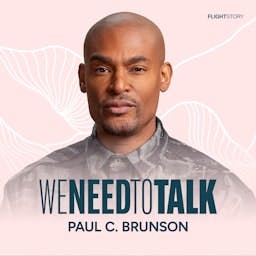
Colton only had same-sex encounters with married straight men because they had more to lose. It was cold, transactional self-protection — and it trained him to sever his emotions so completely that the skill haunts his marriage today.
Podbit · We Need To Talk with Paul C. Brunson
Colton only had same-sex encounters with married straight men because they had more to lose. It was cold, transactional self-protection — and it trained him to sever his emotions so completely that the skill haunts his marriage today.
Where this was said
At 23:03 · chapter starts 12:13
This is the longest and most revealing chapter of the episode. Colton explains his increasingly elaborate system of self-concealment: telling college friends he had a girlfriend back home, and home friends he was seeing someone at college, so the two groups could never cross-reference. He joined FCA (Fellowship of Christian Athletes), attended Bible study, and prayed sincerely to God to make him straight [1] — Colton Underwood "Colton prayed to God to make him straight, joined The Bachelor believing the public heterosexuality would trap him into straightness, and e…" 18:24 . To survive the locker room, he kept a folder of women's photos on his phone ready to produce at a moment's notice. For the rare same-sex encounters he did allow himself, he imposed an iron rule: married men only, because they had more to lose. The emotional cost was profound — he became expert at severing his own feelings, a learned skill that still affects his marriage to Jordan today. Paul gently names the experience as chronic internalised homophobia, and Colton agrees that watching Ellen on his small dorm TV was sometimes his only therapy.
Every coach in Colton's life made homophobic remarks as a matter of course, using gay slurs only when players screwed up. That relentless messaging fused sexual identity with failure, and drove Colton so deep into the closet he couldn't even defend gay teammates without risking exposure.
Colton kept a fake folder of women's photos on his phone to produce during locker-room peacocking sessions. Each small lie required another, and the spider web of deception eventually disconnected him from his own identity.
Colton kept a folder of women's photos on his phone to show teammates in the locker room and deflect questions about his sexuality.
Colton prayed to God to make him straight and believed becoming The Bachelor would force him into heterosexuality through public performance.
Colton prayed to God to make him straight, joined The Bachelor believing the public heterosexuality would trap him into straightness, and even got a large cross tattoo on his wrist — then wrapped it during same-sex encounters. He was running his own conversion therapy.
Most people confuse things they value instrumentally (because they get them other things) with things they value intrinsically (for their own sake). Greenberg's friend stayed in a miserable relationship for years because she was living by her parents' values, not her own — the values map made the mismatch instantly visible.
Jungian analyst James Hollis distills a good life to four things: shut up (have gratitude, stop whining), suit up (prepare yourself to fulfill a role), show up (do the actual work in service of others), and daily get out of stimulus-response to ask what your deeper wish actually is. The whole landscape of self-help slots into just these four bins.
Toward the end of their 20s, many men discover that all the strategies that earned them recognition and success have stopped working. It's a second adolescence — more important than the first — where the question shifts from 'how do I play the game?' to 'who do I actually want to become?' Most people going through it look fragile from the outside. They're actually building a foundation.
Boys are told from childhood not to cry, not to feel, not to be weak — but anger gets a pass. The result: a generation of men who reroute every emotion, including sadness and fear, through the only acceptable channel. Emotional avoidance isn't toughness, it's misdirected sensitivity.
Men need a 'bank account' of masculine status — muscle, money, success — before society grants them permission to express vulnerability. Chris Bumstead can cry at the Olympia and get celebrated. A struggling nobody doing the same thing gets contempt. This creates a tragic paradox where the men who most need emotional support get the least of it.
Emotional sensitivity isn't a defect — it's a high-resolution scanner for human experience. Highly sensitive people pick up body language, tone, and unspoken tension that others miss entirely. In the right environment, that's not a liability. It's a superpower.
Her supervisor told her she was too emotional for the pediatric ICU. So she asked herself: 'What area of medicine can I cry in?' That question led her to psychiatry. Finding the environment that holds your emotional sensitivity isn't retreat — it's strategy.
For someone with RSD, ghosting isn't ambiguity — it's a self-verdict. Their brain doesn't read 'this relationship ended,' it reads 'I am the reason this failed.' No closure means the brain fills the gap with evidence of personal insufficiency, and it keeps filling indefinitely.
More freedom doesn't produce more happiness — it produces more anxiety. Kierkegaard identified this 180 years ago: the more options you have, the more you feel the 'dizziness of freedom,' a paralytic unease at having to choose any single one. The freest generation in history is, by his prediction, exactly the most anxious.
We use essential and analytics cookies to run Vuci. To understand how the site is used: Privacy Policy.
Install Vuci on your phone
Add it to your home screen for a faster, app-like experience.
Install Vuci on your phone
Tap the Share button, then “Add to Home Screen”.
A new version is available
Reload to get the latest Vuci.
