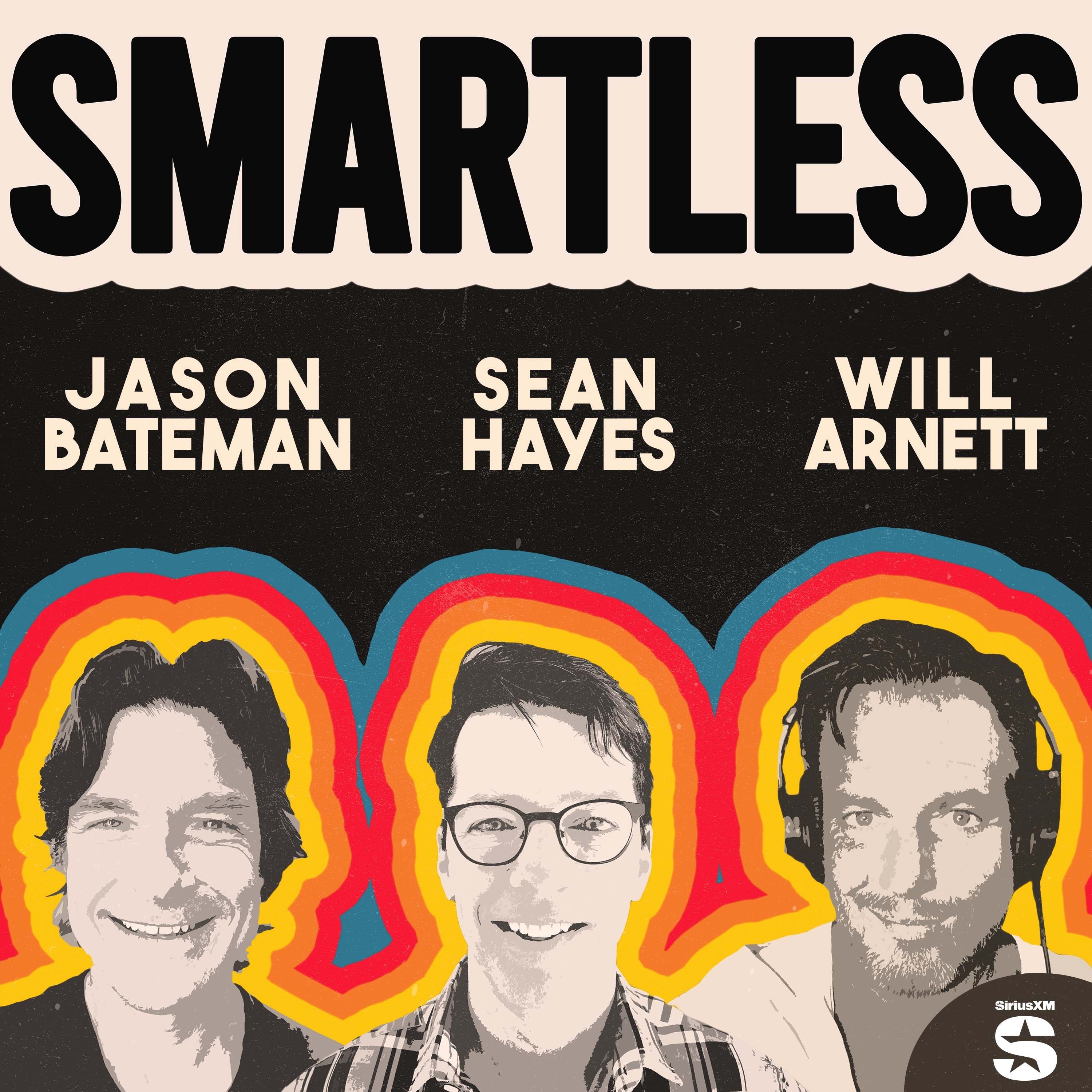
Marcus Mumford met his future wife Carey Mulligan at Bible camp when he was 10 and she was 12 — and she rated him 9 out of 10 in her journal, outscoring his older, taller cousin.
Jul 27, 20261:00:34
Difficulty: Beginner
Played
SmartLess
"Marcus Mumford"
Marcus Mumford met his future wife Carey Mulligan at Bible camp when he was 10 and she was 12 — and she rated him 9 out of 10 in her journal, outscoring his older, taller cousin.
Jul 27, 20261:00:34
Difficulty: Beginner
Played
TL;DR
Jason Bateman, Sean Hayes, and Will Arnett welcome Marcus Mumford — frontman of Mumford & Sons — for a warm, wide-ranging conversation. Marcus shares how he met wife Carey Mulligan at Bible camp aged 10[1]— Marcus Mumford"Marcus was 10, Carey was 12, and they were at Bible camp together. She wrote in her journal that Marcus got a 9 out of 10 — beating his old…"13:40, how Babel's runaway success drove him toward unhealthy drinking habits before he quit booze[2]— Marcus Mumford"Marcus started drumming on pots and pans in the kitchen, took it seriously through school, then quit college to be Laura Marling's session …"20:40, and how fatherhood has flipped his priorities to a "season of gratitude"[3]— Marcus Mumford"Mumford & Sons hired all their favourite musicians as a house band and rode a train across America, learning special guests' songs the day …"47:15. He also breaks down vocal warm-up secrets (penguin noises and vocal straws), the train tour doc made with Sam Jones, and why he quit TikTok before releasing his new record[4]— Marcus Mumford"Marcus quit TikTok before releasing his new record. He didn't want any comment to spoil his own experience of the album. It's the first rec…"25:45. Best takeaway: quitting alcohol and simply getting home for the school run made him a better musician and father.
Marcus Mumford of Mumford & Sons joins Jason Bateman, Sean Hayes, and Will Arnett for a wide-ranging conversation covering his Bible camp romance with Carey Mulligan, the pressure of Babel's success, vocal warm-up techniques, the train tour documentary, and fatherhood as an antidote to narcissism.
Chapter list
The episode opens on a deliberately low bar: it's hot outside. Sean, Jason, and Will swap observations about the heat before quickly spiralling into a debate about personal hairdressers — specifically whether having one come to your home is 'highfalutin.' Will reveals he's just had a haircut by his guy Kevin Woon, Sean has a new hairdresser named Marcos, and Jason defends himself by pointing out that the hairdresser technically came to him because he's directing. The name 'Marcos' will become an accidental foreshadowing of the guest. Will is called out for chewing gum on a podcast, a recurring offence the production team has to mute around. The group settles into the energy of a rare 1 PM coffee, comparing themselves to Regis and Kathie Lee, before deciding to move on and do the guest reveal.
Jason reads his hints with characteristic confidence: the band sounds like a family law firm, they're Grammy winners, the guest isn't yet 40 but is approaching 20 years with his band. Will Arnett gets it immediately — Marcus Mumford — while Sean protests he'd just been talking about Marcus minutes before the recording. Marcus joins and immediately disarms the room, confessing he nearly laughed during the pre-reveal silence. He reveals he came to a SmartLess live show in LA — at the Orpheum — but was too polite to go backstage because it was hectic. This kicks off a discussion about whether famous people should go backstage uninvited, a debate the whole group has strong opinions on.
Jason argues it's presumptuous for famous audience members to assume they're welcome backstage — you're not doing the performer a favour by showing up. Marcus agrees instinctively, then pivots to a story that perfectly illustrates the opposite: Kendrick Lamar headlined Bonnaroo and 'sent word down from on high' that Kendrick would like to see Marcus.[1]— Marcus Mumford"Kendrick Lamar invited Marcus backstage after his Bonnaroo headline set. Marcus walked in to find Kendrick stripping down to his underwear …"10:30 When Kendrick summons you, you go. Marcus walked in to find Kendrick already stripped to his underwear, utterly unconcerned. Pure gumption. Sean then counters with the most famous backstage slight in pop history: Kevin Costner telling a post-show, sweat-drenched Madonna that her show was 'really neat.'[2]— Sean Hayes"After three hours of performing for 5,000 people, drenched in sweat, Madonna got this from Kevin Costner: 'We thought it was really neat.' …"09:58 She turned to the camera the moment he left and essentially dismissed him on the spot. The contrast between Kendrick's radical confidence and Costner's polite cluelessness gives the segment its brilliant comic energy.
Will asks the pivotal question — 'did you guys meet at summer camp?' — and Marcus confirms: Bible camp, age 10 and 12. Carey still has the journal entry from the day they met. Her older, age-appropriate cousin got an 8.5 out of 10, but young Marcus — who was, he admits, a foot shorter and 'definitely not underlined boyfriend material' — scored a 9.[1]— Marcus Mumford"Marcus was 10, Carey was 12, and they were at Bible camp together. She wrote in her journal that Marcus got a 9 out of 10 — beating his old…"13:40 The hosts are genuinely delighted. Marcus adds that Carey noted he'd been aggressive on the football pitch, 'gone in a bit heavy on some tackles,' which he says lines up with his temperament to this day. They stayed in touch as kids and reconnected in their twenties. This leads into a brief digression about football, the Champions League final, and Marcus's standing order to management: never book shows on England match days or everyone is fired.
The Champions League final is happening as the podcast records, which gives Marcus a chance to articulate just how seriously he takes England football. He explains the logistical nightmare of trying to manage a major band tour schedule around international football tournaments — they even delayed their tour announcement to avoid scheduling conflicts with England group-stage games. He has sat management down three times to make the same speech: you're doing great, but if you ever book us on a day England is playing, everyone is fired. The hosts find this both hilarious and entirely believable. Jason wraps the segment up and steers back toward Marcus's childhood.
Marcus was born in Anaheim, California, where his parents were working for a church, but was brought back to England at 6 months old when they returned to plant a church in London. Music was introduced through his mother's vinyl: classical and choral music, but also Bob Dylan's Blood on the Tracks and The Animals' House of the Rising Sun — the only two non-classical records she owned. Springsteen's greatest hits became the family car record. When Jason asks about multi-instrumentalism, Marcus explains the secret: learn 3 chords on lots of instruments. He discusses how he and his bandmates cover almost every genre between them — Ted (bass) is the best guitarist in the band, Ben (piano/saxophone) outdrummed Marcus at school — and how they've always let the song dictate the instrumentation rather than the other way around.
Jason asks the pivotal career question: when did you know music was a real path? Marcus's answer is characteristically self-deprecating: he's still not sure. He explains he was studying Greek and Latin at Edinburgh, wasn't having a great time, took a sabbatical, got hired as a session drummer, and — as he puts it — has been on his sabbatical ever since. The job was playing drums for Laura Marling. Carey Mulligan, meanwhile, booked a ticket to a Laura Marling show expecting Laura, heard Mumford & Sons supporting, remembered 'I knew a kid called Mumford', and left her email address with the tour manager — not a phone number, just an email — a move the hosts immediately identify as the classiest possible play.
When the conversation turns to how Marcus finds new music now, he mentions TikTok in the past tense — he found a band called Divorce through the algorithm, became obsessed, got them on tour, and they recorded together. But then he went dark before releasing Prizefighter.[1]— Marcus Mumford"Marcus quit TikTok before releasing his new record. He didn't want any comment to spoil his own experience of the album. It's the first rec…"25:45 He didn't want any comment anywhere, positive or negative, to alter how he felt about the record because he knew how he felt and he couldn't change it anyway. He describes this as the first time in his career he has released an album without reading a single word about it, and says he feels free. He adds that others run his social media now — he's intentional about what's posted but doesn't have to exist on any platform himself, which he considers a privilege.
Jason leads Marcus through what he was studying at Edinburgh: classics, Greek and Latin, the kind of degree that leads to law or parliament in the UK but has no clear vocational path. Marcus defends it warmly: it gives you access to poetry, philosophy, language, storytelling, ancient history, and anthropology — all through the original texts. He describes the moment at 17 when he fell into T.S. Eliot and suddenly words had new depth. He drew direct connections between Homer's classical references and Eliot's allusions. He talks about sitting in coffee shops in Hudson, New York during the Prizefighter recording sessions with Aaron Dessner at Long Pond, doing his morning pages and reading poetry 'like a real twat,' fully leaning into his identity. The hosts are visibly fascinated.
Babel was recorded in 6 weeks squeezed between tour dates — creatively pressurized, but it landed. Then the world opened up. Shows sold out, venues got bigger, Glastonbury beckoned. Marcus admits nobody prepares you for that level of success unless you're a Simon Cowell project. For him, the runaway fame fed a pre-existing shame narrative.[1]— Marcus Mumford"Babel turned Mumford & Sons into a global phenomenon overnight. Marcus wasn't prepared for it. The success fed a pre-existing shame narrati…"34:55 He drank more, his friendship circle shrank, he went inward. He is candid but not self-pitying about it: 'I did use booze particularly as a bit of an escape.' Throughout it all, his marriage was the saving constant. He eventually quit alcohol 'more out of choice than necessity, although we could debate that,' and promptly replaced it with an ice cream diet. He was confused about not losing weight. Sean and Will both laugh in recognition — they've been on similar journeys.
Sean, a huge Depeche Mode fan, opens the subject by asking whether Marcus has ever had vocal training — noting he could hear Dave Gahan warming up mid-set in concert. Marcus confesses he spent years convinced whiskey and cigarettes helped.[1]— Marcus Mumford"Marcus warms his voice up with 'the penguin noise' — a throat-opening hum — plus blowing bubbles through a straw into a bottle. The back pr…"42:55 Then Brandi Carlile introduced him to vocal coach Rob Stevenson, who changed everything. Marcus now has a full pre-show routine: the penguin noise (a low-resonance hum to drop the larynx), vocal straws (blowing bubbles through a straw into a bottle to create back pressure), and strict avoidance of loud rooms after shows. He's never cancelled for voice reasons — the only cancellations the band has had were when guitarist Ted suffered a brain hemorrhage, yet still headlined Glastonbury 2 weeks later. Jason reveals he had polyps removed and his doctor told him he'd been using his voice incorrectly. Sean's diagnostic test before every one-man show performance: if he can hit the high note in 'All By Myself,' the show is a go.
Jason asks about tour preparation — body, family, logistics. Marcus explains that a few years ago he reached a tipping point and began approaching the physicality of his job like an athlete: weights, cardio, a gym on the road. He notes that stamping his foot while singing and playing guitar turns out to be its own form of cardio — he used to think it was enough, but it wasn't. This segues into the memory of Jason Bateman appearing in the Hopeless Wanderer music video, which Marcus credits as his favourite Mumford & Sons video because he didn't have to do anything and got to just watch Jason and the others commit to the bit. Marcus believes Jason was connected through either Jason Sudeikis or Will Forte. Jason remembers it fondly. Marcus recalls Will Forte with a kiss scene that 'killed him.'
The story of the train tour starts in 2011, when someone offered Mumford & Sons access to vintage rail cars and they said yes, doing it with Edward Sharpe and the Magnetic Zeros. That tour won a Grammy for its associated film. The second iteration, more recently, was more ambitious: hire all their favourite musicians as a house band, have special guests come on each night, learn their songs the day before. Lainey Wilson, Darius Rucker, Maggie Rogers, and Noah Kahn all showed up.[1]— Marcus Mumford"Mumford & Sons hired all their favourite musicians as a house band and rode a train across America, learning special guests' songs the day …"47:15 Everything was run as a socialistic enterprise — everyone got paid the same, and after the considerable expense of the trains, whatever was left got shared out. Sam Jones, who also filmed SmartLess On the Road, directed the documentary. Will and Sean light up at the mention of Sam. Marcus adds that he also worked with Sam on the New Basement Tapes documentary — setting unused Bob Dylan 1960s lyrics (found in shoeboxes at Big Pink) to original music alongside Elvis Costello and Jim James.
Sean asks for a great stage disaster story and Marcus delivers immediately. The Prizefighter tour opened in Australia. The band played a song live for the first time. It fell apart completely — everyone in the wrong key, everyone in the wrong time — and rather than attempt to save it Marcus simply stopped the song at the midpoint, said 'that's live music, folks,' and moved on.[1]— Marcus Mumford"That's live music, folks."51:22 He says it was the worst moment he has ever had on stage. He wanted to fall through the floor. Jason and Sean assure him the audience probably loved it as a blooper moment — Marcus says his wife makes the same point, telling him that the forgotten lyrics and the mistakes are precisely the live moments audiences treasure because they're different from the record. Sean then shares his own one-man-show memory-lapse story where he improvised dialogue to buy himself time.
The final major segment of the interview is its most personal. Jason asks how having three kids has changed Marcus as a musician and a person. Marcus says fatherhood has been a wonderful antidote to his narcissism — it became impossible to remain the center of his own universe.[1]— Marcus Mumford"Having three kids made it impossible for Marcus to stay the center of his own universe. It made him more intentional at work, pack more int…"53:05 It made him more intentional at work: pack more into shorter trips, come home for the school run the morning after. Quitting alcohol accelerated all of this — less dust, earlier mornings, faster re-entry into family life. And then there's the bigger emotional shift: a genuine, consciously felt season of gratitude. He goes away, works as hard as he can, comes home. He wants to be really great at his job precisely because his audience has been so kind and continues to grow. Jason and Will both recognise the same shift in their own lives — the cost-benefit calculation of time away changes when you have a family that needs you home.
After Marcus signs off, wishing everyone well and promising to be at the documentary screening, the hosts reflect warmly. Will calls Marcus's accent 'melodious.' Jason notes that British accents are regional and specific — Liverpudlian, Welsh, aristocratic — and that you can't just play 'British' as an actor; you need to pin down the region. Sean insists the Marcos/Marcus hairdresser coincidence from the top of the show was 'wild.' Jason is unconvinced. The conversation drifts to Jason's wife Amanda, whose plans for Sunday include either dinner with the group or — if that falls through — a full moon women's circle. Will finds this delightful. The hosts search for a 'buy' to close on, can't find one, and conclude with the group's familiar musical sign-off and credits.
Vocal straws
A singing warm-up technique where the performer blows bubbles through a straw into a bottle, creating back pressure that massages and opens the larynx.
Polyps (vocal)
Non-cancerous growths on the vocal cords, often caused by overuse or misuse of the voice; they can impair a singer's range and clarity.
Open tuning
A guitar tuning where the open strings form a full chord, making it easier to play in a percussive style without formal chord knowledge; Marcus Mumford uses this approach.
Stave
The set of five horizontal lines on which musical notation is written; drum music uses an X-based variation of the standard stave.
Session drummer
A professional drummer hired to play for another artist's recording or live tour rather than as a permanent band member; Marcus Mumford's first music job was as a session drummer for Laura Marling.
Sabbatical
An extended leave of absence from an institution, typically a university; Marcus Mumford humorously described his college dropout as a sabbatical he never ended.
Classics (degree)
An academic discipline focused on ancient Greek and Latin languages, literature, history and philosophy; considered a prestigious generalist degree in the UK often pursued by lawyers and politicians.
New Basement Tapes
A 2013 project in which musicians including Marcus Mumford set newly discovered, unused Bob Dylan lyrics from the 1960s to original music, facilitated by producer T-Bone Burnett.
Hegemonic
Describing a dominant, ruling, or all-encompassing influence; not used verbatim in the episode but contextually relevant to the discussion of fame and cultural dominance.
Gumption
Shrewd, bold resourcefulness and confidence to act decisively; used by Marcus Mumford to describe Kendrick Lamar's audacity in stripping down backstage.
Monkish
Living in a disciplined, austere manner resembling a monk; Marcus Mumford used it to describe his post-sobriety touring lifestyle of going straight home after shows.
Top and tail
British expression meaning to watch only the beginning and the end of something; Carey Mulligan uses it to describe how she watches Mumford & Sons shows on tour.
Tekkers
British slang for technical detail or skill (short for 'techniques'); Marcus Mumford used it when offering to go deeper into vocal technique.
Highfalutin
Pompous, pretentious, or self-importantly grand; used by Will Arnett to tease Jason Bateman about having the show's hairdresser come to his apartment.
Artisanal
Made in a traditional or non-mechanized way, usually by skilled hands; used ironically in the SmartLess sign-off to describe the podcast's production.
Chapter 3 · 07:10
Backstage Etiquette: Costner, Kendrick, and the Rules of Fame
Jason argues it's presumptuous for famous audience members to assume they're welcome backstage — you're not doing the performer a favour by showing up. Marcus agrees instinctively, then pivots to a story that perfectly illustrates the opposite: Kendrick Lamar headlined Bonnaroo and 'sent word down from on high' that Kendrick would like to see Marcus.[1]— Marcus Mumford"Kendrick Lamar invited Marcus backstage after his Bonnaroo headline set. Marcus walked in to find Kendrick stripping down to his underwear …"10:30 When Kendrick summons you, you go. Marcus walked in to find Kendrick already stripped to his underwear, utterly unconcerned. Pure gumption. Sean then counters with the most famous backstage slight in pop history: Kevin Costner telling a post-show, sweat-drenched Madonna that her show was 'really neat.'[2]— Sean Hayes"After three hours of performing for 5,000 people, drenched in sweat, Madonna got this from Kevin Costner: 'We thought it was really neat.' …"09:58 She turned to the camera the moment he left and essentially dismissed him on the spot. The contrast between Kendrick's radical confidence and Costner's polite cluelessness gives the segment its brilliant comic energy.
Going backstage uninvited after a show is arrogant, not flattering. Both Jason and Marcus agree: sharing fame doesn't mean you're welcome in someone's dressing room.
After three hours of performing for 5,000 people, drenched in sweat, Madonna got this from Kevin Costner: 'We thought it was really neat.' She turned to the camera and said he had to go.
Kendrick Lamar invited Marcus backstage after his Bonnaroo headline set. Marcus walked in to find Kendrick stripping down to his underwear — and Marcus called it pure gumption.
Carey Mulligan, Bible Camp, and a Journal Score of 9/10
Will asks the pivotal question — 'did you guys meet at summer camp?' — and Marcus confirms: Bible camp, age 10 and 12. Carey still has the journal entry from the day they met. Her older, age-appropriate cousin got an 8.5 out of 10, but young Marcus — who was, he admits, a foot shorter and 'definitely not underlined boyfriend material' — scored a 9.[1]— Marcus Mumford"Marcus was 10, Carey was 12, and they were at Bible camp together. She wrote in her journal that Marcus got a 9 out of 10 — beating his old…"13:40 The hosts are genuinely delighted. Marcus adds that Carey noted he'd been aggressive on the football pitch, 'gone in a bit heavy on some tackles,' which he says lines up with his temperament to this day. They stayed in touch as kids and reconnected in their twenties. This leads into a brief digression about football, the Champions League final, and Marcus's standing order to management: never book shows on England match days or everyone is fired.
Marcus was 10, Carey was 12, and they were at Bible camp together. She wrote in her journal that Marcus got a 9 out of 10 — beating his older, taller, age-appropriate cousin. They became pen pals and reconnected in their twenties.
Carey Mulligan's journal from Bible camp gave 10-year-old Marcus a 9 out of 10, beating his older cousin who got an 8.5, despite Marcus being deemed not boyfriend material.
Marcus Mumford threatened to fire his entire management team if they ever booked the band to play on a day England is playing a World Cup or tournament match.
Born in California, Raised in London: Marcus's Early Life and Musical Roots
Marcus was born in Anaheim, California, where his parents were working for a church, but was brought back to England at 6 months old when they returned to plant a church in London. Music was introduced through his mother's vinyl: classical and choral music, but also Bob Dylan's Blood on the Tracks and The Animals' House of the Rising Sun — the only two non-classical records she owned. Springsteen's greatest hits became the family car record. When Jason asks about multi-instrumentalism, Marcus explains the secret: learn 3 chords on lots of instruments. He discusses how he and his bandmates cover almost every genre between them — Ted (bass) is the best guitarist in the band, Ben (piano/saxophone) outdrummed Marcus at school — and how they've always let the song dictate the instrumentation rather than the other way around.
Marcus started drumming on pots and pans in the kitchen, took it seriously through school, then quit college to be Laura Marling's session drummer. That first job in music led directly to Mumford & Sons.
Marcus Mumford's first professional music job was being hired as a session drummer for Laura Marling, which led him to quit college.
Chapter 7 · 23:00
Quitting College to Play Drums for Laura Marling
Jason asks the pivotal career question: when did you know music was a real path? Marcus's answer is characteristically self-deprecating: he's still not sure. He explains he was studying Greek and Latin at Edinburgh, wasn't having a great time, took a sabbatical, got hired as a session drummer, and — as he puts it — has been on his sabbatical ever since. The job was playing drums for Laura Marling. Carey Mulligan, meanwhile, booked a ticket to a Laura Marling show expecting Laura, heard Mumford & Sons supporting, remembered 'I knew a kid called Mumford', and left her email address with the tour manager — not a phone number, just an email — a move the hosts immediately identify as the classiest possible play.
TikTok, Divorce the Band, and Going Dark Before a Record Release
When the conversation turns to how Marcus finds new music now, he mentions TikTok in the past tense — he found a band called Divorce through the algorithm, became obsessed, got them on tour, and they recorded together. But then he went dark before releasing Prizefighter.[1]— Marcus Mumford"Marcus quit TikTok before releasing his new record. He didn't want any comment to spoil his own experience of the album. It's the first rec…"25:45 He didn't want any comment anywhere, positive or negative, to alter how he felt about the record because he knew how he felt and he couldn't change it anyway. He describes this as the first time in his career he has released an album without reading a single word about it, and says he feels free. He adds that others run his social media now — he's intentional about what's posted but doesn't have to exist on any platform himself, which he considers a privilege.
Marcus quit TikTok before releasing his new record. He didn't want any comment to spoil his own experience of the album. It's the first record he's released without reading a single word of press — and he feels free.
When Carey Mulligan recognised Marcus at a Laura Marling show, she didn't go backstage. She left her email address with the tour manager. No phone number. Pure class.
When Carey Mulligan recognized Marcus at a Laura Marling gig, she left only her email address with the tour manager rather than going backstage — a move the hosts praised as classically elegant.
Chapter 9 · 28:50
Classics, T.S. Eliot, and the Poetry Behind the Lyrics
Jason leads Marcus through what he was studying at Edinburgh: classics, Greek and Latin, the kind of degree that leads to law or parliament in the UK but has no clear vocational path. Marcus defends it warmly: it gives you access to poetry, philosophy, language, storytelling, ancient history, and anthropology — all through the original texts. He describes the moment at 17 when he fell into T.S. Eliot and suddenly words had new depth. He drew direct connections between Homer's classical references and Eliot's allusions. He talks about sitting in coffee shops in Hudson, New York during the Prizefighter recording sessions with Aaron Dessner at Long Pond, doing his morning pages and reading poetry 'like a real twat,' fully leaning into his identity. The hosts are visibly fascinated.
Marcus studied classics at Edinburgh before dropping out for music. Reading Homer led him to T.S. Eliot at 17. That love of language and poetry became the bedrock of how he writes lyrics today.
Marcus Mumford studied classics — Greek and Latin — at Edinburgh University before dropping out to play drums for Laura Marling.
Chapter 10 · 32:00
Babel: Overnight Success, Imposter Syndrome, and Drinking Too Much
Babel was recorded in 6 weeks squeezed between tour dates — creatively pressurized, but it landed. Then the world opened up. Shows sold out, venues got bigger, Glastonbury beckoned. Marcus admits nobody prepares you for that level of success unless you're a Simon Cowell project. For him, the runaway fame fed a pre-existing shame narrative.[1]— Marcus Mumford"Babel turned Mumford & Sons into a global phenomenon overnight. Marcus wasn't prepared for it. The success fed a pre-existing shame narrati…"34:55 He drank more, his friendship circle shrank, he went inward. He is candid but not self-pitying about it: 'I did use booze particularly as a bit of an escape.' Throughout it all, his marriage was the saving constant. He eventually quit alcohol 'more out of choice than necessity, although we could debate that,' and promptly replaced it with an ice cream diet. He was confused about not losing weight. Sean and Will both laugh in recognition — they've been on similar journeys.
Babel turned Mumford & Sons into a global phenomenon overnight. Marcus wasn't prepared for it. The success fed a pre-existing shame narrative and he drank more than he should. His friendship circle shrank. His marriage saved him.
Vocal Health, Polyps, and the Penguin Noise Warm-Up
Sean, a huge Depeche Mode fan, opens the subject by asking whether Marcus has ever had vocal training — noting he could hear Dave Gahan warming up mid-set in concert. Marcus confesses he spent years convinced whiskey and cigarettes helped.[1]— Marcus Mumford"Marcus warms his voice up with 'the penguin noise' — a throat-opening hum — plus blowing bubbles through a straw into a bottle. The back pr…"42:55 Then Brandi Carlile introduced him to vocal coach Rob Stevenson, who changed everything. Marcus now has a full pre-show routine: the penguin noise (a low-resonance hum to drop the larynx), vocal straws (blowing bubbles through a straw into a bottle to create back pressure), and strict avoidance of loud rooms after shows. He's never cancelled for voice reasons — the only cancellations the band has had were when guitarist Ted suffered a brain hemorrhage, yet still headlined Glastonbury 2 weeks later. Jason reveals he had polyps removed and his doctor told him he'd been using his voice incorrectly. Sean's diagnostic test before every one-man show performance: if he can hit the high note in 'All By Myself,' the show is a go.
Marcus warms his voice up with 'the penguin noise' — a throat-opening hum — plus blowing bubbles through a straw into a bottle. The back pressure acts like a reverse massage on the larynx. He learned all this from Brandi Carlile's vocal coach.
Marcus Mumford uses vocal straws — blowing bubbles in a bottle — as a warm-up technique to create back pressure that opens and massages the larynx.
Chapter 12 · 44:40
Touring, Training, and the Physicality of Being a Frontman
Jason asks about tour preparation — body, family, logistics. Marcus explains that a few years ago he reached a tipping point and began approaching the physicality of his job like an athlete: weights, cardio, a gym on the road. He notes that stamping his foot while singing and playing guitar turns out to be its own form of cardio — he used to think it was enough, but it wasn't. This segues into the memory of Jason Bateman appearing in the Hopeless Wanderer music video, which Marcus credits as his favourite Mumford & Sons video because he didn't have to do anything and got to just watch Jason and the others commit to the bit. Marcus believes Jason was connected through either Jason Sudeikis or Will Forte. Jason remembers it fondly. Marcus recalls Will Forte with a kiss scene that 'killed him.'
Mumford & Sons hired all their favourite musicians as a house band and rode a train across America, learning special guests' songs the day before performing them. Everyone got paid equally. Whatever was left after the expensive trains got shared out.
47:15
49:45
Chapter 13 · 47:20
The Train Tour, the House Band, and the Sam Jones Documentary
The story of the train tour starts in 2011, when someone offered Mumford & Sons access to vintage rail cars and they said yes, doing it with Edward Sharpe and the Magnetic Zeros. That tour won a Grammy for its associated film. The second iteration, more recently, was more ambitious: hire all their favourite musicians as a house band, have special guests come on each night, learn their songs the day before. Lainey Wilson, Darius Rucker, Maggie Rogers, and Noah Kahn all showed up.[1]— Marcus Mumford"Mumford & Sons hired all their favourite musicians as a house band and rode a train across America, learning special guests' songs the day …"47:15 Everything was run as a socialistic enterprise — everyone got paid the same, and after the considerable expense of the trains, whatever was left got shared out. Sam Jones, who also filmed SmartLess On the Road, directed the documentary. Will and Sean light up at the mention of Sam. Marcus adds that he also worked with Sam on the New Basement Tapes documentary — setting unused Bob Dylan 1960s lyrics (found in shoeboxes at Big Pink) to original music alongside Elvis Costello and Jim James.
T-Bone Burnett found unused Bob Dylan lyrics from the 1960s in shoeboxes at Big Pink and asked if musicians could set them to music. Dylan said yes. Marcus joined Elvis Costello, Jim James and others to write and record songs for them — with Sam Jones documenting everything.
50:16
50:40
Chapter 14 · 50:38
Disasters Onstage: The Song They Stopped Mid-Way in Australia
Sean asks for a great stage disaster story and Marcus delivers immediately. The Prizefighter tour opened in Australia. The band played a song live for the first time. It fell apart completely — everyone in the wrong key, everyone in the wrong time — and rather than attempt to save it Marcus simply stopped the song at the midpoint, said 'that's live music, folks,' and moved on.[1]— Marcus Mumford"That's live music, folks."51:22 He says it was the worst moment he has ever had on stage. He wanted to fall through the floor. Jason and Sean assure him the audience probably loved it as a blooper moment — Marcus says his wife makes the same point, telling him that the forgotten lyrics and the mistakes are precisely the live moments audiences treasure because they're different from the record. Sean then shares his own one-man-show memory-lapse story where he improvised dialogue to buy himself time.
In Australia on the opening night of the Prizefighter tour, Mumford & Sons started a new song that went so catastrophically wrong — everyone in the wrong key and wrong time — that they just stopped halfway through and never restarted it. Marcus wanted to fall through the floor.
The final major segment of the interview is its most personal. Jason asks how having three kids has changed Marcus as a musician and a person. Marcus says fatherhood has been a wonderful antidote to his narcissism — it became impossible to remain the center of his own universe.[1]— Marcus Mumford"Having three kids made it impossible for Marcus to stay the center of his own universe. It made him more intentional at work, pack more int…"53:05 It made him more intentional at work: pack more into shorter trips, come home for the school run the morning after. Quitting alcohol accelerated all of this — less dust, earlier mornings, faster re-entry into family life. And then there's the bigger emotional shift: a genuine, consciously felt season of gratitude. He goes away, works as hard as he can, comes home. He wants to be really great at his job precisely because his audience has been so kind and continues to grow. Jason and Will both recognise the same shift in their own lives — the cost-benefit calculation of time away changes when you have a family that needs you home.
Having three kids made it impossible for Marcus to stay the center of his own universe. It made him more intentional at work, pack more into shorter trips, and come home sooner. He calls it a season of gratitude.
Marcus was 10, Carey was 12, and they were at Bible camp together. She wrote in her journal that Marcus got a 9 out of 10 — beating his older, taller, age-appropriate cousin. They became pen pals and reconnected in their twenties.
Kendrick Lamar invited Marcus backstage after his Bonnaroo headline set. Marcus walked in to find Kendrick stripping down to his underwear — and Marcus called it pure gumption.
Factual claims made this episode, and whether a source was named.
⚠
Mumford & Sons were playing approximately 250 shows a year during the Babel era.
Marcus Mumfordno source cited
⚠
Mumford & Sons took only 6 weeks off from touring to record Babel, which frustrated their producer.
Marcus Mumfordno source cited
⚠
There was roughly a 7-year gap between Mumford & Sons' fourth and fifth albums.
Marcus Mumfordno source cited
⚠
Carey Mulligan attended 48 Mumford & Sons shows in one year but only watched 2 of them fully.
Marcus Mumfordno source cited
⚠
Marcus Mumford's first professional music job was as a session drummer for Laura Marling, which caused him to leave Edinburgh University.
Marcus Mumfordno source cited
⚠
Mumford & Sons guitarist Ted had a brain hemorrhage but headlined Glastonbury just 2 weeks after surgery.
Marcus Mumfordno source cited
⚠
Brandi Carlile introduced Marcus Mumford to her vocal coach Rob Stevenson, who transformed his approach to vocal care.
Marcus Mumfordno source cited
⚠
Talking in loud rooms after shows is more damaging to a singer's voice than performing the show itself.
Marcus Mumfordno source cited
⚠
Marcus Mumford met Carey Mulligan at Bible camp when he was 10 and she was 12, and she rated him 9 out of 10 in her journal.
Marcus Mumfordno source cited
⚠
Bob Dylan allowed musicians to set unused 1960s lyrics found in shoeboxes at Big Pink to new music for the New Basement Tapes project.
Marcus Mumfordno source cited
⚠
Marcus Mumford was born in California but moved to England at 6 months old when his parents returned to plant a church in London.
Marcus Mumfordno source cited
⚠
Mumford & Sons recorded a song with the British band Divorce after discovering them through TikTok and bringing them on tour.
Marcus Mumfordno source cited
This episode
Cast
Marcus Mumford's wife and Oscar-nominated actress; met Marcus at Bible camp age 12 and is discussed in relation to touring life and the film The Ballad of Wallace Island.
Photographer and documentary filmmaker who shot the Mumford & Sons train tour documentary, the SmartLess On the Road special, and the New Basement Tapes film.
British folk artist for whom Marcus Mumford served as a session drummer — his first professional music job — and at whose show Carey Mulligan first reconnected with Marcus.
Mentioned in relation to the New Basement Tapes project in which unused 1960s Dylan lyrics found in shoeboxes at Big Pink were set to music by Marcus and others.
Glastonbury Festival, which Mumford & Sons headlined twice and where guitarist Ted performed just 2 weeks after brain hemorrhage surgery.
Discussed in the context of Marcus Mumford being summoned backstage at Bonnaroo to find Kendrick stripping to his underwear.
Discussed as the poet Marcus Mumford became obsessed with at 17 after studying classics, whose work influenced Marcus's approach to writing song lyrics.
British comedian and actor described by Marcus as one of his favourite comics and a genius; starred in The Ballad of Wallace Island with Carey Mulligan.
Major American music festival where Kendrick Lamar headlined and invited Marcus Mumford backstage.
Grammy-winning singer-songwriter who introduced Marcus Mumford to her vocal coach Rob Stevenson, transforming his approach to vocal care.
Country music star who appeared as a special guest during the Mumford & Sons train tour, performing with the band as a house band.
Producer who facilitated the New Basement Tapes project by finding unused Bob Dylan lyrics and getting Dylan's permission to set them to new music.
Producer and musician (The National) with whom Marcus Mumford recorded the Prizefighter album at Long Pond studio in Hudson, New York.
Marcus Mumford's Grammy-winning band, discussed throughout in terms of touring, recording history, and the Prizefighter era.
Mumford & Sons' Grammy-winning second album, whose global success caught the band off-guard and contributed to Marcus's unhealthy drinking habits.
The name used to reference Marcus Mumford's new album/tour, recorded with Aaron Desnter at Long Pond in Hudson, New York.
Film starring Carey Mulligan and Tim Key, praised by both Marcus Mumford and Will Arnett as a brilliant, poignant film.